
1/2 Inch Socket Bits Explained for DIYers and Pros
Master 1 2 socket bit selection for DIY and pro projects with our complete guide to sizes, types, and impact-rated options.

What Is a 1/2 Inch Socket Bit — and Do You Actually Need One?
A 1 2 socket bit is a two-in-one tool: it combines a standard socket body with a driver bit tip, letting you drive hex, Phillips, Torx, or slotted fasteners using a 1/2-inch drive ratchet, torque wrench, or impact wrench.
Here's a quick breakdown:
| Feature | 1/2 Inch Socket Bit |
|---|---|
| Drive size | 1/2 inch square drive |
| Bit types | Hex, Phillips, Torx, Slotted, Ribe |
| Common use | Driving recessed or internal fasteners |
| Tool compatibility | Ratchets, torque wrenches, impact wrenches |
| Typical materials | S2 steel bit, chrome-moly or chrome-vanadium socket body |
The 1/2-inch drive size is the most common choice for heavy-duty work — plumbing, HVAC, automotive, and electrical utility jobs. It handles more torque than a 3/8-inch drive and fits the impact wrenches most tradespeople already own.
If you're a property manager or small contractor juggling maintenance calls, having the right socket bit set on hand saves you time and prevents stripped fasteners.
I'm Jacob Reese, VP at Standard Plumbing Supply, and I've spent years sourcing and recommending tools — including the right 1/2 inch socket bit configurations — for plumbing and HVAC contractors across our distribution network. Understanding these tools at a spec level is what helps our customers buy once and buy right.
What is a 1 2 Socket Bit and How Does It Differ from Standard Sockets?

To understand why a 1 2 socket bit is so critical for modern service trucks and DIY garages alike, we first have to look at how it differs from a traditional socket.
Standard sockets are designed with a female opening (usually 6-point or 12-point) meant to grab the outside of a male hex bolt or nut. They are the bread and butter of basic mechanical assembly. However, they are completely useless when you encounter a fastener that has an internal drive recess—such as a hex socket head cap screw, a Torx bolt, or a large Phillips or slotted screw.
This is where the 1 2 socket bit comes in. Instead of a hollow, recessed opening at the business end, a socket bit features a male bit protruding from the socket body. The drive end remains a standard 1/2-inch square drive, allowing you to attach it to your favorite 1/2-inch ratchets, breaker bars, and torque wrenches.
By combining the leverage of a heavy-duty wrench with the precise fit of a driver bit, these tools deliver incredible torque capacity directly into the recess of the fastener. This mechanical advantage makes it much easier to break loose rusted, over-tightened, or thread-locked fasteners without slipping or camming out.
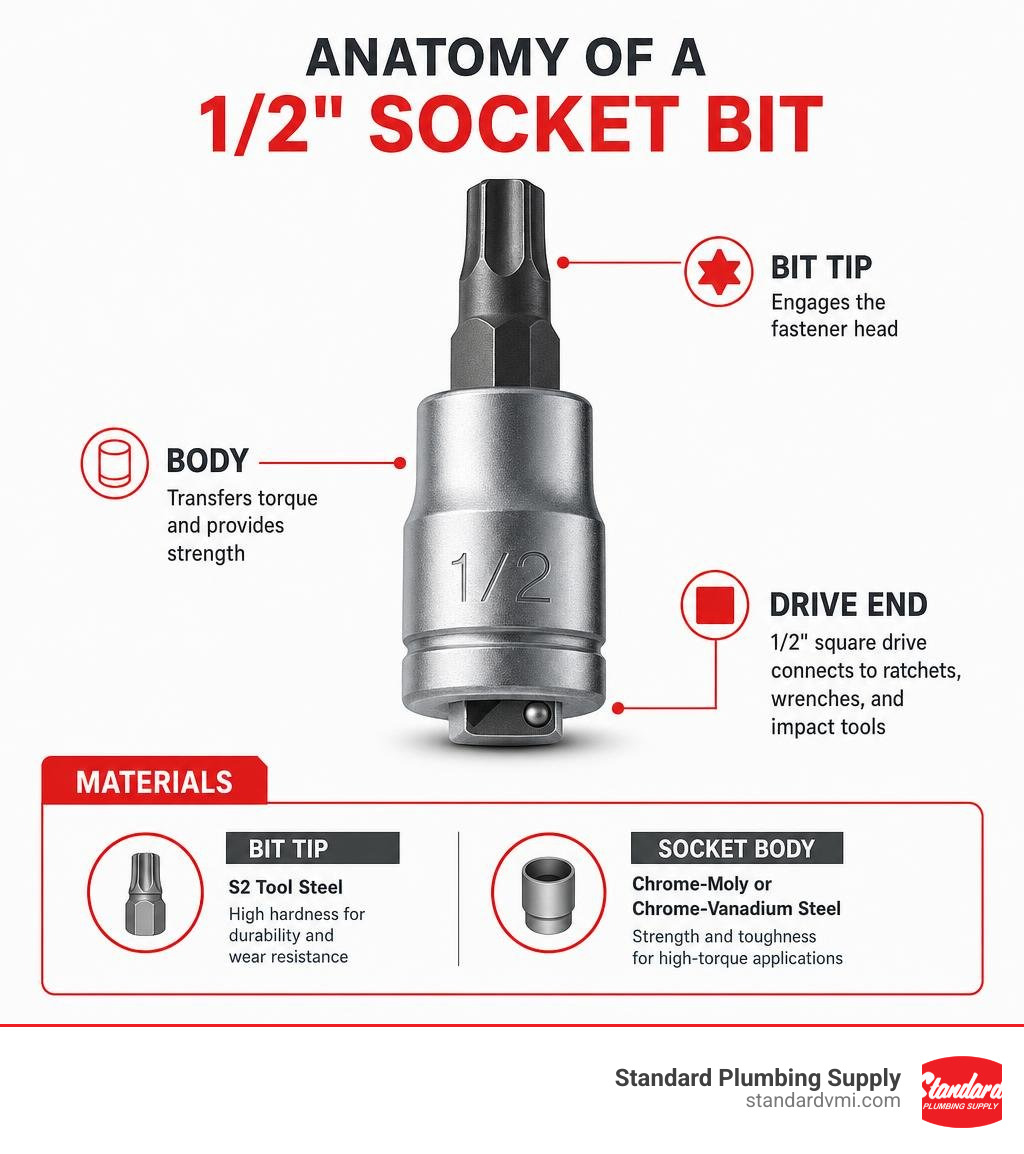
Anatomy of a 1 2 Socket Bit
Every 1/2-inch drive socket bit is composed of two primary functional zones:
- The Drive End: This is the square opening at the base of the socket body. It is precisely machined to 1/2-inch specifications, featuring detent notches or pin holes to lock onto your drive tools securely.
- The Bit End: This is the working tip of the tool. Depending on the job, it can be a hex key, Torx star, Ribe, Phillips, or flathead slotted tip.
High-quality hand tool socket bits, like the 1/2 Inch Drive x #2 Phillips Bit Socket (which weighs a light 0.16 lb for easy tool-belt carry), utilize a premium S2 steel bit pressed into a chrome vanadium or chrome-plated steel socket body. You can find similar high-grade options like the 1/2 Inch Drive x #2 Phillips Bit Socket | Bit Sockets | handsockbit.com to fill specific gaps in your tool chest. The S2 steel is heat-treated to high hardness levels to resist twisting and wear, while the socket body is optimized for tough toughness to handle the torque applied by the ratchet.
Key Differences in Fastener Engagement
The primary difference in fastener engagement comes down to how force is distributed:
- Male vs. Female Fasteners: Standard sockets wrap around the outside of a male fastener, distributing force across the flat outer walls. Socket bits insert directly into the female recess of a fastener.
- Recess Depth and Alignment: Because the bit must sit perfectly straight inside the fastener recess to transfer torque effectively, high-quality socket bits are machined to incredibly tight tolerances. If the bit is even slightly misaligned, it can wobble, leading to uneven force distribution.
- Slip Resistance and Stripping Prevention: When dealing with high-torque demands, standard screwdrivers or L-key hex wrenches often slip or bend. A robust 1/2-inch drive socket bit keeps the driver perfectly perpendicular to the fastener head, virtually eliminating the risk of stripping the recess.
Common Sizes, Types, and Applications of 1/2-Inch Drive Socket Bits
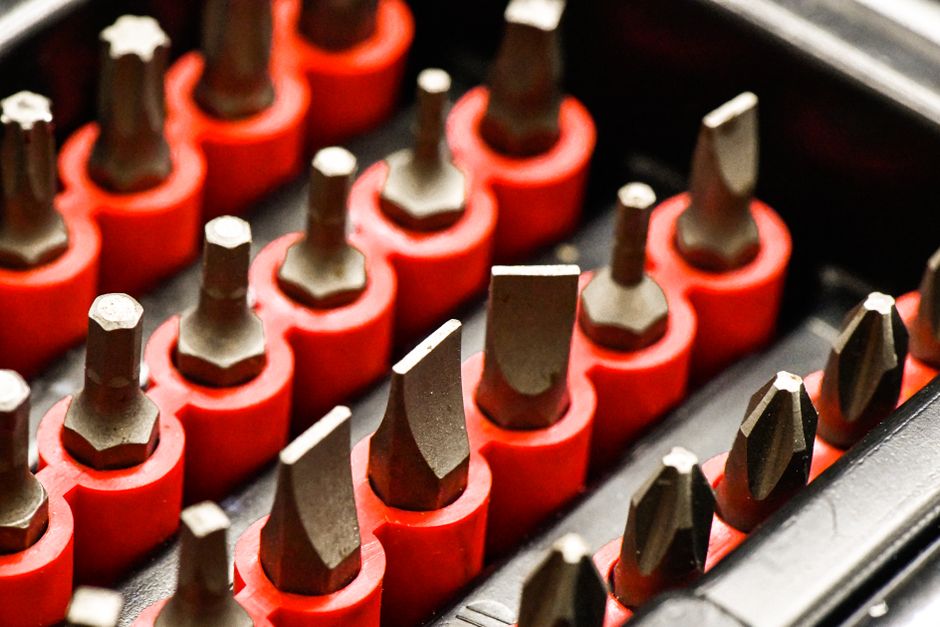
Whether you are working out of our Sandy, Orem, or Heber City locations, you know that Utah's extreme seasonal temperature swings can make plumbing and HVAC hardware seize up fast. Having a broad variety of socket bit profiles ensures you are never stuck on a job site with a stripped bolt.
Socket bits come in both SAE (fractional inches) and metric sizes. For heavy-duty industrial and automotive work, hex sizes typically range from 1/4 inch up to 3/4 inch, and 6mm up to 19mm.
Choosing the Right 1 2 Socket Bit for Plumbing and HVAC
In the plumbing and HVAC trades, you will frequently run into specialty fasteners that require more torque than a standard hand key can provide:
- Shear Bolts and Structural Connections: Often found on heavy-duty pipe hangers, commercial boiler frames, and support brackets.
- Pad-Mount Transformers and Commercial HVAC Cabinets: These units frequently use secure, high-torque hex or Torx fasteners to prevent unauthorized access while maintaining a weatherproof seal.
- Valve Adjustments and Manifolds: Large commercial mixing valves and hydronic manifolds often require precise hex bit adjustments to set flow limits.
For European-designed commercial boilers and high-end hydronic systems, you may even encounter specialized Ribe profiles. In these cases, a specialty tool like the Bit socket 1/2" ribe M12 - Sonic Equipment is indispensable for completing maintenance without damaging the proprietary hardware.
Specialty Profiles: Ribe, Torx, and Slotted
While hex bits are the most common, other profiles play a crucial role in professional work:
- Torx and Tamper-Resistant Torx: Known for their six-point star shape, Torx fasteners prevent cam-out and are common in modern commercial HVAC blowers and electrical control panels.
- Slotted (Flathead) Bits: While less common for high-torque applications today, large slotted fasteners are still found on older water meters, brass cleanout plugs, and vintage commercial hardware. Having a heavy-duty option like the 1/2 Inch Drive x 1/2 Inch Slotted Bit Socket | TEKTON | SHB20203 (weighing 0.23 lb) ensures you can break these stubborn brass screws free without chewing up the soft metal slot.
Material Science: One-Piece vs. Two-Piece Bit Socket Designs
When shopping for a 1 2 socket bit, you will quickly notice two manufacturing styles: one-piece solid construction and two-piece press-fit construction. Each has its own distinct advantages depending on your daily workload.
| Feature | One-Piece Design | Two-Piece Design |
|---|---|---|
| Construction | Single piece of forged alloy steel | Separate bit pressed permanently into a socket base |
| Material Optimization | Single steel alloy throughout the tool | Different alloys optimized for the socket and the tip |
| Profile | Extremely compact and low-profile | Standard profile, slightly taller |
| Best Used For | High-torque impact applications, tight spaces | Precision hand tool use, maximum wear resistance |
| Repairability | Must replace the entire tool if damaged | Often more cost-effective to manufacture in large sets |
Two-Piece Construction Benefits
The primary advantage of a two-piece design is material optimization. Because the socket base and the driver bit perform different jobs, they require different steel characteristics:
- The Bit: Usually made of S2 tool steel, which is heat-treated to a high hardness of 57-63 HRC. This extreme hardness allows the tip to resist wear, twisting, and deformation under high loads.
- The Socket Base: Usually forged from 4140 Chrome-Molybdenum (Cr-Mo) or Chrome-Vanadium (Cr-V) steel, heat-treated to a tougher, more ductile 40-45 HRC. This allows the base to absorb the torsional stress from the drive tool without cracking.
For comprehensive coverage, many professionals opt for multi-piece kits like the 1/2 Inch Drive Bit Socket Set (52-Piece) | Bit Sockets | handsockbit.com , which weighs a substantial 14.44 lb and provides a complete array of hex, Torx, Phillips, and slotted options in a single organized carrying case.
One-Piece Construction Benefits
One-piece socket bits are forged from a single continuous piece of steel. This design is highly favored in heavy-duty utility and lineman work where maximum shear resistance is required.
Without the joint of a press-fit connection, one-piece bits can achieve an incredibly compact, low-profile design. For example, some specialized lineman's impact sockets feature an overall length of under an inch, allowing them to slip easily into tight spaces around pad-mounted transformers and electrical utility enclosures where a standard two-piece tool simply won't fit.
Impact-Rated vs. Standard Hand Tool Socket Bits
A common mistake among DIYers and apprentice plumbers is using standard, chrome-plated hand tool socket bits on an impact wrench. Doing so is not only bad for the tool—it is a serious safety hazard.
Why Use Impact-Rated Bit Sockets?
Impact-rated socket bits are specifically engineered to withstand the rapid, violent rotational blows delivered by pneumatic or cordless impact wrenches.
- Chrome Molybdenum Steel (Cr-Mo): Unlike the stiff, brittle chrome vanadium steel used in hand tools, impact sockets are made from ductile Chrome Moly. This steel is slightly softer, allowing the socket to flex microscopically under impact loads rather than shattering.
- Black Oxide Finish: Instead of a smooth chrome plating that can peel and flake off under stress, impact tools feature a black oxide coating that resists corrosion without compromising the structural integrity of the metal.
- Thicker Walls: Impact sockets are built with thicker walls to absorb and distribute the massive torque spikes generated by modern power tools.
If you frequently work on rusted commercial piping, auto chassis, or heavy equipment, investing in an impact-rated set—such as the 1/2 in. Drive Hex Bit Impact Socket Set SAE (7-Piece) —is a smart move that will save your knuckles and your tools.
Hand Tool Socket Bit Limitations
Chrome-plated hand tool socket bits are designed strictly for manual ratchets and torque wrenches. Under the rapid-fire hammering of an impact gun, the chrome finish can fracture, sending sharp metal shards flying across your workspace. Additionally, the harder, more brittle S2 steel bits used in hand-tool designs can snap instantly when subjected to impact forces.
For massive industrial fasteners, you may even need to step up past the 1/2-inch drive size entirely. Heavy industrial maintenance occasionally requires tools like the massive Products :: Hand Tools :: Hex Bit Socket 1-1/2in.Dr. x 1-1/2in.Hex - Products - BTI Tool - BTI Inc - Better Tools For Industry to handle extreme mechanical loads safely.
Frequently Asked Questions about 1/2 Inch Socket Bits
What is the difference between a 1/2-inch drive and a 3/8-inch drive socket bit?
The primary difference is torque capacity and physical scale. A 1/2-inch drive socket has a larger square drive interface, allowing it to handle significantly higher torque loads without breaking. While 3/8-inch drive tools are excellent for light-duty automotive work and general plumbing, 1/2-inch drive socket bits are the go-to choice for heavy-duty commercial installations, structural assemblies, and stubborn, rusted fasteners.
How should I store and organize my socket bits?
Because socket bits are heavy and compact, keeping them organized prevents tool-box chaos and saves time on the job. Many professional sets, such as the TEKTON 24-piece impact hex set (weighing 10.73 lb), come in dedicated, blow-molded carrying cases that keep each size securely in place. If you prefer to store your tools in a rolling chest, high-quality aluminum socket rails with spring-loaded ball clips are an excellent way to keep your bits organized by size and profile. Always look for tools with deep, stamped size markings so you can identify the correct bit at a glance, even in low-light crawlspaces.
Can I use standard hex bits in an impact wrench?
No. Standard hex bits designed for hand ratchets are made of harder, more brittle steels that cannot handle the rapid, high-torque impacts of a power tool. Using them in an impact wrench carries a high risk of shattering the bit, stripping the fastener, or causing personal injury. Always verify that your socket bit is explicitly rated for impact use before attaching it to a power tool.
Conclusion
Whether you are a professional HVAC technician installing commercial boilers in Orem, a plumber running new water lines in Heber City, or a dedicated DIYer tackling home repairs in Sandy, having the right 1 2 socket bit in your toolbox is essential for working efficiently and safely. By choosing the correct material, profile, and rating for your specific applications, you can protect your fasteners from stripping and ensure your tools last for years to come.
At Standard Plumbing Supply, we are dedicated to helping tradespeople and businesses streamline their operations. Beyond offering the industry's most trusted tool brands and fast nationwide shipping, we provide tailored inventory management programs to keep your shop or service fleet fully stocked without tying up your valuable cash flow.
Optimize your tool inventory with Standard Plumbing Supply VMI solutions