
No More Lost Parts: Top HVAC Warehouse Management Solutions Reviewed
Discover how HVAC inventory management software for contractors prevents stockouts, streamlines warehouse operations, and boosts technician efficiency.

Why HVAC Contractors Keep Losing Time and Money Without the Right Inventory System
The best HVAC inventory management software for contractors can be the difference between a profitable service call and a costly return trip — and in a $16.3 billion industry, the margin for error is slim.
Here are the top HVAC inventory management software options for contractors in 2026:
| Software | Best For | Standout Feature |
|---|---|---|
| ServiceTitan | Large commercial & residential | All-in-one FSM + inventory integration |
| BuildOps | Commercial contractors | Job-tied inventory and part reservation |
| Housecall Pro | Residential contractors | Simple mobile-first workflow |
| Jobber | General contractors | Ease of use and fast setup |
| inFlow | Small to mid-size teams | Real-time truck and jobsite tracking |
| Sortly | Non-technical teams | Visual inventory with no hardware needed |
| FieldEdge | Small businesses | QuickBooks integration and flat-rate pricing |
| Workiz | Growing HVAC businesses | Auto-updates stock on invoice |
| Stocklyst | Field-heavy teams | Offline mobile app with AI import |
A single missing part can stall a job, blow your schedule, and leave a customer waiting in the heat. Yet many contractors are still running their inventory on spreadsheets or, worse, relying on memory. Over 60% of wholesale HVACR distributors still depend on legacy platforms — leading to manual entry mistakes, fragmented data, and delays that ripple across every job on the board.
The problem isn't just disorganization. It's money. Missed parts mean wasted truck rolls. Overbought stock ties up cash. Unbilled materials quietly drain your margins every single week.
The good news? Modern inventory software built specifically for HVAC contractors solves all of this — and the options have never been better.
I'm Jacob Reese, Vice President at Standard Plumbing Supply, where I've spent years working directly with HVAC contractors on supply chain operations, inventory challenges, and the distributor relationships that keep their businesses running. My experience evaluating HVAC inventory management software for contractors from the supply side gives me a practical view of what actually works in the field — not just on a demo screen. In the sections below, I'll break down the key features, software types, and top platforms so you can find the right fit for your operation.
What is HVAC Inventory Management Software for Contractors?
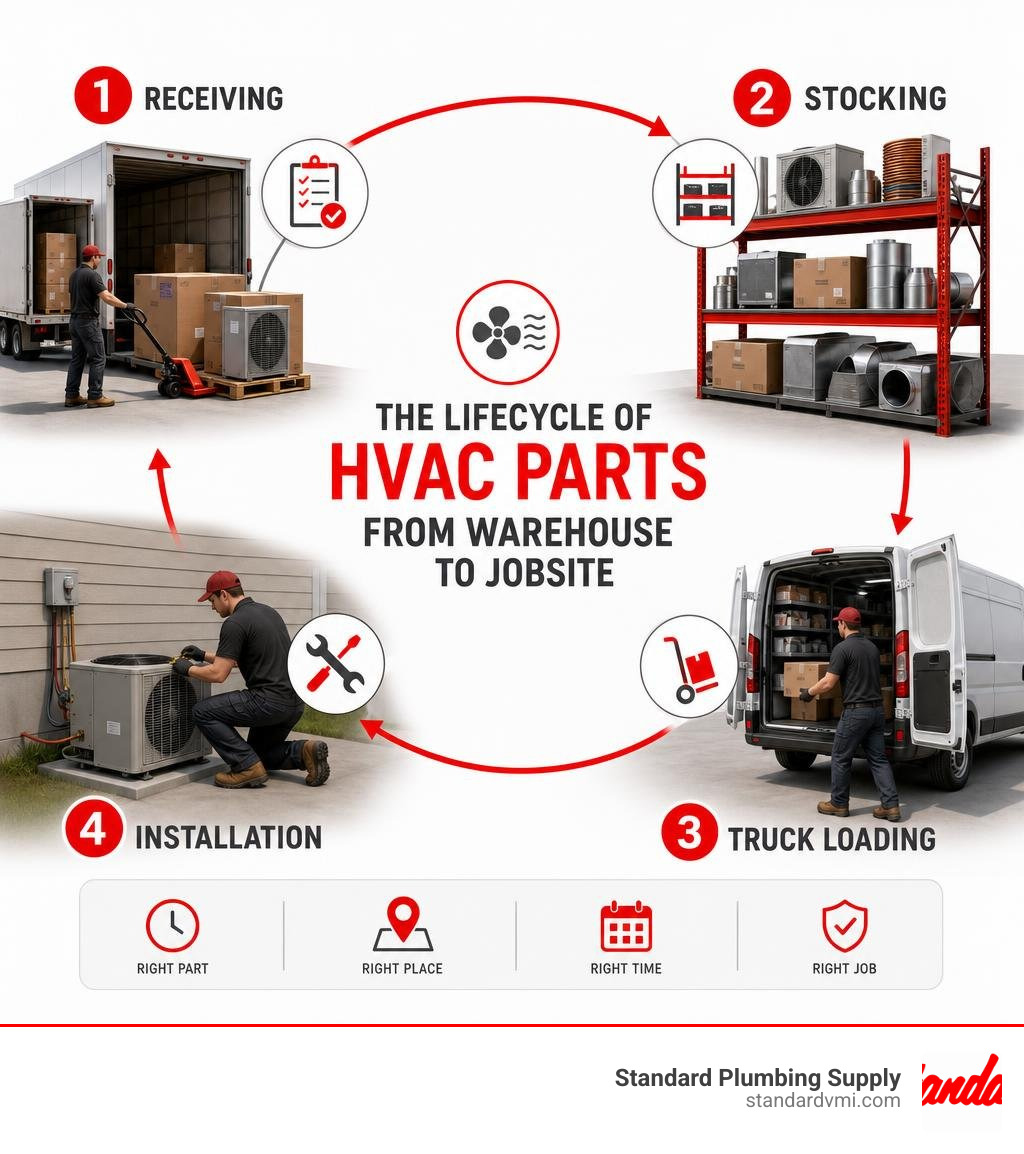
For a modern heating and cooling business, inventory is a moving target. Unlike a traditional retail store where stock sits neatly on shelves, your inventory is constantly on the move. It travels from our wholesale branches to your main warehouse, gets loaded onto service vans, and is ultimately installed on residential or commercial jobsites.

A dedicated HVAC inventory management software for contractors is a specialized digital platform designed to track these moving pieces in real time. Rather than using generic spreadsheets that are outdated the moment they are saved, these systems provide a single, unified view of every motor, capacitor, compressor, and roll of sheet metal in your business.
Whether your business is based in Salt Lake City, Utah, Boise, Idaho, or Phoenix, Arizona, managing truck stock is one of the biggest operational hurdles you face. When you use specialized HVAC inventory tracking, your service vans are treated as mobile warehouses. The software monitors what is currently on each truck, what has been used on a job, and what needs to be replenished.
By organizing your parts dynamically, your field technicians spend less time driving back to the shop or making emergency runs to a local distributor, and more time billing active hours.
Key Features of Modern HVAC Inventory Systems
When evaluating software options, it is easy to get overwhelmed by flashy dashboards. However, the systems that deliver the highest return on investment focus on a core set of practical features built for the daily grind of field service.
First and foremost is real-time tracking across multiple locations. You need to know exactly what is sitting in your Sandy, Utah warehouse versus what is riding around in Van #4 in Las Vegas, Nevada. Second, automated replenishment tools are vital. These features allow you to set minimum and maximum stocking levels, triggering purchase orders before you completely run out of critical components.
To understand how these tools fit into your business, it is helpful to look at how different platform types handle asset management.
| Feature Category | Standalone Inventory Software | All-in-One FSM Platforms |
|---|---|---|
| Primary Focus | Granular warehouse control, barcoding, and purchasing | Dispatching, scheduling, CRM, invoicing, and basic tracking |
| Field Usability | Highly accurate for parts; requires integration for jobs | Seamlessly links parts directly to active work orders |
| Setup Complexity | Fast implementation (often days to weeks) | Longer onboarding; requires entire team transition |
| Best Suited For | Dedicated warehouse managers and large stock operations | Contractors wanting a single "source of truth" software |
To get the most out of your inventory, you also need specialized Asset tracking solutions that monitor the lifecycle of high-value physical assets. This goes beyond simple consumables like wire nuts or tape. We are talking about expensive tools like recovery machines, vacuum pumps, and combustion analyzers that frequently get left behind on jobsites or misplaced during truck handoffs.
Mobile Access and Barcode Scanning in HVAC Inventory Management Software for Contractors
Field operations are where the battle for inventory accuracy is won or lost. If your technicians have to write down every part they use on a paper ticket, mistakes will happen.
Modern HVAC inventory management software for contractors solves this by putting a powerful barcode and QR code scanner directly onto your technicians' smartphones.
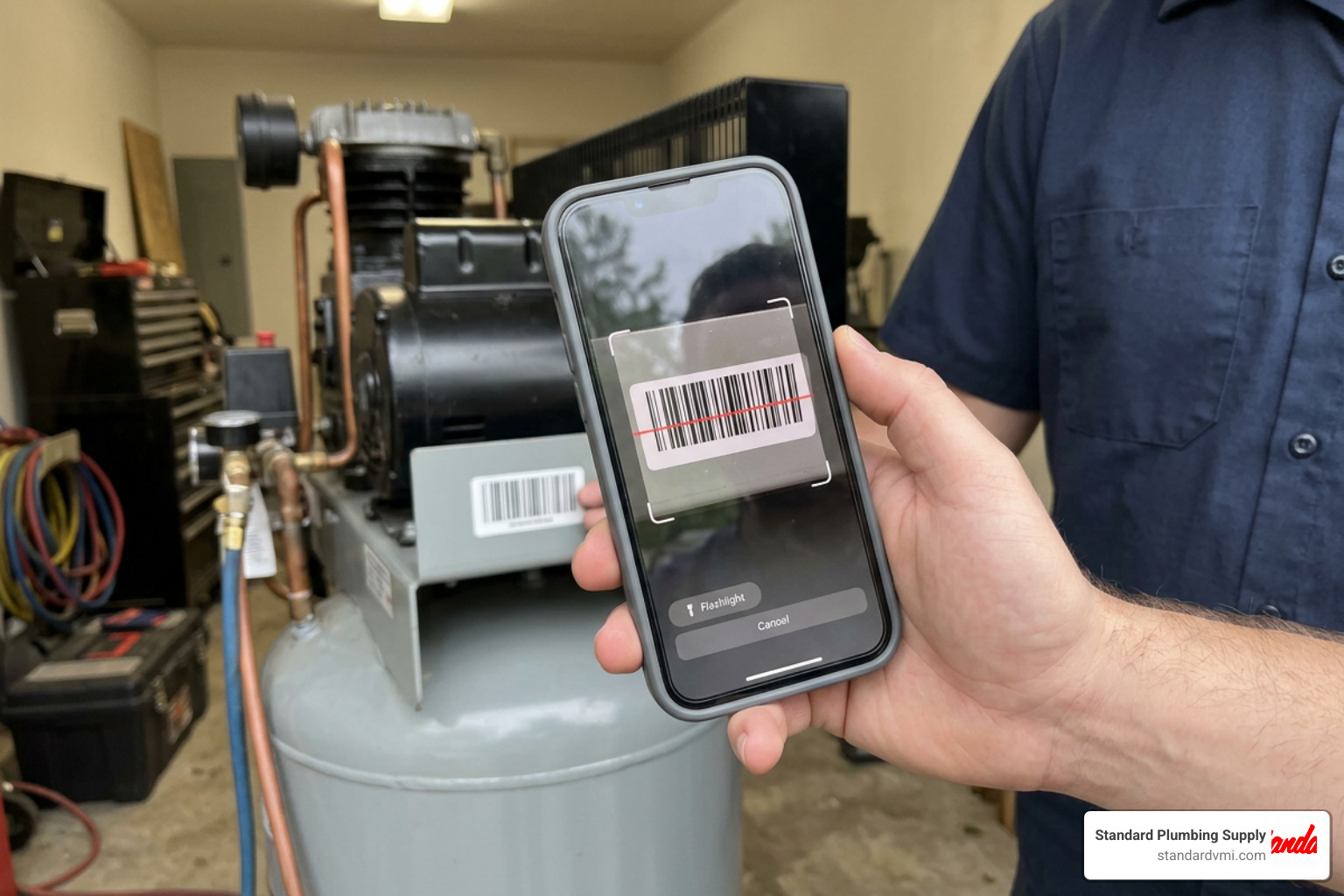
When a technician pulls a condenser fan motor from their truck stock, they simply scan the barcode using their phone's camera. The software instantly updates the system, deducting the part from that specific truck's inventory and adding it to the customer's invoice.
Crucially, top-tier platforms feature offline synchronization. Since your technicians frequently work in basements, mechanical rooms, or remote locations across Wyoming or Oregon where internet connectivity is spotty, the mobile app stores the scans locally and syncs them automatically once a cellular connection is restored.
Serialized Tracking for Warranties and Compliance
In the HVAC world, tracking high-value equipment like furnaces, heat pumps, and compressors requires absolute precision. You cannot treat a $3,000 AC condenser the same way you treat a box of wire connectors.
This is where serialized tracking becomes essential. By capturing the unique serial number of every major unit from the moment it arrives at our loading dock to the day it is installed, you build a permanent, unalterable equipment history.
With robust Equipment tracking features, managing manufacturer warranties is simple. If a compressor fails three years down the road, your team can instantly pull up the original installation record, verify the warranty status, and file the claim without digging through old filing cabinets. This level of tracking also ensures strict compliance with environmental regulations, particularly when tracking refrigerant cylinders and recovery logs.
Preventing Stockouts and Improving Job Costing
Inconsistent stock levels are silent profit killers. When a technician arrives at a home in Logan, Utah, during a July heatwave only to realize they do not have the right dual-run capacitor on their truck, everyone loses. The customer remains uncomfortable, the technician is frustrated, and your business loses money on a second truck roll.
By implementing Automated stock alerts, you can virtually eliminate these emergency supply runs. The software monitors your usage patterns and alerts your purchasing manager the moment stock drops below your designated safety thresholds.
Furthermore, accurate inventory tracking is the backbone of precise job costing. To understand your true profit margins, you must know your landed costs—which include the base price of the equipment plus any freight, handling, or tax. When your inventory software links directly to your active projects, every single fitting, length of ductwork, and hour of labor is captured, giving you an accurate picture of your profitability on every single job.

How Automated Reordering Protects Your Bottom Line
Automated reordering is not just about keeping your shelves full; it is about keeping your cash flow healthy.
By utilizing dynamic min-max stocking levels, the software analyzes historical data to help you prepare for seasonal demand shifts. For example, as the spring transition approaches in places like Boise or Salt Lake City, the system will suggest ramping up your stock of contactors, motors, and refrigerants. Conversely, as winter nears, it will automatically prompt you to stock up on igniters, gas valves, and draft inducer motors.
This ensures you are never sitting on thousands of dollars of dead heating inventory during the peak of summer, freeing up valuable working capital.
Accounting Integrations and Financial Accuracy
An inventory system that does not talk to your financial software is only half a solution. Seamless integration with accounting platforms like QuickBooks Online, QuickBooks Desktop, or Sage Intacct is critical for maintaining financial health.
When your systems are integrated, the transition of data is automatic:
This automatic sync reduces manual billing errors by ensuring that the exact parts used in the field are the ones billed on the final invoice.
Contractors using integrated systems report a 10% average increase in invoices paid on time, alongside a 40% faster cash cycle. Instead of waiting weeks to reconcile paper tickets and manually enter invoices, your billing cycle is completed in real time, keeping your cash flowing smoothly.
Evaluating Software Types: Standalone vs. All-in-One Platforms
As you look to upgrade your operations, you will face a fundamental choice: do you install a dedicated, standalone inventory program, or do you adopt an all-in-one Field Service Management (FSM) platform?
Standalone inventory systems are laser-focused on warehouse logistics, barcodes, and purchasing workflows. They are incredibly powerful for companies with dedicated warehouse staff and complex supply chains.
On the other hand, all-in-one FSM platforms integrate your inventory directly with dispatching, scheduling, customer relationships, and invoicing. When a dispatcher schedules a job, the system can automatically reserve the required equipment from your warehouse stock.
Technicians love this integrated approach because they only have to learn a single mobile app, which dramatically boosts software adoption rates across your entire team.
To see the real-world impact of making this transition, look at the numbers. HVAC businesses using modern, integrated platforms see an average 15% boost in field efficiency and a 30% reduction in data entry errors. Furthermore, companies utilizing these connected platforms experience an average 16% increase in annual revenue growth, proving that operational efficiency directly drives business expansion.
Choosing the Right HVAC Inventory Management Software for Contractors
Selecting the perfect software requires balancing your current operational needs with your future growth plans.
First, consider scalability. Will the software easily accommodate more trucks, additional warehouses, or new locations as your business expands across Utah, Idaho, or Oregon?
Second, evaluate the implementation timeline and software cost. A standalone system might get you up and running in a couple of weeks, while a full FSM transition can take months of careful planning and training.
Ensure you choose a platform with an intuitive user interface; if the software is too complicated, your field technicians will simply avoid using it, rendering your investment useless.
Commercial vs. Residential Contractor Needs
Your ideal software solution also depends heavily on the type of work you perform.
Commercial HVAC contractors manage complex, multi-site projects that require precise tracking. They need a system that supports job ticket association, allowing them to allocate specific materials to massive commercial projects and track equipment performance by floor, room, or zone.
Commercial teams also rely on robust preventative maintenance tracking to service high-value customer assets on a strict schedule.
Residential contractors, by contrast, operate in a environment where speed and simplicity are paramount. They need software that supports flat-rate pricing models, allowing technicians to present good-better-best options on a tablet and get immediate customer approval right at the kitchen table.
Frequently Asked Questions about HVAC Inventory Management
How does HVAC inventory software prevent technicians from arriving without needed parts?
By establishing clear truck stock profiles and setting up automated low-stock alerts, the software ensures that every service van is stocked with the essential parts needed for a first-visit fix. Technicians can perform quick, barcode-enabled audits of their trucks, and dispatchers can view real-time truck stock levels across the entire fleet before assigning a job.
Should I choose a standalone inventory system or an all-in-one FSM platform?
If your primary pain points are warehouse disorganization and purchasing chaos, a standalone system may be the fastest fix. However, if you want to streamline your entire business—from the first customer call to the final payment—an all-in-one FSM platform with integrated inventory capabilities is generally the best choice for long-term growth.
How does inventory software integrate with accounting tools like QuickBooks?
Modern platforms utilize direct APIs to sync data automatically. When a purchase order is fulfilled in your inventory software, it automatically updates your accounts payable in QuickBooks. Similarly, when a technician adds a part to an invoice in the field, the inventory level is adjusted, and the financial transaction is logged in your accounting software without any double-entry.
Conclusion
Taking control of your inventory is one of the most effective ways to boost your profitability, improve technician satisfaction, and deliver an exceptional experience to your customers. Whether you choose a standalone tracking tool or a comprehensive field service management platform, eliminating the chaos of lost parts is a critical step toward growing your business.
At Standard Plumbing Supply, we do more than just supply the industry's best HVAC brands from our locations across Utah, Idaho, Wyoming, Colorado, Nevada, Oregon, California, Arizona, and Nebraska. We also partner with you to make your entire operation more efficient. By combining modern tracking software with our specialized inventory solutions, you can eliminate manual ordering, reduce your carrying costs, and keep your trucks fully stocked with the exact parts your team needs.
Ready to streamline your warehouse and free up valuable cash flow? Optimize your supply chain with Standard Plumbing Supply VMI today.