
No Hot Water? A Quick Guide to Replacing Your Flow Sensor
Troubleshoot and replace your water heater flow sensor fast—restore reliable hot water with this step-by-step guide.

When Your Hot Water Stops Working, the Flow Sensor Is Often Why
A water heater flow sensor is one of the smallest parts in your system — and one of the most important. When it fails, you get no hot water, temperature swings, or a heater that won't even turn on.
Quick answer — how to replace a water heater flow sensor:
- Turn off the water supply and disconnect power to the heater
- Locate the flow sensor on the cold water inlet line
- Remove the sensor (usually twist-off or clip-mounted)
- Swap in the compatible replacement, including a new O-ring if needed
- Restore water supply, check for leaks, and restore power
- Test by running hot water and confirming normal operation
The full process is covered step by step below.
If you manage a rental property or run a small business, a broken water heater isn't just inconvenient — it's urgent. Tenants call. Customers complain. Every hour without hot water costs you.
The good news? A faulty flow sensor is one of the faster fixes in plumbing. You don't need to replace the whole unit. You just need the right part and a clear process.
I'm Jacob Reese, VP at Standard Plumbing Supply in Salt Lake City. In my years working with contractors and property managers on parts sourcing and maintenance decisions, the water heater flow sensor comes up constantly — it's a small component that causes outsized headaches when it's overlooked.
What is a Water Heater Flow Sensor and How Does It Work?

At its core, a water heater flow sensor is a diagnostic gatekeeper. In tankless (on-demand) water heaters and modern high-efficiency storage models, this sensor monitors when water begins moving through the system and measures its exact volume in real time.
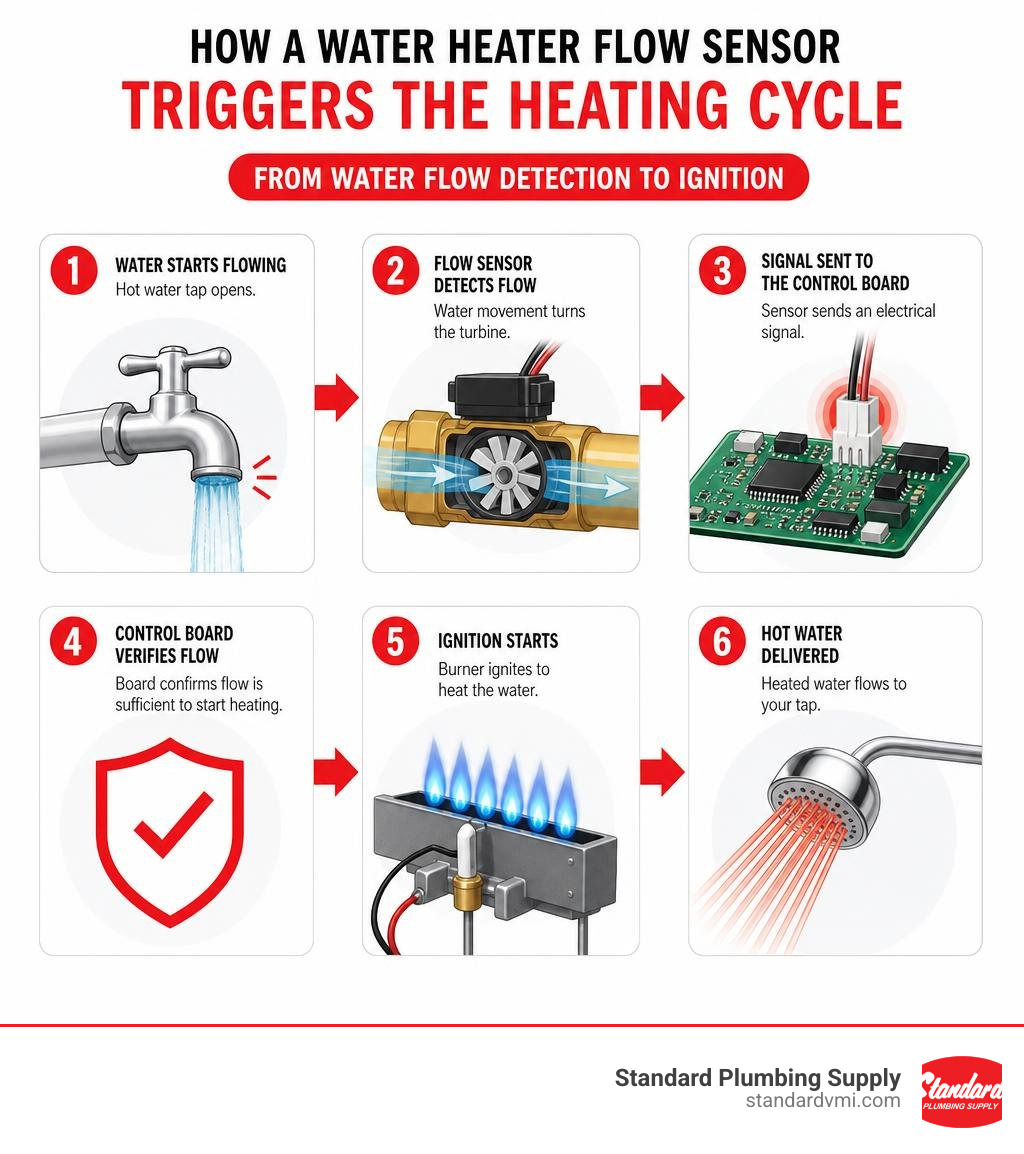
When you turn on a hot water tap, water rushes into the heater's inlet pipe. The flow sensor detects this movement and immediately sends an electrical signal to the water heater's main control board. Only when the flow reaches a specific activation threshold does the control board permit the gas burner to ignite or the electric heating elements to energize.
This mechanism is vital for dry firing prevention. "Dry firing" occurs when a heating element or burner activates without water surrounding it, leading to instant, catastrophic damage to the heat exchanger or elements. By ensuring that heating only occurs when water is actively moving, the flow sensor acts as a primary safety shield.
Modern water heating systems generally utilize one of two control methodologies:
- Feed-Forward Control: This system reacts to flow rate changes before outlet temperature shifts actually occur. When the flow sensor registers a sudden increase in demand (e.g., someone opens a second shower), the control board instantly ramps up the burner intensity to prevent a sudden drop in water temperature.
- Feedback Loops: This traditional method relies primarily on temperature sensors downstream. It adjusts the heating elements only after detecting a drop in the water temperature.
By combining these two approaches, modern systems deliver exceptionally stable temperatures. For those interested in the deep engineering behind these systems, you can review these Technical details on flow sensor operation which outline how domestic hot water control loops are engineered for instantaneous heating.
Mechanical vs. Magnetic vs. Ultrasonic Flow Sensors
Not all flow sensors are engineered the same way. Depending on whether you are working with a residential tankless unit, a commercial boiler, or an industrial system, you will encounter different sensor technologies:
- Mechanical (Turbine/Paddle Wheel) Sensors: These feature a physical rotor suspended in the water stream. As water flows, the turbine spins. A small magnet attached to the turbine passes by an external sensor (often a Hall effect sensor), generating a pulsed output. The frequency of these pulses is directly proportional to the flow rate.
- Magnetic (Reed Switch) Sensors: Often used as simpler "flow switches," these utilize a magnetic piston that rises when water pressure builds. When the piston reaches a certain height, its magnetic field closes a hermetically sealed reed switch, signaling the system to turn on.
- Ultrasonic Sensors: Reserved for high-end commercial or industrial applications, ultrasonic sensors use sound waves to measure velocity without any moving parts in the wet chamber. This eliminates mechanical wear and minimizes pressure drops.
| Sensor Type | Operating Principle | Pros | Cons | Typical Application |
|---|---|---|---|---|
| Mechanical (Turbine) | Rotating paddle wheel with magnet and Hall effect sensor | High accuracy, real-time volume tracking | Susceptible to scale buildup and mechanical wear | Residential tankless water heaters |
| Magnetic (Reed Switch) | Moving magnetic piston closes electrical contacts | Highly reliable, low cost, simple design | Only measures binary flow/no-flow state, not precise rate | Basic flow switches, safety backups |
| Ultrasonic | Measures transit time of sound waves through water | No moving parts, zero mechanical wear, handles extreme temps | High initial cost | Commercial facilities, industrial heat meters |
How Flow Sensors Improve Efficiency and Safety
The transition from old-school tank heaters to modern tankless systems was made possible by precision flow sensing. By accurately tracking water movement, these sensors provide:
- On-Demand Energy Savings: Traditional tank heaters cycle on and off constantly to keep 50 gallons of water hot 24/7. A flow-sensor-driven tankless system only consumes energy when water is actively moving through the pipes, slashing standby energy losses.
- Dry-Fire Protection: If your water mains are shut off for local utility work and someone turns on a hot water tap, a heater without a functional flow sensor could attempt to heat an empty chamber. The flow sensor prevents this by confirming physical water movement before ignition.
- System Longevity: By restricting burner and element operation to precise windows of active water flow, the system avoids unnecessary thermal stress, extending the lifespan of your heat exchanger.
Signs Your Water Heater Flow Sensor Needs Replacement

Like any mechanical or electronic component exposed to constant water flow, sensors eventually wear out. Mineral scaling, electrical surges, and physical wear on turbine bearings can cause the sensor to send inaccurate data or fail entirely.
If you suspect your system is acting up, watch for these common warning signs:
- Inconsistent Water Flow or "Cold Water Sandwiches": You are in the shower, and the water suddenly goes freezing cold for 30 seconds before warming back up. This often happens because a sticking turbine inside the flow sensor momentarily stopped spinning, telling the computer that water flow stopped and causing the burner to shut down.
- System Error Codes: Most modern tankless water heaters will display specific diagnostic codes on their digital interfaces when they detect a flow sensor issue. For example, if the control board detects that the temperature is rising but the flow sensor is reporting zero flow, it will shut down the system and throw a fault code.
- Irregular Heating Performance: If the sensor's calibration drifts, it might report a lower flow rate than what is actually passing through the unit. This leads to weak, lukewarm water because the control board isn't firing the burners at the correct intensity.
- Unusual Operating Noises: A worn-out turbine wheel can develop loose bearings. When water passes through, you may hear a faint buzzing, clicking, or humming noise coming directly from the cold-water inlet pipe.
- No Ignition At All: If the flow sensor fails in the "open" position, it will never register that water is running. You can open every hot water tap in the house, and the water heater will sit completely silent, never attempting to ignite.
How to Choose the Right Replacement Sensor
Selecting the correct replacement water heater flow sensor requires matching the technical specifications of your existing unit. Installing an incompatible sensor can lead to incorrect flow readings, erratic heating, or a system that refuses to boot up due to voltage mismatches.
Key Specifications of a Water Heater Flow Sensor
When comparing replacement parts, look closely at these technical parameters:
- Flow Range: Sensors are rated for specific minimum and maximum flow rates. For example, a standard residential sensor might support a flow range of 1–30 L/min (liters per minute), while a heavy-duty commercial model might support much higher rates.
- Pulse Output and K-Factor: Mechanical sensors output a pulse frequency proportional to the flow rate. This is represented by the formula F = K × Q, where F is the frequency in Hz, Q is the flow rate, and K is the sensor's unique K-factor (pulses per liter). For instance, some residential sensors produce approximately 486 pulses per liter. If the replacement sensor's K-factor doesn't match what your heater's computer expects, your temperature regulation will be completely inaccurate.
- Operating Voltage: Most residential sensors operate on low-voltage DC power, typically ranging from DC 3.5–24 V (with a rated operating voltage of DC 5 V) and drawing a maximum current of 15 mA. Commercial models, such as the premium Belimo 22PF-5XUHN NEMA 4 flow sensor, run on AC/DC 24 V and cost significantly more due to their advanced ultrasonic capabilities and integration protocols.
- Pressure and Temperature Ratings: Ensure the sensor body can withstand your system's working pressure (typically rated up to 1.75 MPa or 17.5 bar) and maximum water temperatures. Standard residential sensors are rated for water temperatures up to 100 °C, while industrial hot water sensors (like the WPD FS series) can handle continuous process water up to 130 °C.
For those sourcing standard residential parts, you can explore these Detailed specifications of 1-30 L/min sensors to see how pulse outputs, operating voltages, and pressure limits are structured on standard PPS plastic models.
Avoiding Common Compatibility Issues
To ensure a seamless repair, avoid these common pitfalls:
- Pipe Diameter and Thread Type: Verify the inlet and outlet sizes. Common residential sizes are G1/2" or G3/4" threads. For commercial systems, sizes scale up to DN 50 or larger flanged connections.
- OEM vs. Aftermarket: While aftermarket sensors can save money, OEM (Original Equipment Manufacturer) parts guarantee that the electrical connector plugs directly into your wiring harness without splicing, and that the K-factor matches your control board perfectly. For example, brands like Noritz offer over a dozen distinct flow sensor models ranging from $25.37 to $137.32 to match their specific heater lines.
- Sensor Body Materials: Plastic (PPS) bodies are common in residential units because they resist corrosion and scale. Brass and stainless steel are preferred in high-pressure or commercial applications where durability is paramount.
How to Install and Maintain Your Flow Sensor
Replacing a flow sensor is a highly manageable DIY project or a quick service call for a professional technician. By following the correct safety protocols, you can get your hot water back online in under an hour.
Step-by-Step Guide to Replacing Your Water Heater Flow Sensor
Before you begin, gather your tools: a screwdriver set, adjustable wrenches, a bucket, some rags, and a tube of silicone plumbing grease.
Step 1: Isolate the System (Power and Water)
Safety first! Turn off the electrical breaker powering your water heater (or unplug it if it uses a standard outlet). If you have a gas water heater, turn off the gas supply valve. Next, close the cold-water inlet valve supplying water to the heater.
Step 2: Drain the Water Heater
Open a hot water tap somewhere in your home to relieve pressure in the lines. Place a bucket under your water heater's drain valve or service valves, open the valves, and let the water drain out of the unit. You only need to drain the water down below the level of the flow sensor, not empty the entire home's plumbing system.
Step 3: Access and Disconnect the Old Sensor
Remove the front cover of your water heater. Locate the flow sensor, which is always positioned on the cold-water inlet pipe before the water enters the heat exchanger. Carefully unplug the electrical wiring harness connecting the sensor to the main control board.
Step 4: Remove the Sensor Body
Using your adjustable wrench, loosen the threaded fittings holding the flow sensor in place. If your model uses retaining clips or pins, gently pry them out with a flathead screwdriver. Slide the old sensor out of the pipe assembly. Keep a rag handy to catch any residual water.
Step 5: Install the New Sensor
Inspect your new sensor. Crucial step: Look for an arrow molded into the plastic or metal body of the sensor. This arrow indicates the direction of water flow. The arrow must point in the direction the water travels (into the heater).
Slip a new O-ring onto the connection points. Applying a very thin film of silicone plumbing grease to the O-ring will help it seat correctly and prevent leaks. Hand-tighten the connections, then give them an additional quarter-turn with your wrench. Do not over-tighten plastic sensor bodies, as they can crack.
Step 6: Test for Leaks and Restore Power
Slowly open the cold-water inlet valve to repressurize the system. Check the connections around the new sensor closely for any signs of weeping or leaking. Once you are confident the seals are watertight, plug the wiring harness back into the control board. Reinstall the heater's front cover, turn the power and gas back on, and run a hot water tap to verify the burner ignites and delivers consistent hot water.
Maintenance Tips to Prevent Future Failure
To maximize the lifespan of your new sensor, implement these preventive steps:
- Install an Inlet Mesh Filter: Debris, rust flakes, and sand from municipal water lines can easily jam a turbine flow sensor. Installing a simple mesh strainer on your cold-water inlet line will catch these particles before they reach the sensor.
- Perform Annual Descaling Flushes: If you live in an area with hard water, calcium scale will build up on the sensor's turbine blades, increasing friction and causing inaccurate readings. Flushing your tankless water heater with food-grade white vinegar once a year dissolves this scale and keeps the sensor spinning freely.
Smart Home Integration and IoT Capabilities
As homes become increasingly connected, water heaters are no longer isolated appliances in basement closets. Modern smart water heaters utilize advanced flow sensors to communicate directly with home automation hubs and energy management platforms.
By integrating flow sensor data with smart home ecosystems, property owners can unlock several powerful features:
- Real-Time Flow and Volume Monitoring: Smart systems track exactly how many gallons of hot water are consumed daily, helping families optimize their energy and water usage.
- Advanced Leak Detection: If a smart flow sensor detects a continuous, low-volume flow of water for several hours (such as a running toilet or a pinhole pipe leak), the system can send an alert to your smartphone or trigger an automatic shutoff valve to prevent water damage.
- Predictive Hot Water Estimations: For tech enthusiasts, flow sensor data can be integrated into custom home automation setups. For example, check out this DIY smart hot water monitoring project which demonstrates how to connect a Hall effect flow sensor to an Arduino microcontroller and use AWS Lambda to ask Alexa how much hot water capacity is remaining in your system.
Frequently Asked Questions about Water Heater Flow Sensors
Does a faulty flow sensor always cause error codes?
No, a failing flow sensor does not always trigger an immediate error code. If a sensor fails completely (e.g., the wiring breaks), the control board will easily detect the open circuit and throw a fault code. However, if the sensor is slowly failing — such as when mineral scale causes the turbine to spin sluggishly — it may simply report an inaccurate, lower-than-actual flow rate. This results in erratic water temperatures, delayed ignition, or lukewarm water without triggering a hard system shutdown or displaying an error code.
Can I clean a flow sensor instead of replacing it?
In many cases, yes, you can clean a dirty flow sensor. If your water heater is suffering from calcium scale buildup or has sucked in sand or rust debris, removing the sensor and soaking it in warm white vinegar for 30 minutes can dissolve the scale and restore normal turbine rotation. However, if the internal magnets have demagnetized, the turbine bearings are physically worn out, or the electronic Hall effect chip has shorted, cleaning will not help, and the entire sensor must be replaced.
Does the flow sensor affect my home's water pressure?
Under normal operating conditions, a properly sized flow sensor has no noticeable impact on your home's water pressure. The internal flow channels of modern sensors are hydrodynamically optimized to keep pressure drops to an absolute minimum. For example, a standard residential flow sensor like the Honeywell C7195 causes a negligible pressure drop of 0.15 bar or less at a standard flow rate of 10 L/min. As long as you replace your sensor with a model that matches your system's original pipe diameter and rated flow range, your water pressure will remain unaffected.
Conclusion
A malfunctioning water heater flow sensor can bring your daily routine to a grinding halt, but it doesn't require a costly, full-system replacement. By understanding how these small components monitor water flow, identifying the early warning signs of failure, and choosing a compatible replacement part, you can quickly restore reliable hot water to your home or business.
At Standard Plumbing Supply, we are dedicated to helping contractors, property managers, and homeowners keep their systems running efficiently. With our extensive inventory of trusted plumbing brands, fast shipping, and locations across Utah — including Sandy, Orem, and Heber City — we have the replacement parts and technical expertise you need to tackle any repair.
If you manage commercial properties or run a plumbing business, ask us about our customized Vendor Managed Inventory (VMI) solutions. We help streamline your parts management, boost your operational efficiency, and free up valuable cash flow so you always have the right parts on hand when a critical system goes down.
Need help finding the exact flow sensor for your water heater model? Find replacement parts and expert support through Standard Plumbing Supply today, and let our team get your hot water flowing again.