
Soundbar vs. Bluetooth Speaker: Raising the Bar on Your Home Audio
Discover how a bluetooth speaker bar delivers powerful home audio with easy Bluetooth connectivity and portability.

Soundbar vs. Bluetooth Speaker: What's Actually the Difference?
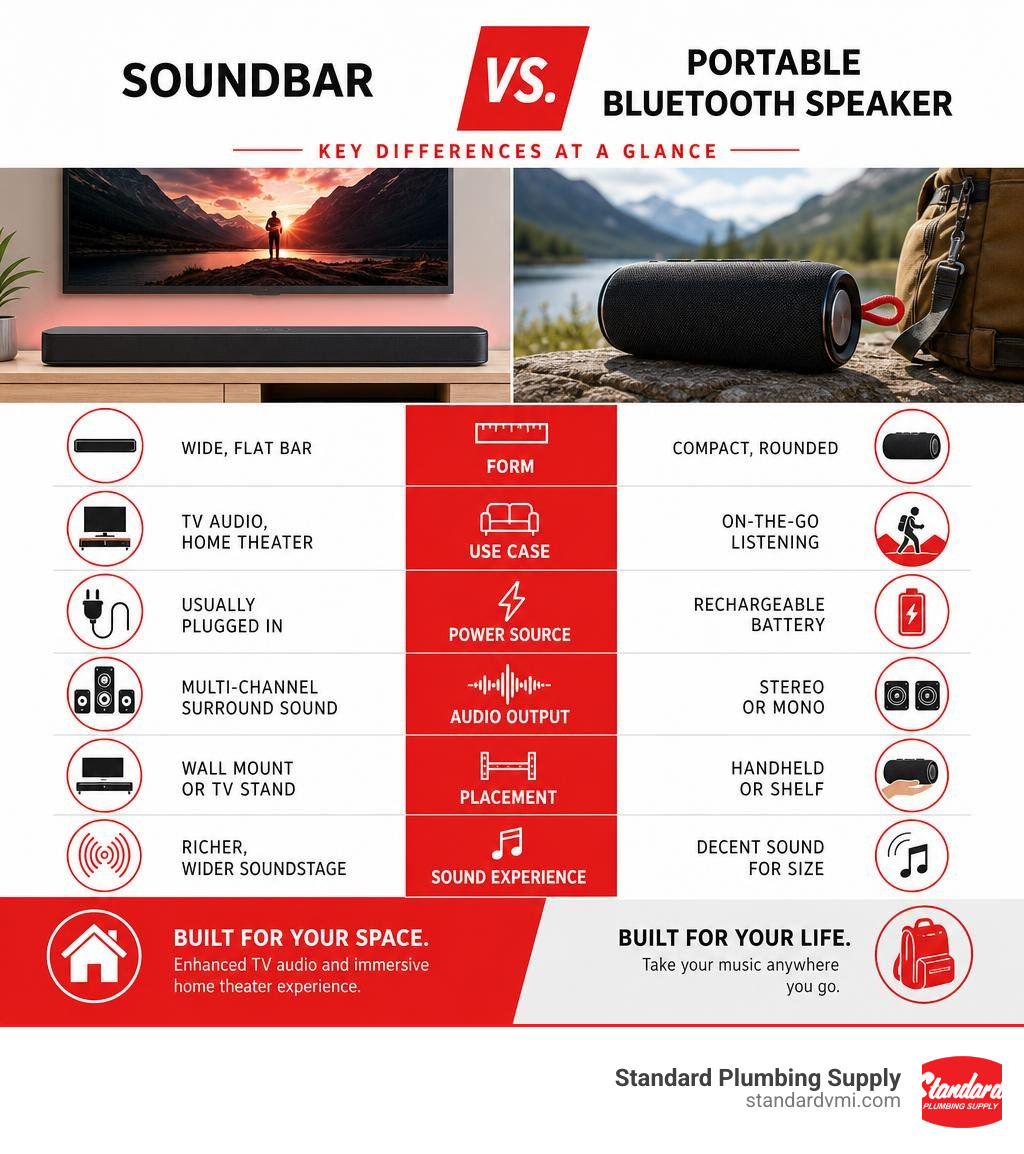
A Bluetooth speaker bar is a slim, horizontal audio device that connects wirelessly to your TV, phone, or computer to deliver better sound than built-in speakers. Here's a quick breakdown:
| Feature | Bluetooth Speaker Bar (Soundbar) | Portable Bluetooth Speaker |
|---|---|---|
| Shape | Wide, flat bar | Compact, rounded |
| Best for | TV audio, home theater | On-the-go listening |
| Power source | Usually plugged in | Rechargeable battery |
| Sound channels | 2.0 up to 11.1.4 | Typically stereo or mono |
| Mounting | Wall or TV stand | Handheld or shelf |
| Audio quality | Richer, wider soundstage | Decent for size |
You've probably noticed that your TV's built-in speakers just don't cut it anymore. Dialogue is muddy. Action scenes fall flat. Music sounds thin.
That's the problem a Bluetooth speaker bar solves.
Soundbars have exploded in popularity — and for good reason. Products like the Sony S100F have racked up over 7,000 customer reviews on Amazon alone, with thousands of buyers purchasing each month. The demand is real, and the options are overwhelming.
This guide cuts through the noise. Whether you're upgrading your living room, outfitting a plumbing or HVAC workshop, or mounting audio on an off-road vehicle, we'll help you understand exactly what to look for — and what to skip.
I'm Jacob Reese, Vice President at Standard Plumbing Supply. While we are known for supplying top-tier plumbing, HVAC, and irrigation equipment, we also know that a productive job site or workshop runs on good energy and reliable gear. I've spent years navigating complex product categories and helping customers find the right fit fast — the same clear-eyed approach I'm bringing to the bluetooth speaker bar. Let's get into it.
What is a Bluetooth Speaker Bar and How Does It Work?
To understand why a bluetooth speaker bar is such an effective audio upgrade, it helps to look under the hood. Unlike a traditional speaker cabinet, which is typically boxy and designed to project sound from a single point, a soundbar is wide and shallow. This unique form factor is engineered specifically to match the physical width of modern flat-screen televisions, but its benefits go far beyond aesthetics.
Inside that slim cabinet, manufacturers pack multiple individual speakers, known as audio drivers. In a basic setup, you might find left and right channel drivers positioned at opposite ends of the bar. In more advanced models, you will find dedicated center channel drivers specifically tuned for human vocal frequencies, side-firing drivers to bounce sound off your walls, and even up-firing drivers that aim sound at the ceiling to create height effects.
Wireless connectivity is the second major piece of the puzzle. While older audio systems required a maze of receiver cables and speaker wires, modern soundbars rely heavily on Bluetooth and Wi-Fi. A high-quality bluetooth speaker bar uses updated Bluetooth standards, such as Bluetooth 5.0 up to the latest Bluetooth 5.3. These newer protocols offer several key advantages:
- Lower Latency: Older Bluetooth versions often suffered from a noticeable delay between the video on screen and the audio in your ears. Modern versions minimize this sync issue.
- Higher Bandwidth: More data can travel through the air, preserving the rich detail of high-resolution audio files.
- Multi-Device Pairing: Some advanced models can remain simultaneously paired to your computer and your smartphone, allowing you to seamlessly switch from a video call to a phone call.
For home theater integration, a premium soundbar will also feature physical ports like HDMI eARC (Enhanced Audio Return Channel) or digital optical inputs. This allows you to connect the bar directly to your TV for uncompressed spatial audio formats, while still keeping the Bluetooth connection active for streaming music from your phone when the TV is off.
If you are looking for an intelligent home theater hub that leverages these technologies, you can Learn more about the Bose Smart Soundbar, which features proprietary TrueSpace upmixing to turn standard stereo signals into immersive spatial audio, alongside advanced A.I. Dialogue Mode for crystal-clear spoken words.
Soundbar vs. Traditional Bluetooth Speaker: Key Differences
When deciding between a bluetooth speaker bar and a traditional portable Bluetooth speaker, the choice ultimately comes down to your primary use case. While both devices can play music wirelessly from your phone, they are built for entirely different environments and performance levels.

The most significant difference lies in channel configuration. Traditional portable speakers are almost always mono (1.0 channel) or basic stereo (2.0 channels) housed in a single, compact chassis. Because the physical distance between the left and right drivers in a portable speaker is only a few inches, you get very little "stereo separation"—the audio sounds like it is coming from a single point in space.
A soundbar, by contrast, utilizes its wide physical footprint to create a broad soundstage. Even a standard 2.0 or 3.0 soundbar places the left and right drivers far apart, immediately making movies and music feel wider and more immersive. When you step up to advanced multi-channel soundbars, they can simulate or physically deliver true surround sound using configurations like 5.1, 7.1, or even 11.1.4 channels.
To decode those numbers:
- The first digit (e.g., 5) represents the number of traditional ear-level channels (left, right, center, and surround).
- The second digit (e.g., 1) indicates the presence of a dedicated subwoofer channel for deep bass.
- The third digit (e.g., 4) represents the number of dedicated up-firing height channels designed for spatial audio formats like Dolby Atmos and DTS:X.
Power output is another major differentiator. Portable Bluetooth speakers are designed to run on small, efficient batteries, usually capping their output between 5 and 40 watts. A stationary bluetooth speaker bar is powered by a standard AC wall outlet, allowing it to drive much larger amplifiers. Power ratings on home soundbars routinely range from 100 watts to over 1,000 watts on flagship systems, giving them the muscle to fill large living rooms with clean, undistorted sound.
Audio Performance of a Bluetooth Speaker Bar
The physical design of a soundbar allows it to handle complex audio tracks in a way that portable speakers simply cannot match. By separating audio frequencies across dedicated drivers, a soundbar ensures that different parts of a soundtrack don't crowd each other out.
In a high-quality soundbar, dedicated high-frequency drivers (tweeters) handle crisp details like whispering, shattering glass, or violin notes. Mid-range drivers focus on vocal clarity and sound effects, while low-frequency drivers or dedicated subwoofers handle the heavy lifting of deep bass, such as explosions or bass guitars.
If you want a powerful, streamlined setup without the clutter of an external subwoofer, you can Explore the JBL Bar 300MK2. This all-in-one 5.0 channel soundbar delivers an impressive 450 watts of maximum output power, utilizing MultiBeam 3.0 technology and built-in bass ports to deliver a wide, cinema-like soundstage and punchy low-end without requiring a separate box on your living room floor.
Portability and Power Source
While home-theater-focused soundbars are designed to live permanently on a media console or mounted to a wall beneath your television, the lines of portability have blurred in recent years.
Most home soundbars rely entirely on AC power and do not contain internal batteries. However, some premium home systems feature unique hybrid designs. For example, systems like the JBL BAR 1300 and the JBL Bar 800MK2 feature detachable, battery-powered rear surround speakers. You can leave them docked to the main bar to charge, and then pop them off and place them behind your couch for up to 10 to 12 hours of completely wireless surround sound during movie night. Some of these detachable speakers can even be paired independently to your phone as standalone portable Bluetooth speakers when you are away from home.
For true outdoor and utility applications, however, portability takes on a completely different meaning. In these scenarios, the soundbar is mounted permanently to a vehicle, drawing its power directly from a 12-volt battery system rather than an AC wall outlet or a delicate internal lithium-ion pack.
Taking the Beat to the Job Site and Outdoors: Powersports, Workshops, and Utility Applications
While we often think of the bluetooth speaker bar as a living room luxury, it has rapidly become one of the most popular audio upgrades for workshops, commercial job sites, and powersports vehicles. If you are a contractor spending long hours in a plumbing workshop, a technician outfitting a service van, or an outdoor enthusiast with a UTV (side-by-side), an ATV, a golf cart, or a marine vessel, a ruggedized outdoor soundbar is often the easiest and most effective way to bring high-volume audio to your workspace or the trail.
Standard home soundbars and portable speakers are completely unsuited for these environments. The intense vibrations of off-road trails or active construction zones will quickly rattle internal home audio components loose, while dust, drywall plaster, mud, rain, and direct sunlight will ruin delicate plastics and exposed drivers. Powersports and job-site soundbars are engineered specifically to withstand these punishing conditions, featuring heavy-duty extruded aluminum housings, solid-state internal electronics, and marine-grade weatherproofing.

Choosing an Amplified vs. Passive Bluetooth Speaker Bar
When shopping for an outdoor or powersports soundbar, one of the most critical decisions you will make is choosing between an amplified (active) and a non-amplified (passive) model.
- Amplified (Active) Soundbars: These are all-in-one, plug-and-play systems. The amplifier is built directly into the soundbar's housing, meaning you only need to run a power and ground wire directly to your vehicle's 12V battery or a portable job-site power station. They feature built-in Bluetooth receivers, control buttons on the bar itself, and sometimes integrated LED utility lights. For the vast majority of DIY installers and contractors, an amplified bar is the preferred choice because it eliminates the need to find a mounting spot for a separate, bulky marine amplifier.
- Passive Soundbars: These bars contain only the speaker drivers and crossovers. They do not have a built-in amplifier or a Bluetooth receiver. To use a passive soundbar, you must install a separate external marine amplifier and run speaker wires from the amp to the bar. While this installation is significantly more complex, it is highly favored by audiophiles who want to customize their power delivery, integrate a separate standalone subwoofer, or build a massive multi-speaker system across a larger boat, workshop, or UTV.
Key Features for Rugged Environments
If you are taking your audio system onto active job sites, into dusty plumbing warehouses, or onto the trails of northern Utah, you need to pay close attention to the specifications sheet. Look for these key features to ensure your investment survives the elements:
- Ingress Protection (IP) Rating: This rating tells you exactly how resistant the speaker is to dust and water. Look for a rating of at least IP66 or IP67. An IP66 rating means the soundbar can handle high-pressure water jets (perfect for when you are hosing off mud or construction dust), while an IP67 rating means the unit can survive complete submersion in shallow water for up to 30 minutes.
- Mounting Clamps and Roll Cage Compatibility: Unlike a home soundbar that sits flat, an outdoor soundbar must be bolted securely to your vehicle's frame or a workshop beam. High-quality powersports bars come with heavy-duty cast aluminum mounting clamps. Ensure the kit includes rubber inserts or adjustable clamps that match the exact outer diameter of your vehicle's roll cage, utility rack, or mounting surface.
- UV and Corrosion Resistance: Constant exposure to high-altitude UV rays (especially common in sunny Utah mountain towns like Heber City) can degrade cheap plastics and rubber surrounds in a matter of months. Ensure the soundbar features UV-resistant coatings and stainless-steel hardware to prevent rust.
Frequently Asked Questions about Bluetooth Soundbars
How do I verify vehicle compatibility before buying a powersports soundbar?
Before purchasing an outdoor bluetooth speaker bar, you must verify three key areas of compatibility: physical space, electrical capacity, and mounting options.
First, measure the available space along your roll cage, roofline, or dashboard. Powersports soundbars vary widely in length, typically ranging from 14 inches to over 34 inches. Make sure the bar will not block your rearview mirror, interfere with your windshield operation, or hang too low and compromise your headroom.
Second, check your roll bar's outer diameter using a caliper or a flexible measuring tape. Most UTV roll cages use tubing diameters of 1.5 inches, 1.75 inches, 1.85 inches, or 2.0 inches. Ensure the mounting clamps included with your soundbar (or available as accessories) match this exact size.
Finally, confirm your vehicle's electrical output. Most amplified soundbars require a standard 12V DC power source and can draw significant amperage at peak volumes. Verify that your vehicle's alternator or stator can handle the additional load, and always install an inline fuse close to the battery to protect your wiring.
What accessories and bundles are available for outdoor soundbars?
To get the most out of an outdoor soundbar installation, buyers often turn to popular accessories and bundles.
- Wiring Harnesses and Power Kits: Many manufacturers offer heavy-duty, marine-grade wiring kits that include pre-terminated power and ground wires, waterproof fuse holders, and quick-disconnect plugs.
- Remote Controls: Reaching up to the roll cage to adjust the volume while driving can be difficult and dangerous. Dash-mounted Bluetooth rocker switches or steering wheel remotes allow you to control your music safely.
- Subwoofer Integration Kits: If you want to add serious low-end punch to your ride, look for soundbars that feature an auxiliary RCA output. This allows you to easily connect a matching powered marine subwoofer down the road.
What is the typical price range for a quality soundbar?
Soundbar pricing varies dramatically based on features, build quality, and intended use.
For home theater audio, entry-level models like the Sony S100F or budget offerings from brands found at retailers like Sound Bars at Lowes.com typically run between $70 and $150. Mid-range home systems with decent smart features and dedicated subwoofers run from $200 to $500, while premium Dolby Atmos systems like the BAR 700 or BAR 500 sit between $400 and $900.
For powersports and outdoor applications, prices are generally higher due to the ruggedized construction. A basic, entry-level outdoor bar might start around $200, while high-performance, fully waterproof, amplified soundbars with integrated LED lighting and premium drivers typically range from $400 to over $1,000. While the upfront cost is higher, the durability and specialized mounting hardware are well worth the investment if you want your audio to survive the elements.
If you are looking for local retail options in the Utah area, checking regional electronics catalogs like the 29 Bluetooth Wireless Sound Bar | RC Willey can give you a great baseline for current pricing on mid-sized home options.
Conclusion
Upgrading your audio system doesn't have to be a headache. Whether you are looking to replace your TV's lackluster built-in speakers with a sleek home theater setup, adding a durable sound system to your plumbing workshop, or mounting a ruggedized bluetooth speaker bar to your side-by-side for weekend trail rides, the right soundbar delivers maximum performance with minimal installation drama.
At Standard Plumbing Supply, we know how important it is to have gear you can rely on, whether it is the tools in your hand or the music keeping your crew motivated. While we are famous across Utah—with convenient locations in Sandy, Orem, and Heber City—for our top-tier plumbing, HVAC, and irrigation products, our core mission is always about delivering expert support, trusted brands, and fast nationwide shipping.
If you run a business or manage inventory, we also offer customized Vendor Managed Inventory (VMI) solutions designed to boost your operational efficiency, reduce waste, and free up valuable cash flow. To learn how we can help streamline your operations, Find expert support and VMI solutions today.