
The Ultimate Guide to Butane Gas Regulators with Gauges
Learn how a butane gas regulator with gauge ensures safety, pressure control, and leak detection in plumbing and HVAC systems.

Why a Butane Gas Regulator with Gauge Is Essential for Safe Gas Monitoring
A butane gas regulator with gauge gives you real-time visibility into your gas levels — so you never get caught mid-job with an empty cylinder.
Here's what you need to know at a glance:
- A butane gas regulator reduces the high pressure inside a cylinder down to a safe, usable level for your appliance
- The built-in gauge lets you visually monitor how much gas remains in the bottle
- Standard butane regulators operate at either 28mbar (small cylinders, indoor appliances) or 37mbar (larger cylinders, outdoor use)
- Compatible cylinder sizes typically range from 4.5kg to 7kg, 12kg, and 15kg
- Connection types include screw-on (for smaller bottles) and push-fit / clip-on (for larger cylinders with 21mm valves)
- Key safety features to look for include OPSO (Over Pressure Shut Off) and excess flow shut-off valves
For property managers and small business owners running gas-powered equipment, a regulator without a gauge is a liability. You can't manage what you can't measure — and an unexpected gas outage mid-operation is a costly, avoidable problem.
This guide walks you through everything: how these regulators work, which one fits your setup, how to install and read the gauge correctly, and when to replace aging equipment.
I'm Jacob Reese, Vice President at Standard Plumbing Supply, and I've worked closely with contractors and property managers across the country on sourcing the right gas control equipment — including the correct butane gas regulator with gauge for their specific cylinder sizes and appliance requirements. If you're managing multiple properties or job sites, getting this right the first time saves you time, money, and risk.
What is a Butane Gas Regulator with Gauge and How Does It Work?
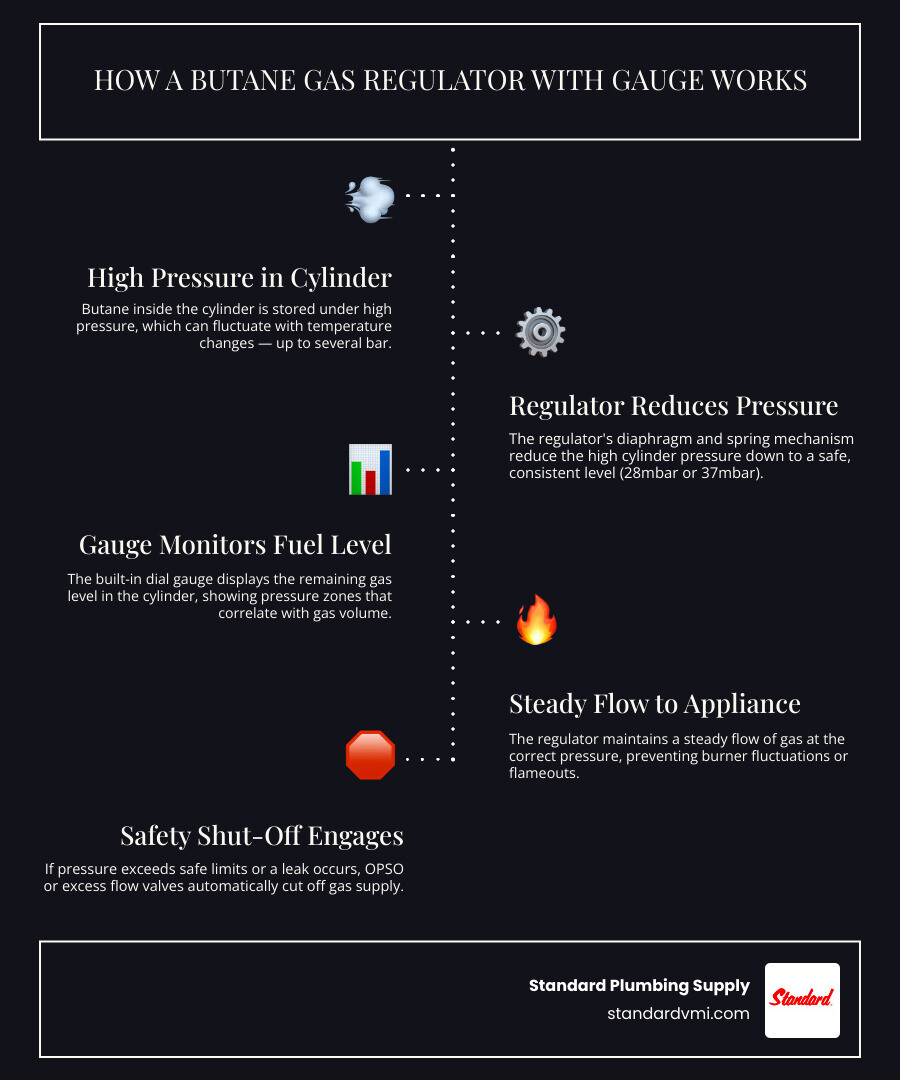
At its core, a butane gas regulator with gauge is a mechanical control valve designed to tame the high, volatile pressure inside a liquefied petroleum gas (LPG) cylinder. The pressure inside a butane bottle can fluctuate wildly depending on the ambient temperature. If you connected an appliance directly to an unregulated bottle, the high pressure would overwhelm the burner, creating a massive safety hazard.
The regulator acts as a protective barrier. It takes the high inlet pressure (which can be up to 7.5 bar) and reduces it to a steady, low outlet pressure (typically 28mbar or 37mbar) that your stove, heater, or burner can safely handle.
Here is how the internal components work together to control the gas flow:
- The Diaphragm: A flexible rubber or thermoplastic disc that moves up and down in response to gas pressure. It acts as the heart of the regulator, constantly balancing the pressure inside the regulator body against the ambient atmospheric pressure.
- The Spring: A calibrated steel spring sits above the diaphragm, pressing down on it. The tension of this spring determines the outlet pressure of the regulator.
- The Valve Seat and Stem: As the diaphragm moves, it opens or closes a small valve orifice. If the pressure on the outlet side drops (because your appliance is burning gas), the spring pushes the diaphragm down, opening the valve to let more gas through. If the pressure builds up, the diaphragm is pushed upward, closing the valve to restrict flow.
- The Gauge (Manometer): Mounted directly on the regulator body, the gauge measures the vapor pressure of the gas on the inlet or outlet side. This provides a visual reading of the system's status, helping you monitor remaining fuel and test for leaks.
Understanding the mechanics of your gas system is key to choosing the right hardware. For a broader look at how different systems manage pressure, you can explore our guide on the different types of gas regulator.
Understanding the Role of a Butane Gas Regulator with Gauge in Plumbing and HVAC Systems
In commercial HVAC and plumbing applications, precise gas pressure control is non-negotiable. While propane is more common for large-scale permanent outdoor heating in colder regions, butane is heavily utilized in mobile heating units, portable commercial cooking setups, and specialized soldering equipment across our service areas—from the high altitudes of Park City, Utah, to the warmer climates of Phoenix, Arizona.
When setting up temporary heating or mobile catering systems, a dual-purpose regulator with an integrated gauge serves as a vital diagnostic tool. In a commercial gas distribution setup, even a minor pressure drop can cause commercial burners to flame out or burn inefficiently, producing dangerous carbon monoxide. By utilizing a high-quality regulator, technicians can ensure that gas pressure remains perfectly consistent, protecting sensitive commercial HVAC components and ensuring compliance with local mechanical codes.
Key Benefits and Safety Features of Monitored Gas Systems
Upgrading to a butane gas regulator with gauge offers several distinct advantages over standard, unmonitored regulators. Let’s look at the primary benefits:
- Accurate Fuel Monitoring: The most obvious benefit is preventing unexpected fuel depletion. Instead of guessing how much gas is left by shaking the bottle, the gauge gives you a clear visual indicator.
- Integrated Leak Detection: The gauge on your regulator can double as a pressure drop tester. By turning on the cylinder valve, turning it back off, and watching if the gauge needle drops over a few minutes, you can easily identify if there is a downstream leak in your hoses or appliance connections.
- Excess Flow Protection: High-quality regulators feature an automatic excess flow shut-off valve. If a hose ruptures or gets severed, the sudden surge in flow triggers an internal mechanism that cuts off the gas supply instantly.
- Over Pressure Shut Off (OPSO): Modern safety standards emphasize OPSO technology. If the regulator’s internal diaphragm fails and pressure spikes dangerously, the OPSO valve trips, completely blocking the gas path to prevent an explosion or appliance damage.
To understand why upgrading to a modern safety regulator is highly recommended, consider the differences below:
| Feature | Standard Regulator | OPSO Safety Regulator |
|---|---|---|
| Pressure Regulation | Yes | Yes |
| Visual Pressure Monitoring | No | Yes (via integrated gauge) |
| Over-Pressure Protection | No | Yes (automatic shut-off) |
| Excess Flow Safety | Optional | Yes (standard on modern units) |
| Recommended Environment | Low-risk outdoor | Indoor, mobile, and commercial |
How to Read the Dial Gauge on a Butane Gas Regulator with Gauge
Reading a gas regulator gauge is simple once you understand what the color-coded zones represent. Most high-quality gauges, such as the iGT Low Pressure Butane Gas Regulator with Gauge, feature a dial divided into three distinct zones:
- Green Zone (Normal/Full): Indicates that the cylinder has sufficient gas and the vapor pressure is optimal for appliance operation.
- Yellow/Orange Zone (Low/Warning): Indicates that the liquid butane inside the cylinder is nearly depleted, and the system is running on the remaining vapor. It is time to source a replacement bottle.
- Red Zone (Empty or Overpressure): If the needle rests in the red zone when the valve is open, your cylinder is either completely empty, or there is an overpressure fault in the system.
The Temperature Factor: It is crucial to understand how ambient temperature affects butane gas. Butane is stored as a liquid under pressure and must boil into a gas (gasify) to be used. Butane struggles to gasify in freezing temperatures; its boiling point is roughly 0°C (32°F).
If you are operating a mobile heater in a chilly mountain town like Jackson, Wyoming, or Logan, Utah, during the winter, the pressure inside your cylinder will drop significantly due to the cold, causing the gauge needle to fall into the yellow or red zone even if the bottle is physically full of liquid gas. Always take ambient temperatures into account when reading your gauge.
Compatibility, Pressure Ratings, and Cylinder Sizing
When choosing a butane gas regulator with gauge, you must match the physical inlet connection of the regulator to the valve on your gas cylinder.
Butane cylinders come in several standard sizes, each utilizing specific valve types:
- 4.5kg Cylinders: These small, blue bottles are highly popular for light camping, portable stoves, and small outdoor heaters. They typically feature a screw-in connection with a 21.8mm left-hand thread.
- 7kg and 13kg/15kg Cylinders: These mid-to-large-sized bottles are commonly used for domestic indoor heaters, larger mobile catering setups, and outdoor barbecues. They generally utilize a tool-free clip-on connection (often 20mm or 21mm in diameter).
Before purchasing, double-check your cylinder's valve size. For instance, if you have a 21mm clip-on bottle, you will need a matching 21mm Clip-on Butane Regulator With Manometer | Purely Outdoors. If you are using a 20mm valve cylinder, you must source a specialized option like the Cavagna 28mbar Butane Gas Regulator - 20mm Clip-On | Butane Gas Regulators | gasproducts.co.uk.
Comparing 28mbar and 37mbar Pressure Settings
In low-pressure gas appliances, operating pressure is measured in millibars (mbar). It is absolutely vital to match your regulator's output pressure to the specific requirements of your appliance:
- 28mbar Butane Regulators: This is the standard low-pressure setting for domestic and recreational butane appliances. Stoves, portable indoor heaters, and light-duty camping gear are engineered to burn butane efficiently at this pressure. If you need a reliable replacement for standard low-pressure setups, the Low Pressure Butane Gas Regulator | Order Online | FSF is an excellent benchmark.
- 37mbar Regulators: This higher pressure setting is standard for propane appliances. Propane operates at a higher pressure than butane to deliver a hotter, more consistent flame, making it ideal for heavy-duty outdoor cooking, patio heaters, and commercial roofing torches.
Using a 37mbar regulator on an appliance rated for 28mbar will cause the burner to run too hot, producing large, unstable yellow flames and creating a serious fire hazard. Conversely, running a 37mbar appliance on a 28mbar regulator will result in a weak, sputtering flame that is easily blown out by the wind.
Step-by-Step Installation, Troubleshooting, and Maintenance
Installing a new butane gas regulator with gauge is a straightforward process, but it requires strict adherence to safety protocols.
Step-by-Step Connection Guide:
- Inspect the Equipment: Check the regulator, the integrated rubber sealing washer, and your gas hose for any signs of cracking, stiffness, or physical damage.
- Prepare the Hose: Push your gas hose onto the regulator's 8mm nozzle. Secure it tightly using a high-quality hose clip or Jubilee clip.
- Remove the Dust Cap: Remove the plastic dust cap from the cylinder valve. Pull the lanyard out and upwards to pop it off without using sharp tools that could scratch the valve.
- Check the Valve Seal: Look inside the cylinder valve to ensure the black rubber sealing washer is present, clean, and undamaged.
-
Connect the Regulator:
- For Clip-on Regulators: Ensure the regulator switch is in the "off" or "disconnect" position (usually 3 o'clock). Place the regulator over the valve and press down firmly until you hear a distinct "click," indicating it has locked into place.
- For Screw-on Regulators: Thread the regulator nut onto the cylinder valve counter-clockwise (left-hand thread) and tighten it firmly using a gas spanner or wrench.
- Turn the Gas On: Turn the regulator switch or valve to the "on" position to pressurize the system.
- Perform a Leak Test: Spray a dedicated leak detector solution or soapy water onto all connections. If bubbles form, immediately turn off the gas and tighten the connections before retrying.
Troubleshooting a Stuck Regulator Switch or Clearance Issues
A common issue during installation occurs when the on/off switch on a clip-on regulator gets stuck or refuses to turn. If this happens, do not force it. Forcing the switch can break the internal locking pins, ruining the regulator.
A stuck switch almost always indicates that the regulator is not perfectly aligned or fully seated onto the cylinder valve. Disconnect the regulator completely, check for any dirt or debris inside the valve neck, and press it down firmly again until it clicks securely into place. Once properly seated, the switch should turn smoothly.
Clearance Issues with Gauges: Older style gas cylinders or bottles with heavy steel shrouds/handles can sometimes present clearance issues. Because a butane gas regulator with gauge has an extra physical dial protruding from the body, it may not fit easily inside tight shroud spaces. If you encounter this, consider using an angled-gauge regulator or a specialized quick-on kit, such as the Butane Gas Regulator Kit Quick-On Valve 27mm + 2m Hose , which provides better clearance and safety features.
Safe Disconnection, Storage, and Lifespan Guidelines
When your gas bottle is empty, or when your equipment is going into seasonal storage, safe disconnection is paramount:
- Turn the regulator switch or cylinder valve to the "off" position.
- For clip-on models, press the release button or lever to pop the regulator off the valve. For screw-on models, unscrew the nut clockwise (remembering it is a left-hand thread).
- Immediately place the protective safety cap back onto the empty cylinder's valve to prevent dirt or moisture from entering.
- Store your regulator and gas bottles in a cool, dry, well-ventilated outdoor area. Never store gas cylinders indoors, in basements, or near direct heat sources.
Lifespan and Replacement Intervals: Gas regulators do not last forever. Over time, the internal rubber diaphragm and seals degrade, increasing the risk of leaks. The industry standard recommendation is to replace your gas regulator every 10 years from the date of manufacture (which is stamped on the regulator body), even if it appears to be working perfectly.
Flexible rubber gas hoses have a much shorter lifespan and should be inspected annually and replaced every 5 years to maintain complete system safety. If you are replacing your entire setup, choosing a pre-matched kit like the Gas Regulator Kit Butane 28 mbar + 2m Flexible Hose Screwable ensures all components are fresh, compatible, and compliant with safety standards.
Frequently Asked Questions about Butane Regulators
Can I use a butane regulator on a propane gas bottle?
No, you should never use a butane-specific regulator on a propane bottle. Butane and propane operate at different pressure standards (28mbar vs 37mbar) and have entirely different physical cylinder connections.
Propane cylinders typically use a male POL thread connection, whereas butane cylinders utilize clip-on valves or left-hand female threads. Attempting to force a connection or use incorrect adaptors can result in dangerous gas leaks or appliance malfunctions.
How do I know if my gas regulator is leaking?
The easiest and safest way to check for a gas leak is to perform a bubble test:
- Mix a solution of dish soap and water in a spray bottle.
- Spray the solution generously over the regulator body, hose connections, and cylinder valve.
- Turn on the gas supply. If you see growing bubbles, gas is escaping. Immediately shut off the valve and rectify the connection.
- You can also monitor your integrated pressure gauge. If you open the valve, close it, and notice the needle dropping steadily over a 5-minute period, there is a leak somewhere in the system.
What size hose and fittings do I need for a 28mbar butane regulator?
Standard low-pressure butane regulators feature an 8mm nozzle (sometimes referred to as a hose tail). To connect this to your appliance, you should use a high-quality, reinforced LPG hose with an 8mm inner bore. Always secure the hose to the nozzle on both ends using stainless steel Jubilee clips or worm-drive hose clamps to prevent the hose from slipping off under pressure.
Conclusion
A high-quality butane gas regulator with gauge is one of the smartest upgrades you can make for your gas-powered appliances. It eliminates the guesswork of fuel monitoring, serves as an essential diagnostic tool for leak detection, and incorporates modern safety features to protect your property and personnel.
Whether you are managing mobile commercial heaters in cold climates, setting up outdoor cooking stations, or maintaining specialized plumbing equipment, standardizing your gas control hardware is critical.
At Standard Plumbing Supply, we serve residential, commercial, and industrial clients across our extensive western footprint—including Utah, Idaho, Wyoming, Colorado, Nevada, California, Arizona, Oregon, and Nebraska. We provide the expert support, trusted brands, and fast nationwide shipping you need to keep your projects running safely and efficiently. If you manage multiple properties or commercial accounts, our vendor-managed inventory (VMI) solutions can streamline your supply chain and free up valuable cash flow.
Ready to upgrade your gas systems or restock your commercial inventory? Explore our inventory of gas regulators and plumbing supplies today to find the perfect fit for your next project.