
The Beginner Guide to Butane Pressure Regulators
Learn how a butane pressure regulator works, key pressure ratings, and safety tips for proper installation and appliance use.

How a Butane Pressure Regulator Works and Key Pressure Ratings
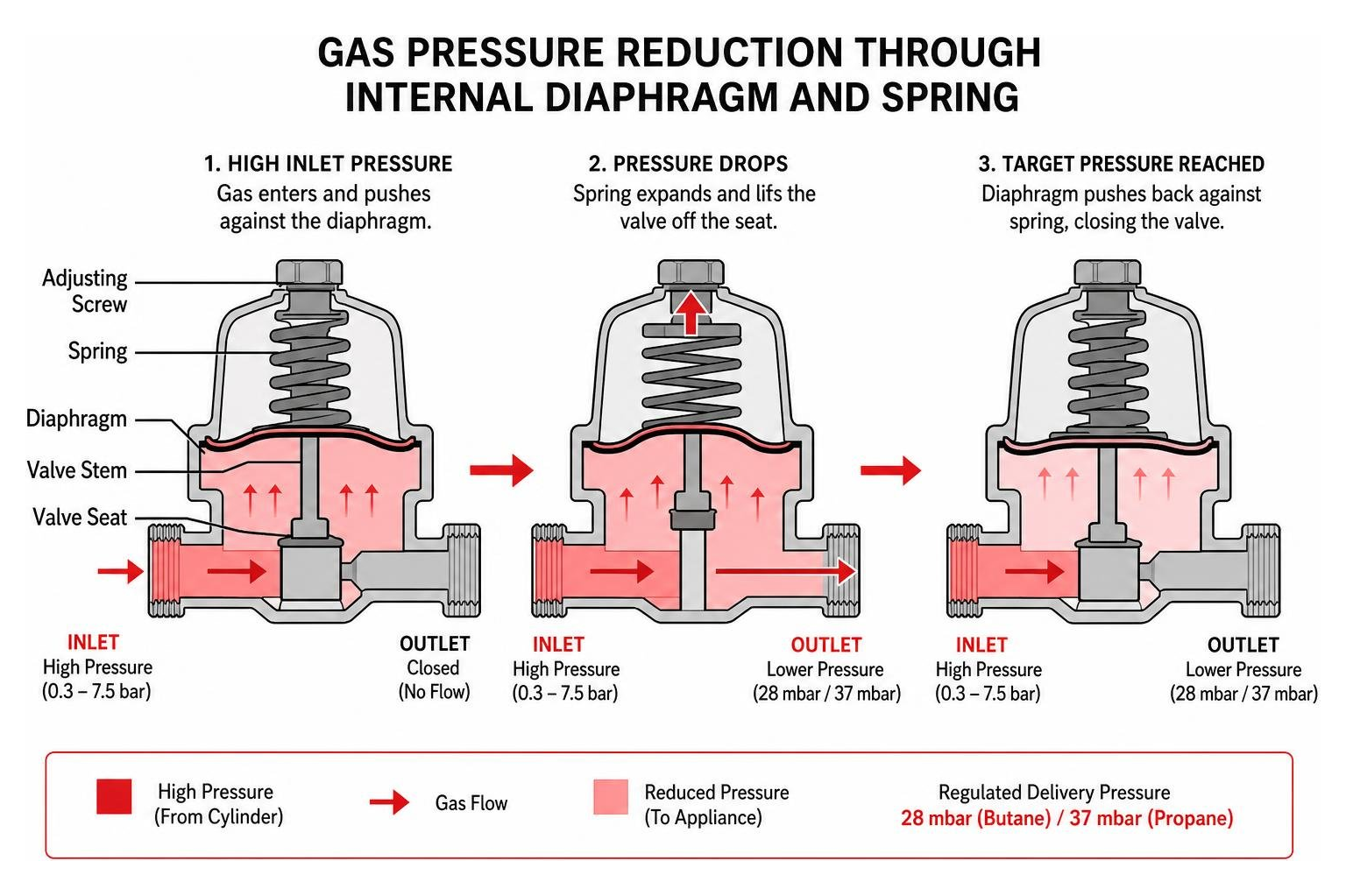
A pressure regulator controls gas mechanics using a diaphragm mechanism, an internal loading spring, and a valve seat. Inside a cylinder, butane is stored as a liquid under its own vapor pressure. This pressure fluctuates wildly based on ambient temperature—commonly ranging between 0.3 bar and 7.5 bar (and up to 16 bar under extreme thermal loads).
Appliances cannot safely consume fuel at these erratic cylinder pressures. The regulator's inlet admits the high-pressure gas into an internal chamber. As gas enters, it pushes against a flexible diaphragm counterbalanced by a precision-calibrated spring. When downstream pressure drops (such as when an appliance valve opens), the spring expands, opening the orifice to let more gas flow. As downstream pressure builds to the target delivery pressure, the diaphragm pushes back against the spring, closing the valve seat.
For standard low-pressure domestic applications, the regulator steps down cylinder pressure to a safe, constant delivery pressure. You can source reliable units such as a Low Pressure Butane Gas Regulator | Order Online | FSF to ensure steady flow for light heating and cooking appliances.
| Parameter | Butane (Low-Pressure) | Propane (Low-Pressure) | Harmonized Dual LPG | High-Pressure Industrial |
|---|---|---|---|---|
| Standard Delivery Pressure | 28 mbar (11" WC) | 37 mbar (14" WC) | 30 mbar (12" WC) | 500+ mbar (7+ PSI) |
| Cylinder Inlet Pressure | 0.3 to 7.5 bar | 2.5 to 16 bar | 0.5 to 16 bar | Up to 16 bar |
| Boiling Point | -0.5°C (31.1°F) | -42°C (-43.6°F) | Varies by mix | -0.5°C to -42°C |
| Standard Domestic Flow | 1.3 – 1.5 kg/h | 1.5 kg/h | 1.5 kg/h | 4.0+ kg/h |
| Common Valve Connection | 21mm clip-on / M16 / 21.7 LH | POL / QCC-1 / 27mm clip | Brand specific | Threaded high-pressure |
Operating Pressure Standards: 28 mbar vs. 37 mbar Propane
Domestic gas systems rely on exact operating pressure standards. The traditional standard butane supply pressure is 28 mbar (equivalent to 11 inches water gauge or water column). By comparison, the standard propane supply pressure is 37 mbar (14 inches water gauge).
Why the difference? Butane and propane possess distinct molecular structures, calorific values, and densities. Because propane delivers slightly less energy per unit volume than butane, propane appliances are engineered to operate at higher delivery pressure (37 mbar) to force sufficient fuel volume through the burner orifice. Supplying 37 mbar to a dedicated 28 mbar butane appliance pushes too much gas through the burner, compromising combustion.
Many modern appliances are engineered to a harmonized European standard of 30 mbar for dual LPG fuels. In terms of volumetric delivery, a standard low-pressure unit like the Butane Low Pressure Regulator - 1.5 kg/hr - 21562 provides an output of 1.5 kg/h, which equals roughly 71,250 Btu/h—sufficient for domestic cookers, patio heaters, and light catering setups.
Single-Stage vs. Two-Stage Pressure Regulation
Regulators fall into two primary mechanical designs:
- Single-Stage Regulators: These reduce cylinder pressure down to final appliance delivery pressure in a single step. They are compact, lightweight, and cost-effective, making them standard for portable camping stoves, patio heaters, and domestic cookers. However, single-stage regulators experience minor downstream pressure "droop" as the cylinder empties or ambient temperatures shift.
- Two-Stage Regulators: These utilize two internal diaphragms in series. The first stage reduces inlet pressure from the tank to an intermediate stage (approx. 0.7 to 1 bar), and the second stage drops it precisely to final working pressure (28–30 mbar). This eliminates inlet pressure fluctuation, controls droplet condensation, and ensures continuous pressure delivery. Two-stage systems are essential for commercial HVAC installations, continuous-draw catering kitchens, and multi-tank configurations.
Common Types and Cylinder Connection Fittings
Choosing a regulator requires matching the mechanical valve connection on your fuel cylinder. Connecting mismatched hardware can crack fittings or ruin internal rubber seals.
Industrial and agricultural tasks—such as roofing torches, cow dehorners, and field heaters—often demand Butane Gas Regulators - High Pressure . These operate at 500 mbar or higher and should never be connected to low-pressure appliances.
Selecting the Right Butane Pressure Regulator for Your System
To select the proper unit, evaluate three variables:
- Total Appliance Demand (Flow Rating / BTU): Sum the input requirements of your connected appliances. If your system draws 60,000 Btu/h, select a regulator with at least a 1.5 kg/h rating (71,250 Btu/h) to avoid starving burners.
- Ambient Operating Temperature: Butane has a boiling point of -0.5°C (31.1°F). In temperatures approaching freezing, butane stops vaporizing effectively inside the cylinder, causing severe pressure drops regardless of the regulator rating.
- Appliance Pressure Specification: Always read the appliance data plate to confirm whether it requires 28 mbar, 30 mbar, or a specialized high-pressure feed.
Clip-On, Quick-On, and Threaded Valve Connections
Cylinder connections vary widely across container sizes and regional standards:
- 21 mm Clip-On: The standard fitting for common domestic 7 kg and 13 kg butane cylinders. It features a tool-free collar that snaps over the cylinder valve.
- 35 mm Jumbo Valve: A larger clip-on design found on high-capacity domestic and commercial utility cylinders, often integrating a manual shut-off lever.
- D20 Quick-On: Engineered for compact bottles (such as Malice, Elfi, and Twiny styles). The Butane pressure regulator 28 mbar Quick-on provides 28 mbar output at 1.3 kg/h with an automatic locking ring.
- 27 mm Quick-On: Commonly paired with modern lightweight composite and steel bottles. Units like the Butane pressure reducer Quick-on connection diameter FAVEX 6375709 deliver 1.3 kg/h flow and incorporate thermal safety mechanisms.
- M16 x 1.5 Threaded Fittings: Dedicated camping cylinders (such as Campingaz R901, R904, and R907) utilize this screw thread. The Crusader Camping Gas Screw-On Butane Regulator 28 mbar for R901 R904 R907 threads directly into the canister without adapters.
- 21.7 mm Left-Hand Threads: Standard on large 13 kg screw-type cylinders. Complete kits like the Gas Regulator Kit Butane 28 mbar + 2m Flexible Hose Screwable use a 21.7 mm nut with a 1.814 left-hand pitch to prevent cross-threading onto incompatible gas lines.
Can You Interchange Butane and Propane Regulators?
A common question among property managers and maintenance technicians is whether propane and butane regulators can be swapped. The short answer is: No, they should not be interchanged.
While both gases belong to the liquefied petroleum gas (LPG) family, their physical properties differ significantly. At 20°C (68°F), propane exerts a vapor pressure of approximately 7.5 to 8.5 bar, whereas butane exerts only about 1.5 to 2.0 bar. Regulators are calibrated specifically around these baseline inlet and delivery characteristics.

Risks of Cross-Fuel Regulator Swapping
- Over-Pressurization: Running butane through a 37 mbar propane regulator subjects a 28 mbar appliance to roughly 32% higher pressure than intended. This leads to oversized, lifting flames, increased carbon monoxide production, burner sooting, and excessive thermal stress on heat exchangers.
- Under-Pressurization: Conversely, running propane through a 28 mbar butane regulator results in an under-fired appliance. Burners will burn weak and yellow, fail to achieve set operating temperatures, and may suffer flame blow-out in breezy conditions.
- Valve and Cylinder Danger: Never attempt to fill or adapt a butane cylinder for propane fuel. Propane generates significantly higher vapor pressures; while cylinder walls are robust, butane cylinder pressure relief valves are calibrated for lower discharge thresholds and can vent hazardous raw gas when exposed to summer heat.
Appliance Calibration and Combustion Hazards
Appliances with manually adjustable burner knobs (such as open cooktop burners) may appear to burn safely under minor pressure discrepancies, but sensitive appliances will fail. Fixed-flame equipment—such as 3-way absorption refrigerators, direct-fired water heaters, and catalytic space heaters—rely on precise gas-to-air stoichiometric ratios. Over-pressuring these units causes incomplete combustion, soot accumulation, and hazardous carbon monoxide generation. Always match the regulator to the appliance data plate.
Step-by-Step Installation, Safety Features, and Maintenance

Installing and maintaining gas hardware demands systematic safety protocols to avoid catastrophic leaks.
How to Safely Install a Butane Pressure Regulator
- Shut Off the Appliance & Cylinder: Ensure all downstream appliance control knobs are fully closed. Ensure the gas cylinder valve is completely shut.
- Inspect the Valve and Seals: Visually inspect the cylinder valve interface and the regulator inlet for dirt, grit, metal burrs, or damaged O-rings. Never connect a regulator with a cracked rubber gasket.
-
Engage the Connection:
- For Clip-On / Quick-On Regulators: Position the regulator vertically over the cylinder valve. Lift the locking collar, push down firmly until you hear a positive click, then release the collar. Turn the operating lever to the "ON" position.
- For Threaded Regulators: Align the threads carefully. 21.7 mm LP fittings use left-hand threads (turn counter-clockwise to tighten). Tighten firmly by hand or use an appropriate gas wrench. Do not over-torque.
- Attach and Secure the Hose: Push the gas hose fully onto the regulator nozzle (such as an 8 mm Fulham nozzle) and secure it tightly with an approved, correctly sized hose clip. Never force a narrow high-pressure hose over a large low-pressure nozzle, as this snaps the internal textile braiding.
Essential Safety Devices and Leak Detection Protocols
Modern certified regulators incorporate integral safety devices:
- Excess Flow Valve (EFV): Automatically cuts off or restricts gas flow if the downstream hose ruptures or becomes detached.
- Thermal Safety Device: Shuts off gas flow permanently if surrounding ambient temperatures exceed safe thresholds (such as in a fire).
- Overpressure Shut-Off (OPSO): Trips closed if internal diaphragm failure allows high cylinder pressure into the low-pressure line.
Leak Testing: Never test for gas leaks with an open flame. Apply a dedicated gas leak detector solution or a mixture of liquid dish soap and water around all joints, threads, and hose connections. Slowly turn on the cylinder valve. If growing bubbles appear, shut off the gas immediately, vent the space, tighten the fittings, and re-test.
Routine Maintenance Checklist:
- Inspect flexible rubber gas hoses monthly for cracking, dry rot, kinking, or stiffness.
- Replace flexible hoses every 5 years (check the manufacturing date stamped on the hose body).
- Replace domestic regulators every 10 years to prevent diaphragm fatigue and spring drift.
- Ensure regulators comply with recognized performance certifications such as the EN 16129 European standard or national standards like NF, which ensure flow limiters and relief mechanisms function under emergency conditions.
Frequently Asked Questions about Butane Regulators
Can I use a propane regulator on a butane cylinder?
No. Standard propane regulators output gas at 37 mbar, whereas domestic butane appliances are calibrated for 28 mbar. Supplying 37 mbar to a butane appliance leads to overfiring, excessive carbon monoxide production, and dangerous soot build-up. Furthermore, propane fittings (like POL or QCC-1) do not physically match butane clip-on or 21.7 mm left-hand threaded valves.
What is the standard lifespan of a butane gas hose and regulator?
Flexible rubber LPG hoses have a maximum recommended service lifespan of 5 years. Low-pressure regulators should generally be replaced after 10 years of continuous or seasonal service. Always replace equipment sooner if you detect cracking, corrosion, stiff rubber, or sticking valve handles.
What certifications should I look for on a butane regulator?
Look for certification to EN 16129 (the harmonized standard specifying test methods for LP gas pressure regulators) or regional safety marks like the French NF certification. These standards ensure the regulator includes verified flow limits, temperature resistance, and internal pressure relief mechanisms.
Conclusion
Understanding how to match, install, and maintain a butane regulator is essential for safe gas system operation. By ensuring your regulator output matches your appliance specifications (28 mbar for dedicated butane or 30 mbar for harmonized LPG), choosing the correct valve connection, and adhering to strict leak-testing protocols, you protect both equipment and property.
At Standard Plumbing Supply, we support contractors, facility managers, and tradespeople across the Western United States with extensive plumbing, HVAC, and gas distribution components. Whether you are maintaining commercial systems or installing residential lines, our team provides expert technical support, trusted brands, fast nationwide shipping, and vendor-managed inventory solutions to keep your operations running smoothly. For specialized piping protection and commercial installations, explore our comprehensive catalog of pressure relief valves to maintain code compliance and system safety on every job.