
Commercial Gas Pressure Regulators 101
Learn how a commercial gas pressure regulator works, its safety features, sizing, and installation best practices for HVAC systems.

What Is a Commercial Gas Pressure Regulator and How Does It Work?
A commercial gas pressure regulator acts as the mechanical brain of any gas piping distribution system. Utility supply mains deliver natural gas or propane at elevated pressures—often between 2 PSIG and 60 PSIG (and up to 125 to 150 PSIG for direct industrial service drops). Most commercial appliances, including rooftop HVAC units, water heaters, and cooking equipment, require low, steady manifold delivery pressures between 3.5 inches Water Column (in. w.c.) and 14 in. w.c., or localized 2 PSIG feeds.
The primary function of the regulator is to automatically reduce this incoming supply pressure to a steady downstream target and maintain that setpoint regardless of upstream pressure swings or downstream demand fluctuations.
Anatomy and Operating Physics of a Commercial Gas Pressure Regulator
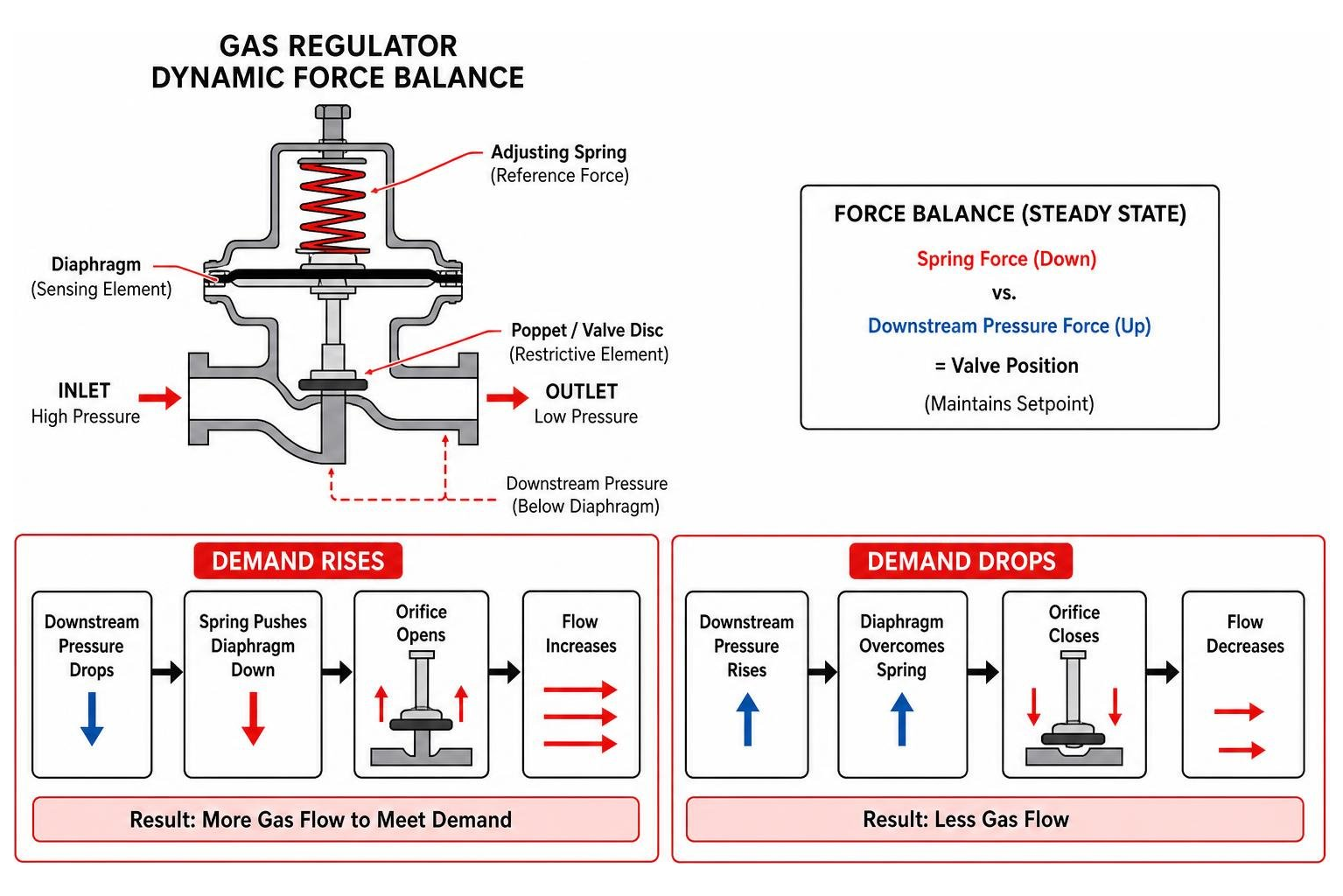
At its core, a gas regulator operates through a continuous mechanical force balance between three main elements:
- The Sensing Element (Diaphragm): A flexible elastomeric disc (often fabric-reinforced Nitrile or Buna-N) exposed to downstream pipeline pressure on one side and atmospheric pressure or reference spring force on the other.
- The Reference Force Element (Adjusting Spring): A calibrated coil spring that pushes downward on the diaphragm to open the valve orifice.
- The Restrictive Element (Poppet / Valve Disc): A movable disc or plug positioned against a stationary orifice that throttles the flow of gas.
When downstream appliances ignite, downstream pressure drops slightly. The loading spring overcomes the reduced pressure underneath the diaphragm, pushing downward. This motion moves the valve disc away from the orifice seat, allowing more gas to flow. Conversely, when appliances shut off, downstream pressure builds beneath the diaphragm, overcoming the spring tension and pulling the valve disc tightly against the orifice to close off flow.
Understanding regulator performance requires evaluating several engineering parameters:
- Droop: The inherent drop in outlet pressure below the nominal setpoint as the flow rate increases. All spring-loaded direct-acting regulators experience some degree of droop due to spring relaxation.
- Lock-up Pressure: The slight rise in downstream pressure above the setpoint required to achieve bubble-tight shutoff against zero downstream flow. Under ANSI Z21.80, lock-up pressure must not exceed 150% or 5 in. w.c. above setpoint within two seconds of a downstream valve closing.
- Hysteresis: The difference in outlet pressure performance depending on whether flow is increasing or decreasing, driven by friction in internal linkages, guides, and diaphragm flex resistance.
- Balanced Valve Design: Advanced regulators, like the Gas Pressure Regulator Series 274, incorporate a balancing diaphragm or sleeve that neutralizes the effects of fluctuating inlet pressure on the valve disc. This maintains steady outlet delivery even when inlet pressures swing widely.
Pressure-Reducing Regulators vs. Back-Pressure Regulators
In commercial gas piping and mechanical rooms, the vast majority of valves are pressure-reducing regulators. These valves monitor and control the pressure downstream on their outlet side, ensuring connected equipment receives a safe, steady working pressure.
By contrast, a back-pressure regulator monitors and controls the pressure upstream on its inlet side. These valves remain closed until inlet pressure rises above an adjustable setpoint, opening to relieve excess pressure into a bypass loop or flare line. In commercial HVAC and plumbing systems, back-pressure regulators are primarily used for system bypass loops, pump recirculation lines, and process stabilization manifolds.
Primary Classifications and Staging Configurations
Commercial gas regulators are categorized by their actuation method and internal staging configuration. Choosing between direct-acting, pilot-operated, single-stage, and dual-stage designs depends on inlet pressure levels, required flow capacity, and acceptable droop tolerances.
| Regulator Feature | Direct-Acting Regulators | Pilot-Operated Regulators |
|---|---|---|
| Operating Principle | Spring acts directly against the sensing diaphragm | Separate pilot regulator uses line gas to load the main diaphragm |
| Pressure Control Accuracy | Moderate (10% to 20% droop across turndown) | High accuracy (1% to 2.5% accuracy class, minimal droop) |
| Inlet Pressure Capability | Low to medium (up to 125–150 PSIG) | High (up to 1,480 PSIG / 102 bar) |
| Flow Capacity Range | Up to 20,000–90,000 SCFH | Over 100,000+ SCFH |
| Response Time | Fast (direct mechanical response) | Slightly slower (pilot line loading delay) |
| Common Commercial Uses | Boilers, unit heaters, kitchens, line regulation | Gas distribution mains, campus master meters, power plants |
Direct-Acting, Pilot-Operated, and Lever-Acting Designs
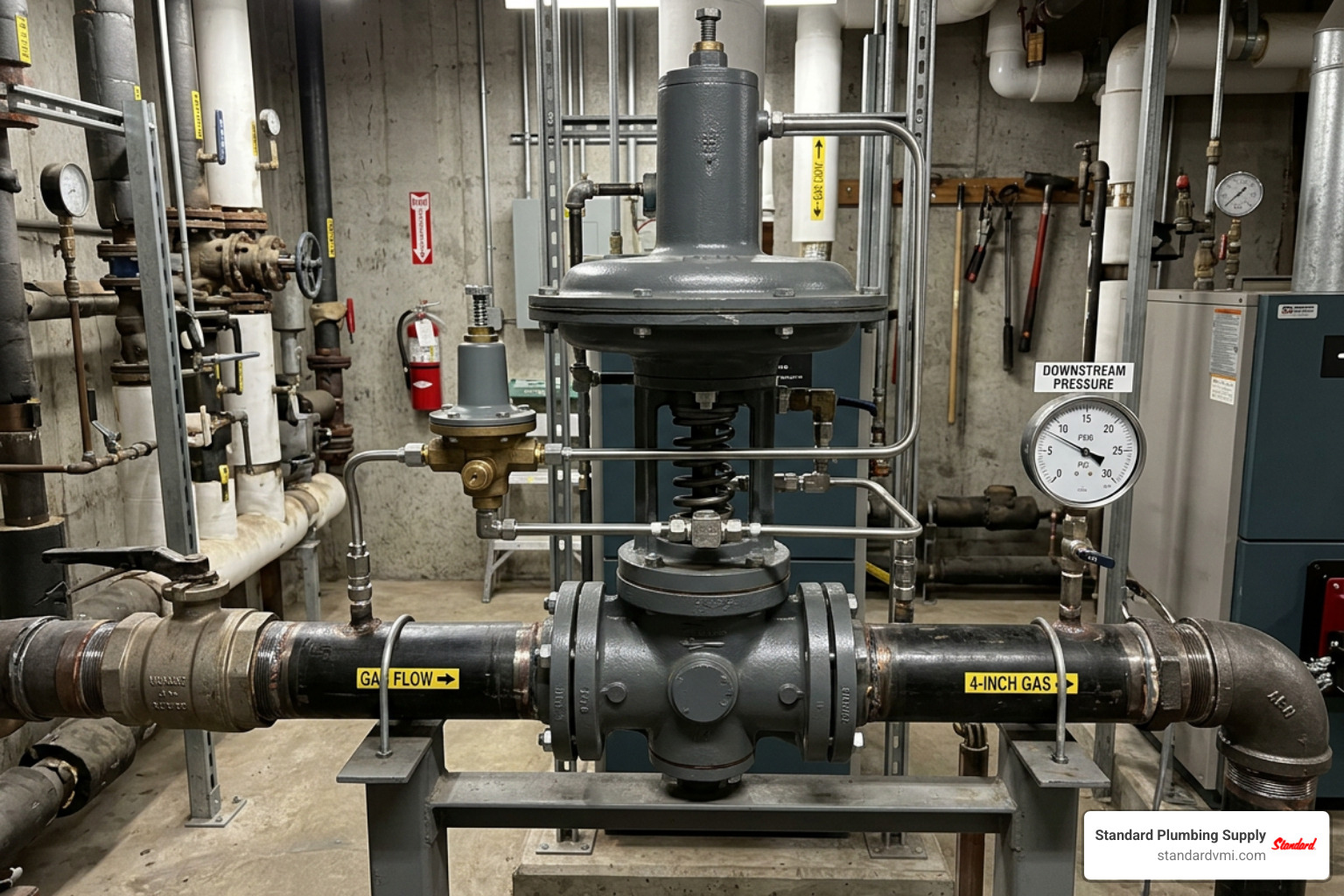
- Direct-Acting Regulators: The standard workhorse of commercial mechanical systems. Because the spring directly loads the main diaphragm, direct-acting units offer rapid response times to burner ignition cycles. For high-demand applications with rapid flow rate variations, heavy-duty commercial models like the RB 1700 - 3/4” offer durable spheroidal graphite cast iron construction and balanced valve designs to eliminate inlet pressure variation effects.
- Lever-Acting Regulators: These use an internal high-leverage mechanical linkage between the diaphragm stem and the valve plug. The mechanical multiplier provides tight dead-end lockup capability and pilot-level modulation (down to 0.15 CFH) while managing inlet pressures up to 2 to 5 PSIG.
- Pilot-Operated Regulators: When supplying large facilities, hospital boiler plants, or campus submetering systems, direct-acting regulators can experience excessive droop. Pilot-operated regulators solve this by using an auxiliary pilot regulator to sense downstream pressure and amplify loading gas onto the main diaphragm. This delivers a flat pressure curve across wide turndown ratios. Modern industrial units are often classified as Fail Open (FO) to prevent total loss of fuel supply during pilot disruption.
Gas Fuel Types and Medium Compatibility
Gas pressure regulators must be matched to the specific gas fuel type flowing through the piping:
- Natural Gas (Methane): Standard natural gas sizing calculations assume a base specific gravity ($SG$) of 0.60 at 60°F and 14.7 psia.
- Liquid Propane (LP): Propane gas is denser than natural gas, with an $SG$ of approximately 1.52. Because propane delivers roughly 2,500 BTU/cu. ft. compared to 1,000 BTU/cu. ft. for natural gas, lower volumetric flow rates are required for identical BTU loads, but higher manifold pressures (typically 10 to 11 in. w.c.) and different spring calibrations are needed. When converting commercial heating equipment between fuels, a dedicated Modine 53080 Single Stage Natural Gas To LP Conversion Kit ensures burner orifices and regulator springs match fuel properties.
- Renewable Natural Gas (RNG) & Hydrogen Blends: Modern commercial regulators are increasingly certified for biomethane and up to 20% hydrogen ($H_2$) blending. Hydrogen molecules are significantly smaller than methane, which increases permeation risks across seals and demands high-grade Nitrile or Viton elastomers.
Critical Safety Features and Code Compliance Standards
Commercial gas installations must adhere to strict safety standards, including ANSI Z21.80 / CSA 6.22 (line pressure regulators), ANSI Z21.18 / CSA 6.3 (appliance regulators), EN 334, and NFPA 54 (National Fuel Gas Code). High-pressure commercial lines require integrated safety mechanisms to prevent catastrophic downstream overpressurization.

Overpressure (OPSO) and Underpressure (UPSO) Shut-Off Systems
- Internal Relief Valves (IRV): When downstream pressure exceeds the setpoint by a set margin, an internal spring-loaded seat on the diaphragm lifts, venting excess gas through the regulator's atmospheric vent port to relieve pressure.
- Overpressure Shut-Off (OPSO / Slam-Shut): When an IRV cannot vent sufficient volume—or in indoor installations where venting gas is prohibited—an OPSO device acts as an emergency stop. If downstream pressure exceeds a preset threshold (typically 15% to 30% above operating pressure), an internal latch releases, snapping a safety shut-off valve shut in milliseconds. OPSO devices require manual reset once the fault is cleared.
- Underpressure Shut-Off (UPSO): Used to detect upstream line breaks or gas supply outages. If inlet pressure drops below a safe threshold, the UPSO slams shut, preventing unburned gas from flooding appliances when upstream supply is restored.
- Thermal Protection: In multi-family or utility risers, fire-rated enclosures like the Sioux Chief Oxbox 696R1031Gf Fire Rated Gas Valve Outlet Box 3 4 In Inlet X 3 4 In Outlet FNPT Inlet ABS Import provide passive fire protection and positive isolation during emergency events.
Indoor Ventless Applications and Vent Limiting Technology
Under NFPA 54, gas pressure regulators installed indoors traditionally require dedicated steel or copper vent lines routed to the outdoors to exhaust gas safely if the internal diaphragm ruptures.
Vent Limiters eliminate the requirement for dedicated outdoor vent piping in approved installations under ANSI Z21.80 / CSA 6.22 (Class I for 2 PSIG systems, Class II for 5 to 10 PSIG systems equipped with Overpressure Protection Devices). A vent limiter incorporates a precision ball-check mechanism or miniature orifice breathing plug. Under normal operation, the limiter allows ambient air to breathe in and out as the diaphragm modulates. If the diaphragm ruptures, escaping gas rushes toward the limiter, forcing the internal check ball against its seat to restrict gas leakage to less than 0.5 to 1.0 CFH at 5 PSI—well within safe indoor atmospheric dissipation thresholds.
Note: Regulators utilizing ball-check vent limiters must be installed strictly in an upright, vertical position to allow gravity to seat the check ball properly.
Selection, Sizing, and Application Best Practices
Selecting a gas pressure regulator requires matching the regulator's flow coefficient and orifice curve to the maximum connected demand of the system.
How to Size a Commercial Gas Pressure Regulator for HVAC and Industrial Loads
To size a regulator, gather five foundational variables:
- Gas Fuel Type and Specific Gravity ($SG$)
- Minimum and Maximum Inlet Pressure ($P_{in}$)
- Desired Outlet Manifold Pressure ($P_{out}$)
- Total Connected Peak Flow Capacity (in SCFH or BTU/hr)
- Pipe Connection Size and Allowable Droop
To convert total heating load in BTU/hr to Standard Cubic Feet per Hour (SCFH): $$\text{SCFH (Natural Gas)} = \frac{\text{Total BTU/hr Input Rating}}{1,000}$$ $$\text{SCFH (Propane)} = \frac{\text{Total BTU/hr Input Rating}}{2,500}$$
When calculating flow capacities for gases other than natural gas ($SG = 0.60$), apply the specific gravity correction factor: $$Fg = \sqrt{\frac{0.60}{SG{\text{actual}}}}$$ $$\text{Corrected Capacity} = \text{Catalog Capacity} \times F_g$$
For example, high-output commercial hydronic equipment like the U S Boiler Alp600Cnf 5L00 Alpine C High Efficiency Stackable Gas Fired Condensing Water Boiler Natural Gas Fuel 517 Mbh Net Ibr 625 Mbh Input Direct Vent Stainless Steel Housing 2 In MNPT Connection Spark Ignition Domestic requires 625 MBH (625,000 BTU/hr input), or approximately 625 SCFH of natural gas. Smaller commercial heating boilers like the KD Navien R Pnhb0044Lz003 Nhb Boiler Natural Liquid Propane Gas 150 Kbtu Hr Input draw 150 MBH (60 SCFH LP / 150 SCFH NG).
Never select a regulator based on nominal pipe connection size alone. A 1-1/4" regulator with an oversized orifice can suffer from instability and hunting, while an undersized orifice will cause excessive pressure droop during peak firing. Orifice size determines the maximum allowable inlet pressure (e.g., a 1/4" orifice may handle 125 PSIG, while a 7/8" orifice on the same body casting is limited to 25 PSIG).
Commercial Kitchen, Boiler Room, and Submetering Integration
- 2 PSIG Distribution Systems: Modern commercial facilities frequently distribute gas at 2 PSIG through corrugated stainless steel tubing (CSST) or rigid black pipe, using dedicated line pressure regulators at each appliance drop. This allows smaller pipe diameters across long building runs before stepping pressure down to 7.0" to 10.0" w.c. at the appliance.
- Appliance Hookups: Ensure flexible appliance hookups utilize code-compliant connectors such as the Brasscraft R Procoat R Cssd4K 30 Gas Connector With Ball Valve 1 2 In MNPT X FNPT 30 In L 304L Stainless Steel Domestic for vibration isolation.
- Rigid Manifolds & CSST: For mechanical room runs, heavy-duty mechanical joints such as the Wardflex R 25Mx1 Wfmjf Mechanical Joint 1 In Nominal FNPT End Style Brass Domestic deliver reliable seals on high-capacity branch lines.
- Pressure Factor Metering (PFM): Commercial submetering applications require strict +/- 1% absolute pressure accuracy for fixed-factor revenue billing.
Installation Best Practices and Troubleshooting Common Failures
A commercial regulator's reliability depends heavily on proper field piping, debris management, and impulse line placement.
Proper Orientation, Venting, and Impulse Line Placement
- Upright Mounting: Always mount spring-loaded regulators with the spring tower positioned vertically upright unless the manufacturer explicitly certifies multi-positional mounting. Units fitted with ball-check vent limiters must remain upright to function safely.
- Upstream Filtration: Particulates, pipe dope, and scale are the leading causes of seat leakage. Installing a 50-micron inline gas strainer directly upstream protects the elastomeric seat.
- Impulse Line Tap Location: For regulators utilizing an External Control Line (ECL), tap the sensing line at least 5 nominal pipe diameters downstream of the regulator outlet in a straight run of pipe, away from elbows, tees, or rapid transitions that create turbulent eddy currents.
- Vent Termination: Outdoor vent lines must point downward, be screened against insects, and terminate above historical snow lines and away from building fresh-air intakes. For indoor pipe terminations, fittings like the Wardflex R 20Mxe Wftf Indoor Termination Fitting 3 4 In Nominal MNPT End Style Brass Domestic provide a clean transition to vent piping.
Resolving Pressure Droop, Lockup Drift, and Diaphragm Issues
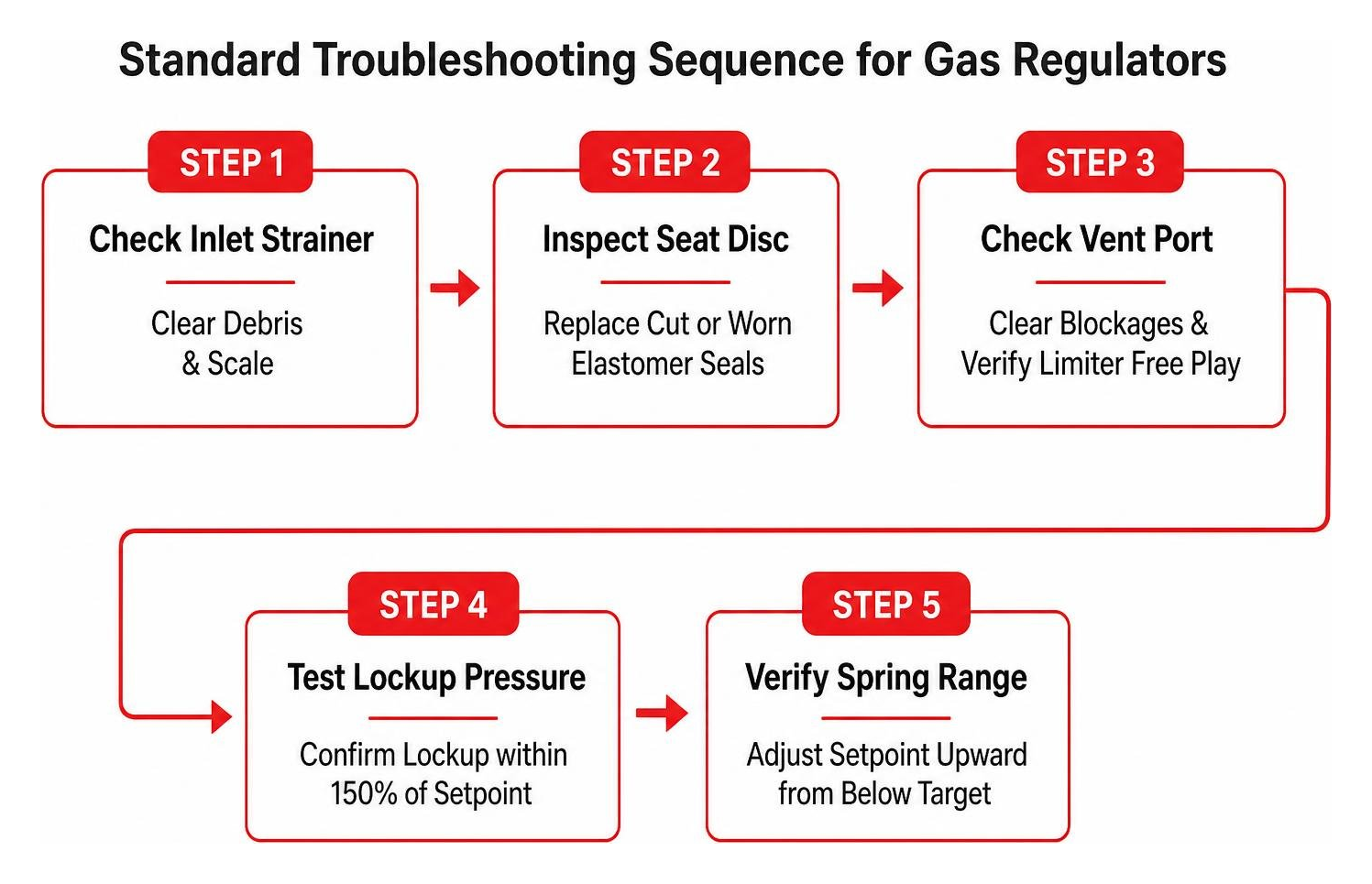
- Pressure Droop During Burner Ignition: If manifold pressure collapses when firing rates step up, check for an undersized orifice, an improperly ranged spring, or a clogged upstream line strainer.
- Lockup Creep / Excessive Lockup Pressure: If downstream pressure slowly climbs above safe thresholds during zero-flow lockup, debris is likely lodged between the valve seat and rubber disc, or the elastomer seat is cut or deformed. Clean or replace the seat disc. If downstream gas valves like the Rheem R 60 101921 81 OEM Gas Valve Natural Gas Gas experience overpressure lockup, shut down supply immediately and inspect the regulator.
- Freezing (Joule-Thomson Effect): When high-pressure gas expands across an orifice, the temperature drops rapidly. If moisture is present in the supply gas, internal icing can freeze the orifice or linkage. Installing upstream gas preheaters or multi-stage pressure step-downs mitigates freezing.
Frequently Asked Questions about Commercial Gas Regulators
What causes a commercial gas regulator to buzz or hum during operation?
Buzzing or humming is caused by high-frequency harmonic vibration in the diaphragm and spring assembly. This occurs when gas velocity across the valve seat is excessively high, when the regulator is oversized for the load, or when turbulent piping geometry exists immediately upstream or downstream. Installing a travel restrictor, selecting a balanced trim, or moving downstream sensing taps stabilizes harmonic flutter.
How often should commercial gas pressure regulators be inspected and tested?
Commercial gas regulators should undergo visual inspection and operational lockup testing at least once per year. Annual testing verifies that lockup pressure does not exceed code limits, vent limiters breathe freely without leakage, and no diaphragm weeping occurs. Industrial process regulators operating on continuous duty or high inlet pressures (>60 PSIG) should be tested semi-annually.
Can natural gas pressure regulators be used for propane systems?
Yes, but only if the internal elastomeric materials are compatible with LP gas and the regulator is recalibrated. Because propane has a higher specific gravity (1.52 vs. 0.60) and operates at higher manifold pressures (typically 10" to 11" w.c.), the regulator must be refitted with an appropriately rated spring and downsized orifice to deliver the proper BTU capacity and maintain lockup control.
Conclusion
A well-designed commercial gas piping system relies on accurate pressure control and safety shut-off systems. Selecting the right commercial gas pressure regulator ensures connected equipment operates reliably, meets local fuel gas codes, and protects building occupants.
At Standard Plumbing Supply, we support mechanical contractors, HVAC professionals, and facility engineers across our branch locations in Utah, Idaho, Wyoming, Colorado, Nevada, Arizona, California, Oregon, and Nebraska. Beyond our extensive inventory of commercial plumbing, HVAC, and gas-piping products, our Vendor-Managed Inventory (VMI) solutions help contractors streamline shop stock, eliminate job-site downtime, and free up operating cash flow.
Whether you are configuring a boiler room manifold, retrofitting a commercial kitchen, or installing safety systems with dedicated Pressure Relief Valves, our team delivers the trusted brands, expert product support, and fast nationwide shipping you need to keep projects on schedule. Reach out to your local Standard Plumbing Supply branch today to review your project specifications and gas regulation requirements.