
Why Your Gas System Needs a Dual Gauge Regulator
Learn why your gas system needs a dual gauge regulator for safety, pressure monitoring, and commercial applications.

Why a Dual Gauge Regulator Is Essential for Safe Gas System Control
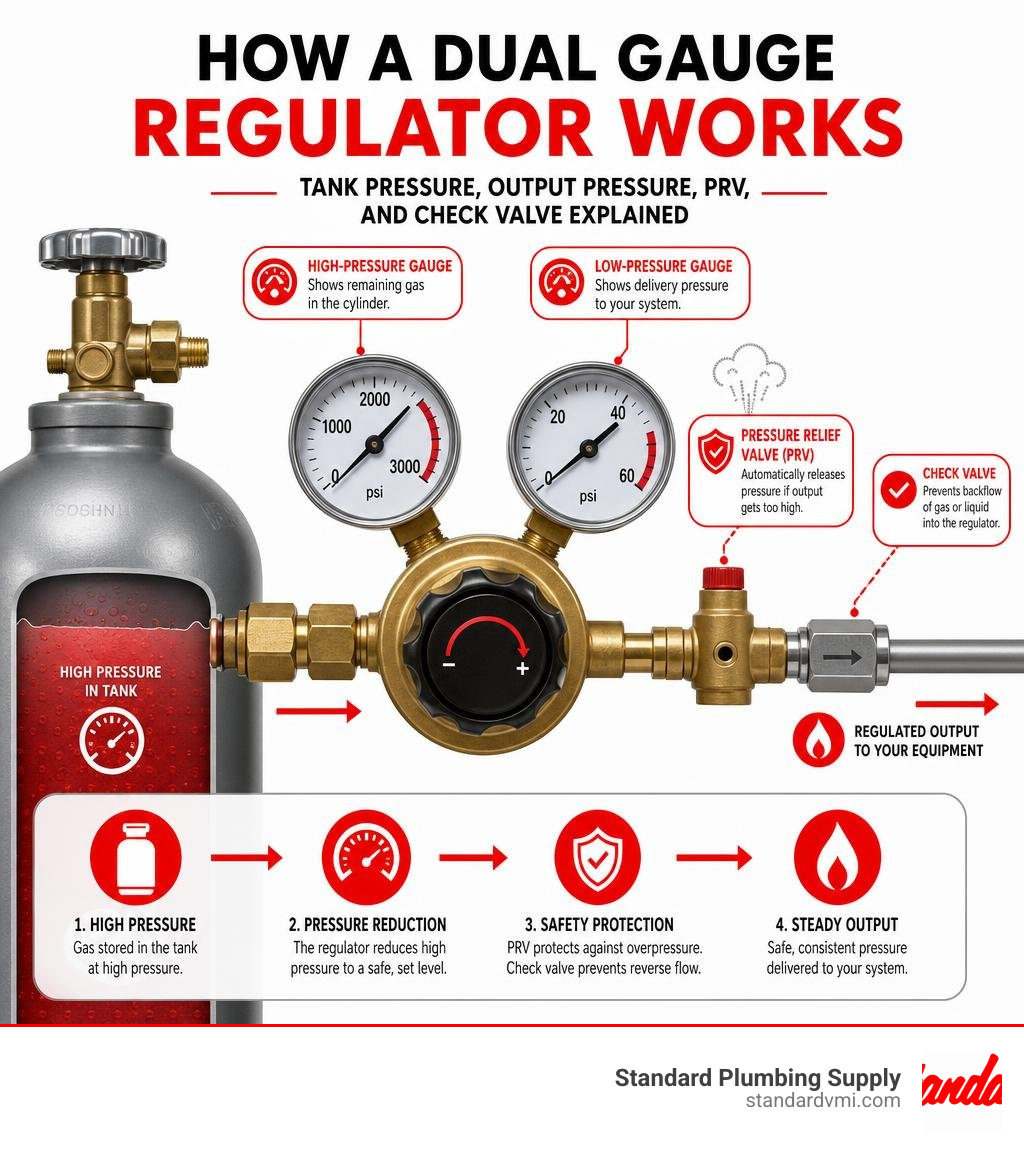
A dual gauge regulator is a pressure control device that shows you two things at once: how much gas is left in your cylinder, and how much pressure is flowing out to your system. Here's a quick breakdown:
| Feature | What It Tells You |
|---|---|
| High-pressure gauge (tank side) | Remaining gas volume in the cylinder (e.g., 0–3,000 PSI) |
| Low-pressure gauge (output side) | Delivery pressure going to your equipment (e.g., 0–60 PSI) |
| Pressure relief valve (PRV) | Auto-releases if output pressure gets dangerously high |
| Check valve | Stops liquid or gas from flowing backward into the regulator |
In plain terms: one gauge watches your supply, the other watches your output. Together, they give you full visibility and control over your gas system — without guesswork.
Running a gas system without that dual-gauge visibility is like driving without a fuel gauge or a speedometer. You don't know if you're about to run out, and you don't know if you're pushing too hard.
For property managers and small business owners, that blind spot causes real problems — unexpected downtime, wasted gas, equipment damage, or worse, a safety incident.
Whether you're managing a commercial draft beer system, an HVAC setup, a welding operation, or an industrial gas distribution line, the right regulator keeps pressure dialed in and your operation running smoothly.
I'm Jacob Reese, Vice President at Standard Plumbing Supply, where I work closely with contractors and facility managers who rely on precision gas control equipment — including the dual gauge regulator — every day across commercial plumbing and HVAC applications. In this guide, I'll walk you through everything you need to know to choose, install, and maintain the right regulator for your system.
What is a Dual Gauge Regulator?
A dual gauge regulator is a specialized mechanical valve designed to take highly pressurized gas from a storage cylinder and step it down to a safe, usable, and consistent working pressure.
But what sets it apart from a single gauge model? To put it simply: a single gauge regulator only shows you the output pressure. It tells you what pressure is flowing into your lines, but leaves you completely in the dark about how much gas is left in your tank. A dual gauge regulator solves this by using two separate dials mounted on a single brass or stainless steel body.
| Feature / Capability | Single Gauge Regulator | Dual Gauge Regulator |
|---|---|---|
| Monitors Output Pressure | Yes (Typically 0–60 PSI) | Yes (Typically 0–60 PSI or 0–100 PSI) |
| Monitors Tank Pressure / Volume | No | Yes (Typically 0–2,000 or 0–3,000 PSI) |
| Prevents Unexpected Gas Depletion | No (You only find out when the tank is empty) | Yes (Real-time tracking of tank volume) |
| Best Suited For | Temporary setups, low-budget systems | Commercial draft, HVAC, welding, industrial lines |
| Gas Flow Control Precision | Moderate | High (Essential for multi-stage monitoring) |
By displaying both metrics simultaneously, a double gauge setup ensures you can maintain perfect gas flow control. You can adjust the output pressure to meet your specific system requirements while keeping an eye on the cylinder's volume so you can order a replacement cylinder long before your system runs dry.
Key Applications in Commercial and Industrial Systems
While homebrewers love them for keeping their kegerators perfectly carbonated, dual gauge regulators are critical workhorses across a wide variety of commercial and industrial applications.
HVAC and Industrial Gas Regulation
In industrial gas distribution and commercial HVAC systems, maintaining a precise gas-to-air ratio is critical for burner efficiency and safety. Industrial systems often utilize ratio regulators and zero governors to manage fuel delivery.
For instance, the Ratio Regulator Zero Governor FRG/6 Series functions by balancing mechanical forces between an adjustable setpoint spring and working diaphragms. It ensures that gas flow to a burner remains in perfect proportion to combustion air flow, preventing startup pressure shocks and optimizing low-fire bypass setups. When dealing with high-pressure gas systems, having dual gauges allows technicians to monitor the massive drop from incoming supply pressure down to the minute water column (in.W.C.) measurements required by industrial burners.
Commercial Beverage and Draft Systems
If you run a restaurant, bar, or coffee shop in Salt Lake City, Utah, or Boise, Idaho, you know that incorrect gas pressure ruins draft beverages. Too little pressure causes flat, lifeless drinks; too much pressure results in a glass full of foam and wasted product.
Different beverages require entirely different gas setups:
- CO2 Systems: Standard draft beers and carbonated sodas rely on CO2. Regulators like the KOMOS Premium Dual Gauge CO2 Regulator - Tool-Free allow for rapid, tool-free manual adjustments to keep carbonation levels precise.
- Nitrogen Systems: Stout beers, nitro cold brew coffee, and draft wines require nitrogen or mixed gases to achieve that signature creamy pour without over-carbonating the liquid.
- Multi-Product Dispensing: If you are running multiple kegs of the same beverage, using a Commercial Grade Dual Gauge Two Product Nitrogen Regulator with a Y-splitter and independent shut-off valves lets you service two kegs at the exact same pressure from a single high-pressure cylinder.
Whether you are carbonating seltzers at a high 30–40 PSI or pouring a delicate stout, a dual gauge setup ensures your delivery pressure stays locked in while monitoring the remaining volume of your high-pressure gas cylinder.
Technical Specifications, Safety Features, and Installation
When choosing a dual gauge regulator for a commercial or industrial environment, you shouldn't just grab the cheapest option on the shelf. You need to look closely at the build quality, pressure limits, and built-in safety mechanisms.
A high-quality regulator should feature:
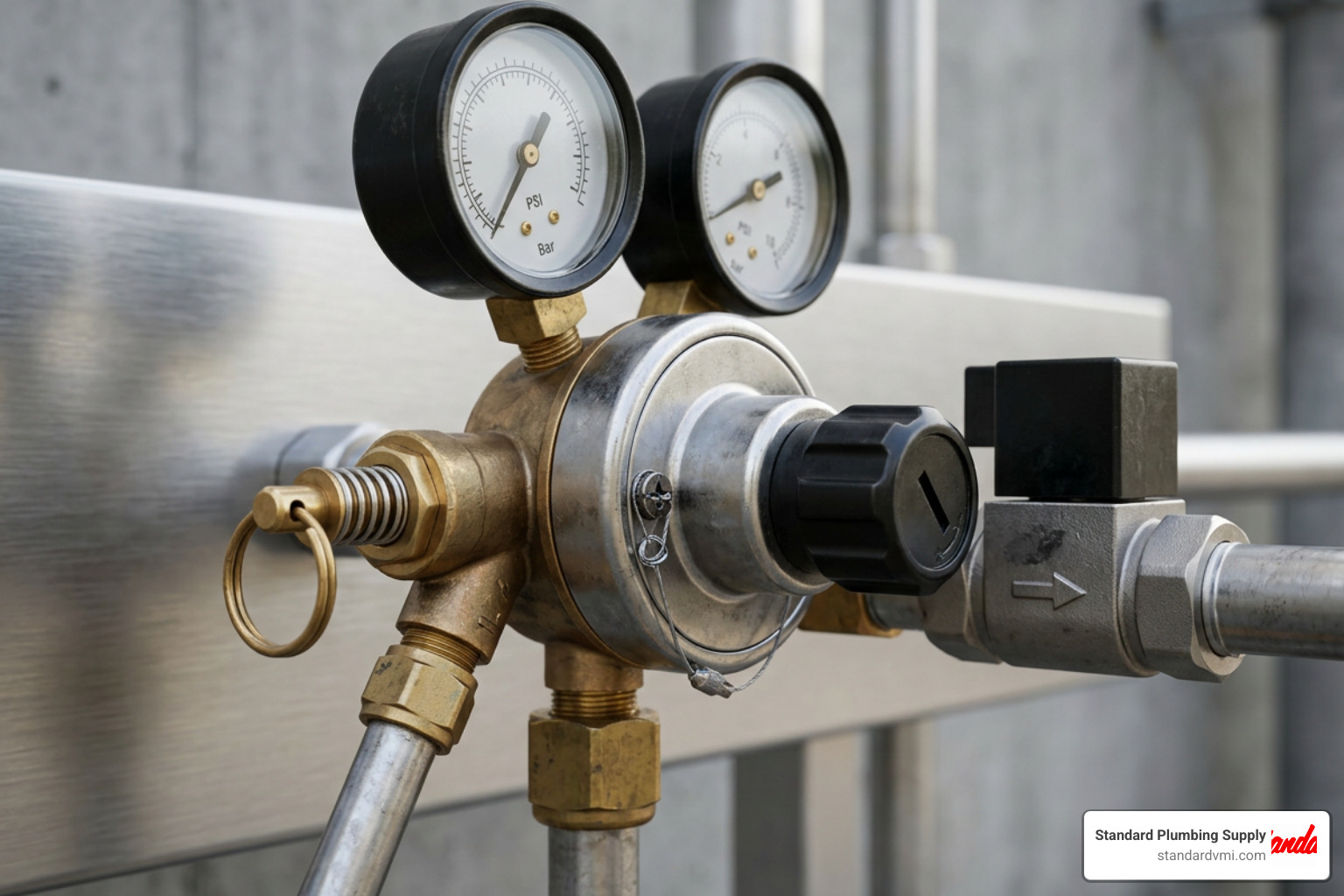
- Integrated Pressure Relief Valve (PRV): An automatic safety valve designed to vent gas safely if the delivery pressure spikes to dangerous levels. For example, the premium KOMOS regulators feature a pull-ring PRV rated to blow off at 65 PSI, while the heavy-duty Premium Plus Dual Gauge CO2 Regulator - Low Pressure - 0-60 PSI auto-vents between 55 and 65 PSI.
- In-Line Check Valve: This is a critical component, especially for draft systems. Because many beverage kegs do not have built-in backflow prevention, an integrated check valve on the regulator's shut-off block physically prevents liquid from backing up into the regulator body and ruining the internal diaphragms.
- Tamper-Evident Adjustment Controls: In commercial environments, unauthorized staff or customers turning pressure knobs can ruin product. Look for regulators with locking nuts or tamper-evident adjustment bonnets to lock your settings in place.
- Sintered Metal Filters: Built-in 10-micron sediment filters in the inlet nipple prevent micro-debris and tank scale from entering the regulator's sensitive internal components.
Choosing a Single-Stage vs. Two-Stage Dual Gauge Regulator
One of the most common questions our team gets at our counter locations in Orem, Utah, or Las Vegas, Nevada, is whether to buy a single-stage or a two-stage regulator.
- Single-Stage Regulators: These drop the cylinder pressure to the output pressure in one single step. They are highly effective and affordable, but they are susceptible to "end-of-tank dump." As the high-pressure cylinder empties, the output pressure can unexpectedly spike, requiring manual readjustment.
- Two-Stage Regulators: These reduce pressure in two distinct steps. The first stage drops the high tank pressure to an intermediate level, and the second stage fine-tunes it for delivery. This design eliminates pressure fluctuations and reduces physical wear on the gauges, making them incredibly stable even in freezing temperatures.
For highly sensitive commercial gas systems, integrated multi-functional blocks like the GasMultiBloc Combined regulator and safety shut-off valves Two-stage function Integrated bypass valve combine filtration, two-stage regulation, and safety shut-offs in a single compact footprint.
Standard Fittings and Connections for a Dual Gauge Regulator
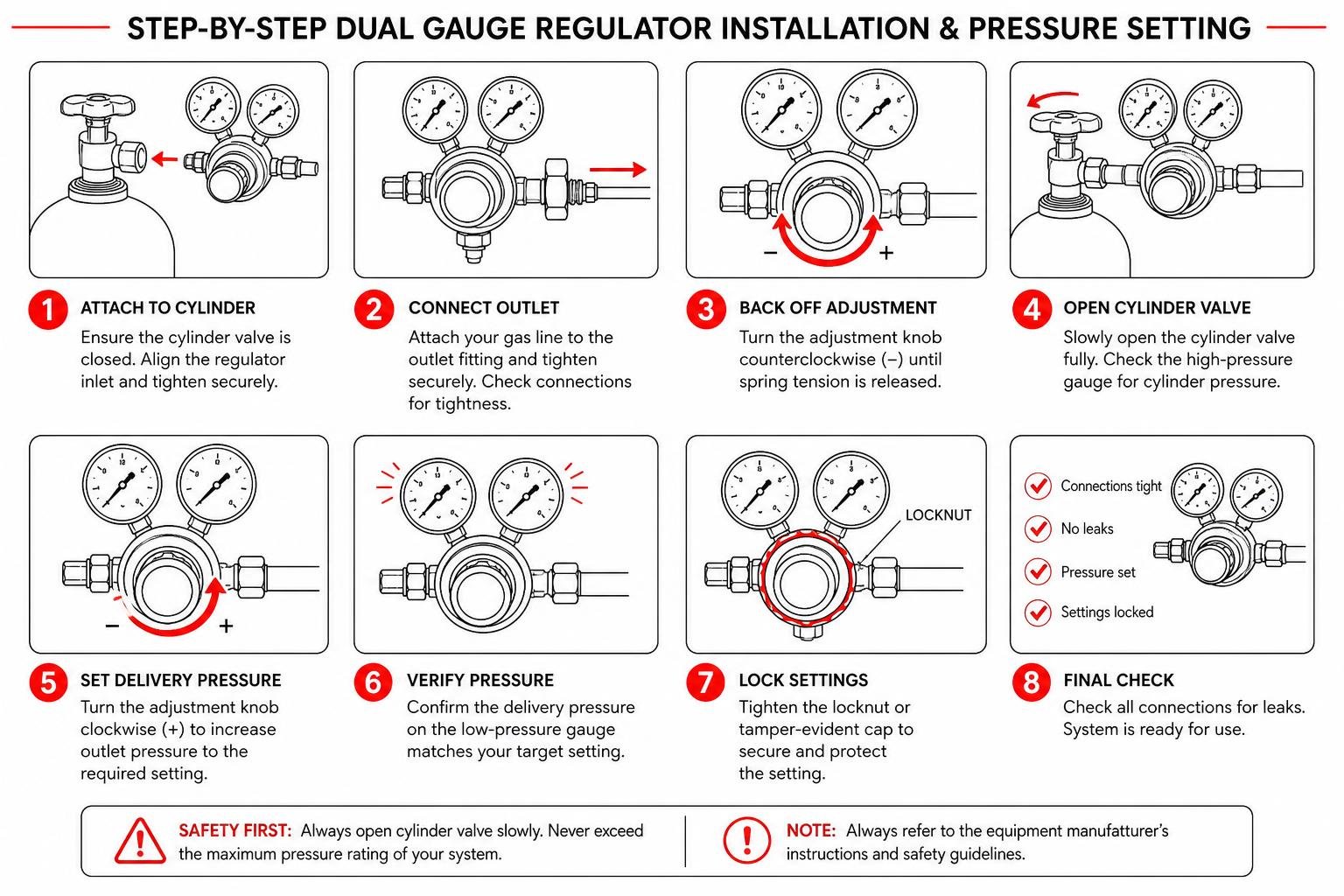
To avoid leaks and ensure a secure fit, you must match your regulator to the correct gas tank and hose connections:
- CGA320: The standard threaded connection for CO2 cylinders in North America.
- CGA580: The standard connection for Nitrogen, Argon, and mixed gas cylinders.
- 1/4" Flare (MFL): A threaded connection that allows you to easily screw on pre-assembled gas lines.
- Duotight Fittings: Modern push-connect fittings designed for quick, tool-free connection to high-performance EVA Barrier tubing.
- Barbed Outlets: Traditional connection points designed for 5/16" or 1/4" inside diameter (I.D.) vinyl pressure tubing, secured with a hose clamp.
Before installing, always verify that your inlet connection matches your gas cylinder. For instance, if you are setting up a welding station in Utah, you can source the correct fittings and high-purity gas at a local supply hub like the Medical Gas & Welding Supply in Salt Lake City, UT - Airgas Store .
Frequently Asked Questions about Gas Regulators
What is the typical PSI range for low-pressure vs. high-pressure gauges?
On a standard dual gauge regulator designed for CO2 or nitrogen beverage dispensing, the gauges serve two very different pressure scales:
- The High-Pressure Gauge (Tank Volume): This gauge typically reads from 0 to 2,000 PSI or 0 to 3,000 PSI. It measures the raw pressure inside the gas cylinder. A full CO2 tank at room temperature usually sits around 800 PSI, while a full nitrogen tank can exceed 2,000 PSI.
- The Low-Pressure Gauge (Delivery Pressure): This gauge monitors the pressure flowing to your equipment, typically reading from 0 to 60 PSI or 0 to 100 PSI. Standard beer dispensing usually happens between 10 and 15 PSI, while carbonating seltzers or rapid burst carbonation can require 30 to 50 PSI.
How do you detect and troubleshoot a failing regulator?
Gas regulators are durable, but mechanical wear, dirt, or freezing can eventually cause them to fail. Here are the most common signs of a failing regulator:
- Pressure Creep: If you set your output pressure to 12 PSI, but it slowly rises on its own over several hours, your internal valve seat is leaking. This is dangerous and can lead to over-pressurization.
- Gas Leaks: If you suspect a leak, mix a small amount of dish soap and water and spray it onto the regulator connections. If bubbles form, you have a leak. Quality regulators like the SKYSHALO Double Gauge Regulator CO2 Regulator Gauge with 0-60PSI ... utilize robust gaskets and heavy-duty brass bodies to minimize leak risks.
- Freezing or Frosting: If gas is drawn from the cylinder too quickly, the regulator body can freeze. This can cause the internal diaphragm to rupture or stick. If you see ice forming on the regulator, slow down your gas flow or switch to a two-stage regulator designed for high flow rates.
- Stuck Gauges: If the needles do not return to zero when the tank is disconnected and fully vented, the internal calibration is broken, and the gauge must be replaced.
What is the difference between CO2 and nitrogen regulators?
You cannot safely use a standard CO2 regulator on a nitrogen tank (or vice versa) without the proper adapters because they operate under completely different physical parameters:
- Connection Standards: CO2 regulators use CGA320 threads, while Nitrogen regulators use CGA580 threads. This physical difference prevents dangerous mix-ups, as nitrogen cylinders operate at much higher pressures than CO2 tanks.
- Pressure Capacity: Because nitrogen is a compressed gas (unlike CO2, which is stored as a liquid under pressure), nitrogen cylinders hold much higher pressures (up to 2,500+ PSI). A nitrogen-specific regulator is built with heavier internal components to handle this extreme stress safely.
Conclusion
A high-quality dual gauge regulator is the unsung hero of any efficient gas system. It takes the guesswork out of gas management, protects your downstream equipment from dangerous pressure spikes, and ensures you never run out of gas in the middle of a busy shift.
At Standard Plumbing Supply, we carry a wide selection of commercial-grade regulators, fittings, and gas control equipment from the industry's most trusted brands. Whether you need a single unit for a local commercial project or a complete inventory solution for your mechanical contracting business, we have you covered.
With locations spanning Utah, Idaho, Wyoming, Colorado, Oregon, California, Arizona, Nevada, and Nebraska, we provide expert local counter support, trusted brands, and fast nationwide shipping to keep your jobs moving forward.
Managing a large volume of gas fittings, regulators, and plumbing inventory? We can help you eliminate stockouts and free up cash flow with our customized vendor-managed inventory (VMI) services.
Optimize your inventory with Standard Plumbing Supply VMI solutions