
A – Z Guide to Comparing Surge Protection Plugs
Learn how a surge protection plug safeguards tools and electronics from voltage spikes, with tips on joules, ratings, and safe use.

Understanding Surge Protectors vs. Standard Power Strips
It is remarkably easy to confuse a basic power strip with a true surge protector. They often share the same rectangular plastic profile, long cord, and row of outlets. However, plugging valuable equipment into a standard power strip provides zero defense against transient voltage. A plain power strip is simply an extension cord with multiple receptacles. It expands your physical access to electricity, but every voltage spike entering that strip passes directly into your connected hardware.
A certified surge protector actively monitors incoming line voltage. When transient voltage spikes exceed normal thresholds—typically 120 volts in standard North American circuits—the surge protective device clamps the excess voltage and diverts it away from sensitive electronics. True surge protection plugs must conform to rigorous testing benchmarks, specifically the UL 1449 safety standard. This listing guarantees the device can safely handle transient overvoltages without creating a fire hazard.
Beyond raw spike suppression, high-grade units often provide electromagnetic interference (EMI) and radio frequency interference (RFI) line noise suppression. Electrical noise created by nearby motorized appliances can introduce hums, data corruption, and micro-faults in sensitive microprocessors.
To evaluate your facility or workstation needs, review the primary distinctions between everyday power management devices:
| Device Type | Primary Function | Surge Suppression | Noise Filtration | Battery Backup |
|---|---|---|---|---|
| Standard Power Strip | Outlet multiplication | None | None | None |
| Surge Protector | Clamps transient voltage spikes | Yes (MOV-based) | Common (EMI/RFI) | None |
| Power Conditioner | Cleans dirty power and sags/swells | Moderate to High | High (Isolated Banks) | None |
| Uninterruptible Power Supply (UPS) | Emergency runtime and surge defense | Yes | High | Yes (Internal Battery) |
Anatomy and Internal Components of a Surge Protection Plug
Inside a certified surge protection plug, several core components work in tandem to intercept dangerous electrical spikes in less than a single nanosecond:
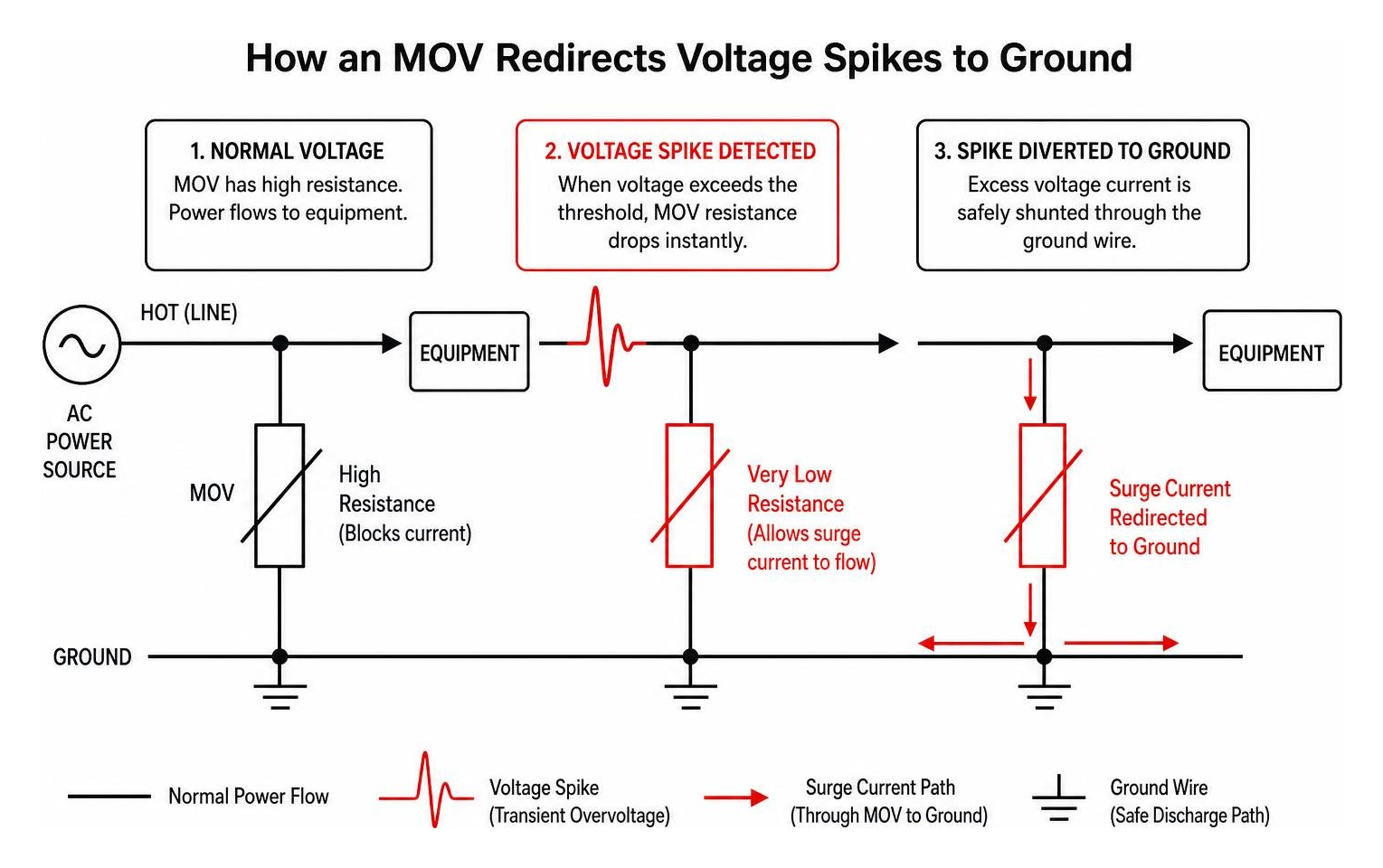
- Metal Oxide Varistors (MOVs): The primary line of defense. An MOV acts as a pressure-sensitive valve. Under normal 120V conditions, it exhibits high electrical resistance, allowing power to flow straight to your equipment. When a voltage spike strikes, its resistance drops almost instantly, diverting excessive current harmlessly through the ground wire.
- Thermal Fuses: High-energy surges can generate extreme heat within an MOV. Integrated thermal fuses disconnect the MOV if it overheats, preventing internal combustion and eliminating household fire hazards.
- Gas Discharge Tubes (GDTs): Often paired alongside MOVs in heavy-duty or industrial designs. GDTs utilize an inert gas contained between two electrodes to conduct heavy surge currents safely to ground during major transient events.
Every time an MOV absorbs a spike, its internal chemistry degrades slightly. This gradual wear is why high-capacity configurations—such as a Protect It! 6-Outlet Surge Protector, 6 ft. Cord, 1200 Joules, 20W PD Charging, 2 USB Ports, Black Housing—are engineered with 1,200 joules of absorption and resettable 15A circuit breakers to maintain safety across continuous commercial use.
Internal vs. External Causes of Electrical Spikes
While dramatic lightning strikes capture attention, industry data reveals that up to 80% of all electrical surges originate inside the building. These internal spikes occur during regular daily operations when inductive loads switch on and off.
High-draw inductive equipment—such as HVAC compressors, motorized drain cleaners, sump pumps, and heavy refrigeration units—requires significant current to start their motors. When these motors cycle off, the sudden collapse of their magnetic field dumps thousands of volts back into the building's electrical wiring. Over time, these frequent, microsecond spikes degrade electronic circuit boards in modern tools, diagnostic monitors, and HVAC system controllers.
External surges, meanwhile, stem from utility grid switching, power restoration after a storm blackout, or nearby lightning events. These external high-energy transients can send thousands of volts rushing through power, data, and coaxial lines simultaneously, destroying unshielded equipment in an instant.
How to Choose the Right Surge Protection Plug for Sensitive Equipment
Selecting the appropriate unit requires matching the technical specifications of the surge protector to the vulnerability and value of your equipment.

When evaluating models, look for these critical performance metrics:
- Joule Rating: The total cumulative energy the protector can absorb over its operating lifetime before its internal components wear out. A higher number equals longer, more robust protection.
- Clamping Voltage (Let-Through Voltage): The voltage threshold that triggers the MOVs to start diverting power. Look for UL 1449 ratings of 330V, 400V, or 500V. A 330V rating provides the tightest safety window for sensitive electronics.
- Response Time: How quickly the clamping circuitry reacts. Quality units respond in less than 1 nanosecond (<1 ns).
- Isolated Filter Banks: Advanced models isolate outlet pairs into independent banks. This stops noise and transient spikes generated by a heavy tool plugged into Outlet 1 from bleeding over to sensitive diagnostic gear plugged into Outlet 2.
Compact point-of-use units, such as the direct plug-in Protect It! 1-Outlet Surge Protector, Direct Plug In, 1080 Joules, 2.4A USB Charger, are ideal for safeguarding isolated items like single diagnostic monitors or battery charging stations without running long cables. For multi-device field setups, a Protect It! 3-Outlet Surge Protector, Direct Plug In, 540 Joules, 2.1 A USB Charger combines a compact footprint with baseline surge absorption for light electronics.
Matching Joule Ratings and Load Capacities to Device Categories
Never rely on a one-size-fits-all approach. Sensitive computer microchips require substantially more absorption capacity than simple resistive loads like basic incandescent task lights:
- Entry-Level (300J – 900J): Suitable for basic workshop task lamps, small power tool battery chargers, or standard shop radios. High-performance industrial options like the Isobar 4-Outlet 230V Surge Protector, 6 ft. (1.83 m) Cord with Right-Angle Plug, 330 Joules, Metal Housing pair specialized isolated noise filtration with rugged metal enclosures for harsh shop environments.
- Mid-Tier (1,000J – 2,000J): Essential for office routers, network switches, smart plumbing cameras, and office desktop monitors.
- High-Capacity (2,000J – 4,000J+): Required for critical diagnostic computers, main server racks, expensive point-of-sale systems, and sensitive HVAC controller boards. A unit like the Protect It! 7-Outlet Surge Protector, 7 ft. Cord with Right-Angle Plug, 2160 Joules, Diagnostic LEDs, Light Gray Housing delivers 2,160 joules of suppression across 7 outlets, safeguarding high-draw office setups from commercial utility fluctuations.
Regardless of the joule rating, standard commercial plugs are limited to 15 amps (1,800 watts at 120 volts). Even if a power strip features 12 individual outlets, you cannot safely run multiple continuous high-draw tools simultaneously without tripping the integrated circuit breaker.
Evaluating Diagnostic LEDs and Connected Equipment Warranties
A quality surge protection plug should feature dual diagnostic LEDs on its housing:
- "Protected" (or "Protection Working") LED: Confirms the internal MOVs are operational. If this light goes out, your strip has absorbed its maximum joule capacity and now functions only as an unshielded power strip.
- "Grounded" LED: Confirms the wall receptacle has a verified low-resistance path to the building ground. If this LED remains dark, the protector cannot safely shunt voltage spikes away from your gear.
Many reputable manufacturers back their hardware with a Connected Equipment Warranty (CEW), covering repair or replacement costs ranging from $5,000 to $75,000 or more if a surge bypasses an operational unit. However, read the fine print carefully: CEWs universally require the unit to have been plugged into a properly grounded 3-prong outlet without intermediate extension cords or daisy chains.
Safe Operation, Maintenance, and Common Mistakes to Avoid
Even the highest-rated surge protector can fail or create fire hazards if deployed improperly in a warehouse, mechanical room, or job trailer.

Avoid these common operational pitfalls:
- Daisy-Chaining: Never plug one surge protector or power strip into another. Daisy-chaining creates excessive electrical resistance, can bypass circuit breaker safeguards, violates OSHA and National Electrical Code (NEC) standards, and immediately voids your manufacturer warranty.
- Extension Cord Pairing: Do not plug a surge protector into a light-duty extension cord, or vice versa. The added wire length increases voltage drop, generates heat under continuous loads, and can prevent thermal protection components from reacting quickly to spikes.
- High-Draw Heating Appliances: Space heaters, high-wattage heat guns, and commercial coffee makers draw 1,200 to 1,500 watts continuously. Plugging them into a shared surge strip alongside sensitive electronics will quickly overload the 15A internal breaker and subject neighboring equipment to severe thermal strain.
- GFCI Interactivity: Plugging a surge protector into a Ground Fault Circuit Interrupter (GFCI) outlet is completely safe. However, if the GFCI trips due to moisture or a minor ground fault, power will instantly cut to everything downstream.
The Risk of Using Ungrounded Outlets
A surge protector relies directly on the circuit's ground wire. When an MOV clamps excess voltage, it shunts the destructive surge current along the neutral-to-ground or hot-to-ground pathway.
If you use a "cheater plug" adapter to insert a 3-prong surge protector into an ungrounded 2-prong wall receptacle, the surge protector cannot do its job. With nowhere for the diverted energy to escape, the voltage spike remains trapped on the line, flashing directly into your connected tools or computer boards. Operating on ungrounded circuits eliminates surge suppression and poses severe electrical shock hazards to technicians.
How to Tell When Your Surge Protection Plug Needs Replacement
Surge protection plugs do not last forever. In a busy shop or commercial setting, plan to inspect and replace units according to these rules:
- The 3-to-5-Year Threshold: Because everyday line noise and minor internal motor surges degrade MOVs continuously, a unit that has been in service for 3 to 5 years has significantly diminished suppression capacity—even if no major storm occurred.
- Extinguished "Protected" Light: If the status LED is dark, replace the unit immediately. It is no longer protecting your devices.
- Audible Buzzing or Humming: Any physical buzzing indicates an internal component failure, electrical arcing, or severe thermal fatigue. Unplug it immediately.
- Physical Discoloration or Heat: Warped plastic casing or scorching near the receptacle slots indicates severe overheating.
Frequently Asked Questions About Surge Protection
Can a surge protector handle a direct lightning strike?
No point-of-use plug-in surge protector can absorb a direct lightning strike, which can carry over 100,000 amperes and hundreds of millions of volts. However, point-of-use units excels at absorbing the indirect, residual surges that travel along utility lines when lightning strikes nearby. For complete facility defense, install Type 1 or Type 2 whole-panel surge protective devices at your main electrical service entrance, paired with point-of-use plugs at individual workstations.
Why does my surge protector trip the circuit breaker?
Surge protectors do not trip due to high voltage; they trip due to excessive current (amperage). Most units incorporate a 15-amp thermal circuit breaker. If the combined wattage of your connected tools, battery banks, or heaters exceeds 1,800 watts (15A × 120V), the internal breaker trips to prevent electrical wiring inside your walls from overheating and catching fire.
Can I use a surge protector on an ungrounded two-prong outlet?
While the unit will still deliver power to your devices through the hot and neutral prongs, its surge suppression capability is largely disabled. Without a low-resistance path to earth ground, the MOVs cannot safely divert transient voltage spikes. To achieve true surge protection, have a licensed electrician upgrade the outlet with a verified ground wire or install a properly grounded subpanel.
Building a Resilient Power Strategy for Your Tools and Equipment
Safeguarding valuable shop tools, HVAC testing equipment, and office computers from unpredictable voltage spikes requires deliberate planning. By deploying UL 1449-certified surge protection plugs with appropriate joule capacities, verifying outlet ground status, and systematically replacing aging units every 3 to 5 years, facility managers and contractors can prevent costly hardware failures and jobsite downtime.
At Standard Plumbing Supply, we know that equipment reliability is critical to your bottom line. Whether you are outfitting a regional service fleet with professional drain cleaning tools, maintaining complex commercial HVAC systems, or stocking mechanical rooms across our branch locations in Utah, Idaho, Wyoming, Colorado, Nevada, California, Oregon, Arizona, and Nebraska, we provide the trusted brands and expert support you need.
Explore our full inventory of commercial-grade tools, plumbing systems, and jobsite equipment, and ask about our Vendor-Managed Inventory (VMI) solutions to keep your operations running smoothly, safely, and efficiently.