
A Quick Start Guide to Type L Copper Pipe Specs
Learn Type L copper pipe specs, grades, and applications for plumbing and HVAC projects with this quick start guide.

Why Type L Copper Pipe Is a Reliable Mid-Grade Choice
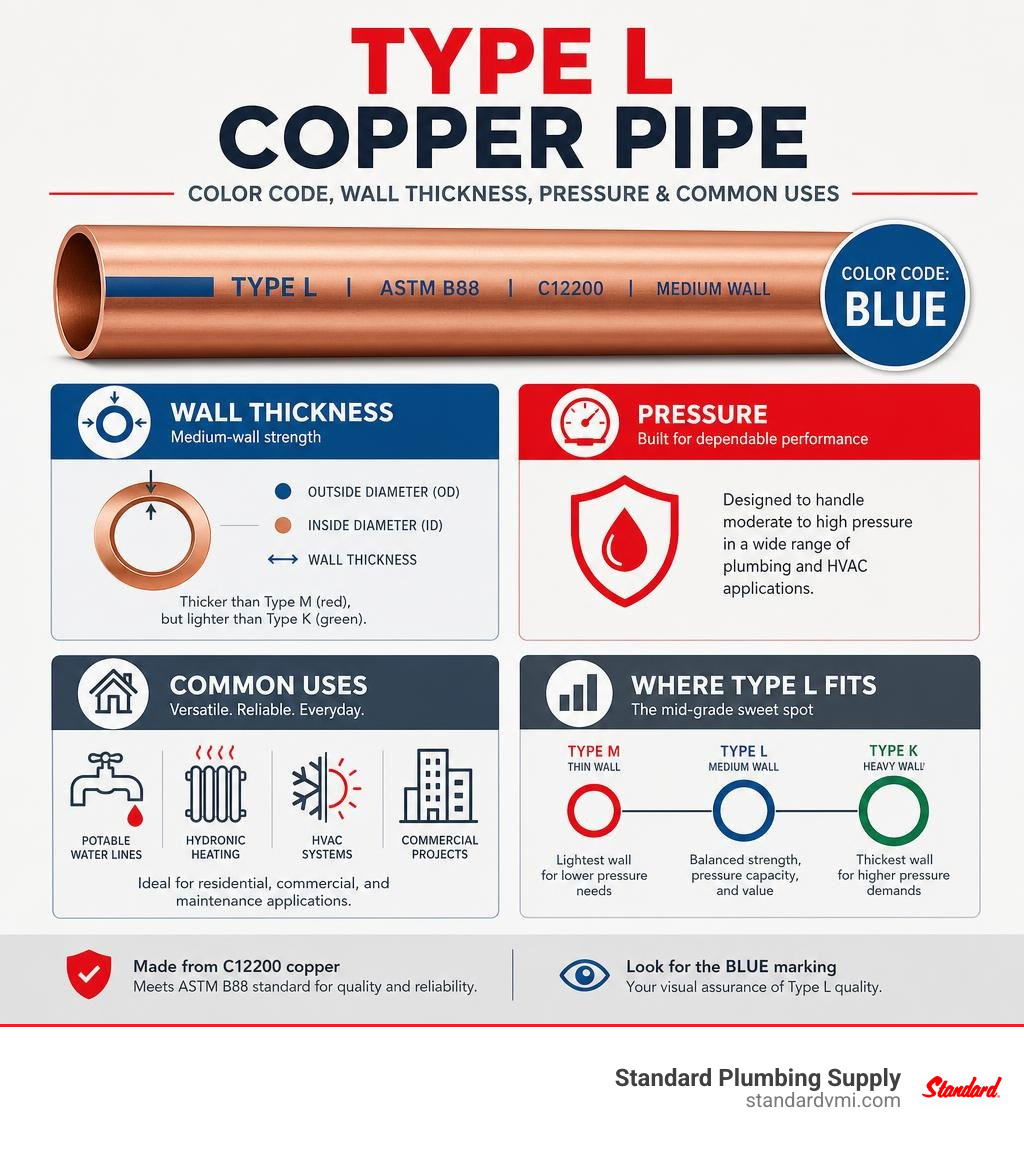
Type L copper pipe is ASTM B88 medium-wall copper tubing, identified by a blue marking. It is thicker and more pressure-resistant than Type M, but lighter and usually less costly than Type K. That balance makes it a common choice for potable-water lines, hydronic heating, HVAC work, and many commercial maintenance projects.
For example, 1-inch Type L has a 1.125-inch outside diameter, a 1.025-inch inside diameter, and a 0.050-inch wall. It is made from C12200 copper and is available as rigid drawn tube or bendable annealed coil. Before ordering, confirm the size, temper, working pressure, temperature, and local code requirements.
For property managers and small contractors, choosing the correct copper grade can prevent costly repeat repairs and avoid stocking material that does not fit the job. Standard Plumbing Supply helps teams source Type L tubing, compatible fittings, and HVAC and plumbing materials with expert support and fast nationwide shipping.
I am Jacob Reese, Vice President at Standard Plumbing Supply, with experience supporting plumbing and HVAC contractors through product selection, inventory planning, and reliable supply. In the sections ahead, I will break down the Type L copper pipe specs that matter most when you are buying, installing, or maintaining a system.
Technical Specifications of Type L Copper Pipe
Manufactured under the rigorous standard specification ASTM B88, Type L seamless copper water tube is crafted from standard UNS C12200 phosphorus-deoxidized, high-residual-phosphorus (DHP) copper. Understanding copper alloy C12200 properties helps explain why this material performs so reliably: it delivers a minimum copper content of 99.9%, provides excellent thermal conductivity (around 401 W/m·K), exhibits remarkable corrosion resistance in domestic water, and offers a yield strength of approximately 57 ksi (393 MPa).
To prevent confusion on busy job sites, manufacturers apply an unmistakable blue incised or ink-printed marking along the entire length of the tube. This color code gives building inspectors and installation crews immediate visual confirmation that the tube is medium-wall Type L rather than thin-wall Type M (red) or heavy-wall Type K (green).
Nominal sizes for Type L range from 1/4 inch up to 12 inches. Wall thicknesses scale proportionally to size, running from 0.030 inches on a 1/4-inch tube up to 0.280 inches on large 12-inch commercial distribution lines. Weight per linear foot correspondingly scales from a lightweight 0.126 lb/ft for 1/4-inch pipe to 40.4 lb/ft for heavy 12-inch main headers. Type L tubing is rated for operating temperatures up to 400°F, though working pressure ratings must be derated as fluid temperatures climb.
| Nominal Pipe Size (NPS) | Outside Diameter (OD, in.) | Inside Diameter (ID, in.) | Wall Thickness (in.) | Weight (lb/ft) | Drawn Max Working Pressure @ 100°F (psi) | Annealed Max Working Pressure @ 100°F (psi) |
|---|---|---|---|---|---|---|
| 1/4" | 0.375 | 0.315 | 0.030 | 0.126 | 1,569 | 912 |
| 3/8" | 0.500 | 0.430 | 0.035 | 0.198 | 1,328 | 772 |
| 1/2" | 0.625 | 0.545 | 0.040 | 0.285 | 1,208 | 702 |
| 3/4" | 0.875 | 0.785 | 0.045 | 0.455 | 967 | 562 |
| 1" | 1.125 | 1.025 | 0.050 | 0.655 | 830 | 483 |
| 1-1/4" | 1.375 | 1.265 | 0.055 | 0.884 | 739 | 430 |
| 1-1/2" | 1.625 | 1.505 | 0.060 | 1.140 | 677 | 394 |
| 2" | 2.125 | 1.985 | 0.070 | 1.750 | 600 | 349 |
| 2-1/2" | 2.625 | 2.465 | 0.080 | 2.480 | 550 | 320 |
| 3" | 3.125 | 2.945 | 0.090 | 3.330 | 519 | 302 |
| 4" | 4.125 | 3.905 | 0.110 | 5.380 | 477 | 277 |
| 6" | 6.125 | 5.845 | 0.140 | 10.200 | 431 | 251 |
Dimensional Specs and Ratings for Drawn vs. Annealed Type L Copper Pipe
Type L copper is produced in two distinct tempers: hard-drawn (rigid) and annealed (soft). The manufacturing process for drawn temper cold-works the copper to maximize its tensile strength and stiffness. This makes drawn pipe ideal for clean, straight plumbing runs suspended in open joists, wall chases, and mechanical rooms. Because drawn copper possesses higher allowable stress (10.3 ksi at temperatures up to 200°F), a 1/4-inch drawn line achieves a maximum working pressure of 1,569 psi at 100°F.
Annealed temper copper undergoes a thermal heat-treatment cycle that softens the metal lattice. This makes the tubing pliable enough to unroll and bend around obstacles without kinks. Soft copper carries an allowable stress rating of 6.0 ksi at 100°F, which delivers an internal working pressure rating of 912 psi for 1/4-inch tube and 483 psi for 1-inch tube. Standard burst pressure ratings for Type L tubing range from 300 to 1,050 psi across normal operational sizing, with ultimate operating safety factors built to accommodate surges up to 2,700 psi depending on system design and wall dimension.
When reviewing ASTM Type L copper pipe specifications, keep in mind how standard lengths are packaged. Drawn hard-temper pipe is supplied in rigid 20-foot straight lengths (as well as convenient shorter lengths for quick repairs), covering diameters from 1/4 inch up to 10 inches and 12 inches. Annealed soft copper is supplied in continuous 60-foot or 100-foot soft coils for nominal sizes up to 1 inch, allowing mechanical installers to make continuous underground runs or long HVAC line-set pulls without hidden intermediate joints.
Comparing Copper Tubing Grades: Type K vs. Type L vs. Type M

When evaluating seamless water tube grades, the primary distinguishing mechanical factor is wall thickness. Outside diameters remain identical across all three grades for a given nominal size (so fittings fit any grade), but the internal wall dimensions differ significantly:
- Type K (Green Code): Features the thickest wall. Designed for harsh environments, heavy underground municipal water service lines, commercial boiler feeds, and high-pressure steam distribution.
- Type L (Blue Code): The balanced mid-wall thickness. Provides robust pressure safety margins, code-compliant interior supply reliability, and excellent longevity under turbulent flow.
- Type M (Red Code): Features the thinnest wall profile. Recommended strictly for light-duty, low-pressure domestic branch lines, vacuum systems, or non-critical heating loops where budgets are tightly constrained and local codes permit.
From a pricing perspective, raw metal content drives the cost. International market averages generally place Type L tubing between $4.00 and $9.00 per linear foot for common commercial branch sizes. Type M is roughly 20% to 30% less expensive up front, while Type K commands a 25% to 40% premium due to its heavier wall.
However, looking strictly at purchase price per foot overlooks life-cycle value. Type M's thin wall provides less metal reserve against velocity-induced erosion corrosion and aggressive acidic water chemistry. Type L delivers an optimal balance between material investment and operational life, routinely exceeding 50 years of trouble-free interior water distribution.
When to Choose Type L Copper Pipe for Plumbing and HVAC Projects
Selecting Type L over Type M or Type K is often dictated by engineering specifications and local building codes. Major municipal codes across regions we serve—from Boise, Idaho and Salt Lake City, Utah to Phoenix, Arizona and Sacramento, California—regularly mandate Type L as the minimum acceptable wall thickness for commercial potable water distribution and multi-family risers.
Type L is particularly well-suited for:
- Pressurized Potable Water Risers & Mains: Handles household supply pressures and dampens hydraulic shockwaves (water hammer) without wall fatigue.
- Hydronic Heating and Chilled-Water Loops: Resists sustained thermal cycling and handles hot-water distribution up to 250°F–400°F depending on operating pressures.
- HVAC and Refrigeration Line Sets: Compatible with standard modern refrigerants like R-410A, propane, CO2, and isobutane when brazed according to industry standards.
- Compressed Air Lines: Provides rigid structure and dependable burst safety margins for shop pneumatic systems where plastic piping poses dangerous shrapnel hazards.
- Solar Thermal Collector Loops: Resists extreme roof-level stagnation temperatures and pressure swings.
Practical Applications and Recommended Joining Methods
Joining Type L copper tubing depends on system pressure, fire-safety regulations on site, and labor requirements. The four primary connection methods include:
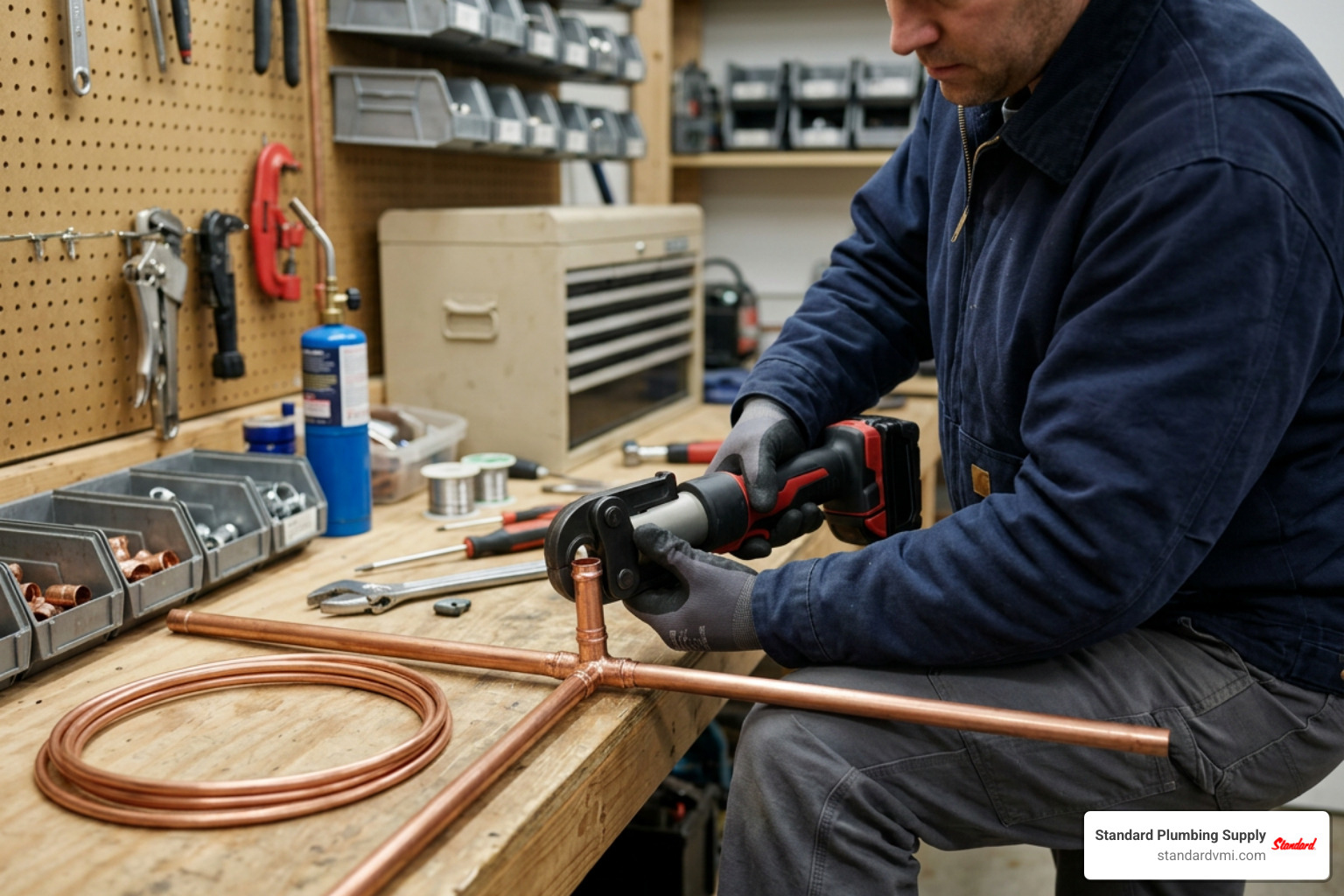
- Sweat Soldering: The traditional standard. Requires cleaning pipe ends, applying lead-free flux, heating the joint with a torch, and feeding lead-free solder alloy into the capillary space.
- Brazing: Uses high-temperature copper-phosphorus (BCuP) or silver-bearing filler metals with torch heat exceeding 1,100°F. Essential for medical gas, refrigeration, and high-pressure HVAC systems.
- Press-Connect Fittings: Modern flameless joining utilizing an engineered EPDM or HNBR O-ring compressed by a calibrated mechanical press tool. Using components like the Legend 90 Deg Copper Press Elbow 2 in. or the ProPress 45 Deg Copper Street Elbow 1/2 in. slashes installation time, eliminates hot-work fire permits, and creates durable, leak-tight joints rated up to 200–300 psi.
- Push-to-Connect / Flare Fittings: Excellent for tight service retrofits, temporary bypasses, or transitions without specialized pressing tools.
Adapters, Reducers, and System Transitions
Complex commercial mechanical layouts require transitioning between nominal pipe diameters, joining different piping materials, and navigating tight wall cavities. When stepping down pipe diameters on supply headers, utilizing a properly sized Streamline Wrot Copper Fitting Reducer 3/4 x 1/2 in. ensures laminar fluid flow without excessive turbulence. For contractors standardizing on flameless mechanical connections, a Legend Copper Press Reducing Coupling 1-1/4 x 3/4 in. creates a strong transition in seconds.
When tying existing copper lines into modern flexible polymer distribution runs, mechanical crews rely on components such as the 1/2 in. Copper Female Sweat x 1/2 in. PEX Adapter to bridge copper mains to cross-linked polyethylene branches safely.
To ensure peak longevity from any Type L copper installation, follow these critical maintenance and commissioning best practices:
- Deburr and Ream Every Cut: Always ream the inner pipe circumference after cutting with a wheel cutter. Internal ridges cause localized turbulence that erodes copper walls over time.
- System Flushing: Thoroughly flush all newly installed lines with potable water to clear metal shavings, excess flux residue, and foreign particulates that cause localized pitting corrosion.
- Thermal Insulation: Insulate hot-water and chilled-water copper lines with closed-cell elastomeric or fiberglass insulation to minimize heat loss, prevent condensation dripping, and protect against freezing in unconditioned spaces.
Frequently Asked Questions About Copper Tubing
Should I use Type L or Type M for domestic water lines?
For long-term reliability and code compliance, Type L is the preferred choice. While Type M carries a lower upfront material price, its thinner wall makes it more vulnerable to aggressive water chemistry, micro-pitting, and pressure spikes from fast-closing solenoid valves. Furthermore, many commercial municipal plumbing codes explicitly require Type L for all pressurized interior domestic water distribution.
Is Type L tubing approved for compressed air lines?
Yes, drawn (hard) Type L copper tubing is widely approved and recommended for compressed air systems. Unlike PVC, which can shatter into dangerous shards under air pressure, Type L copper safely handles pneumatic surges and operating pressures well above typical 90–150 psi shop requirements. Annealed (soft) coil should generally be avoided for long pneumatic runs to prevent sagging and moisture trap pockets.
What is the difference between drawn and annealed copper tube?
Drawn copper is rigid, cold-formed tubing sold in straight sticks (typically 20 feet) that offers high tensile strength and higher internal working pressure ratings. Annealed copper is thermally heat-treated to restore flexibility, allowing it to be bent by hand or with mechanical benders and sold in continuous rolls. While annealed tubing simplifies underground and behind-wall pulls, its allowable working pressure is lower than that of rigid drawn pipe of the same nominal size.
Conclusion
Type L copper pipe remains the plumbing and mechanical industry's most dependable mid-grade workhorse. Delivering an ideal blend of robust wall thickness, high operating pressure tolerance, and broad compatibility with modern press and solder fittings, it is engineered to serve commercial and residential facilities for decades.
At Standard Plumbing Supply, we stock a complete inventory of ASTM B88 drawn sticks and coils, including Type L soft coil copper pipe, along with wrot fittings, press valves, and installation tools. With branches across Utah, Idaho, Wyoming, Colorado, Nevada, California, Arizona, and Oregon, our team delivers expert technical support, trusted industry brands, and fast nationwide shipping. For commercial contractors and multi-family maintenance teams looking to streamline stock levels and free up operating cash flow, our tailored Vendor-Managed Inventory (VMI) solutions ensure you always have the right pipe and fittings on hand when the job demands them.