
Everything You Need to Know About the 100 PSI Relief Valve
Learn how a 100 psi relief valve protects well systems, heaters, and compressors from overpressure damage and failure.

What a 100 PSI Relief Valve Does
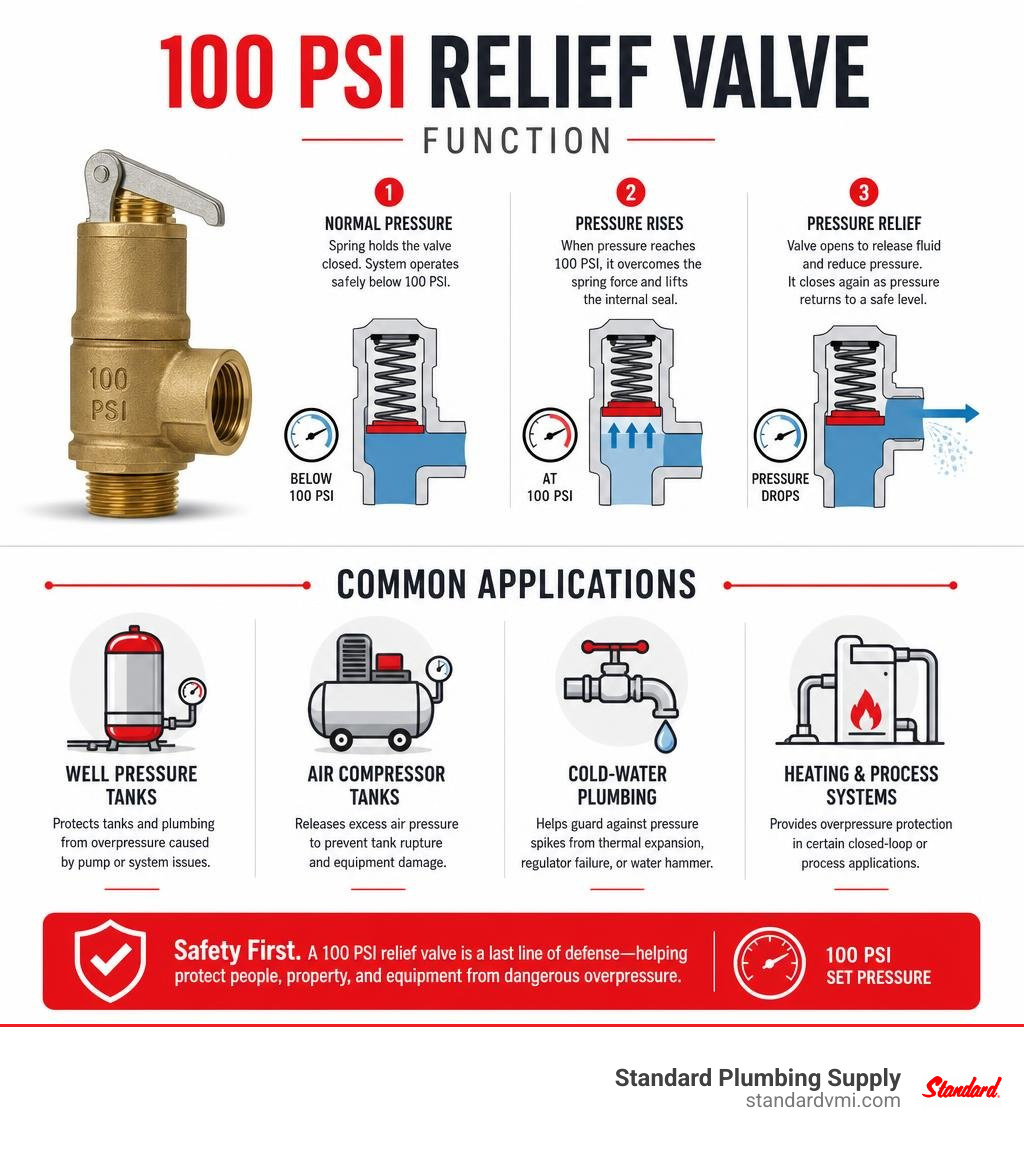
A 100 psi relief valve is a safety device that opens to release water, air, or another approved fluid when system pressure reaches about 100 pounds per square inch (PSI). Its main job is to prevent excess pressure from damaging pipes, tanks, pumps, compressors, or connected equipment, then close again as pressure returns to a safer level.
- Set pressure: 100 PSI, or about 6.9 bar
- Common uses: Well pressure tanks, cold-water plumbing, air compressor tanks, and certain heating or process systems
- How it works: A spring holds the valve closed until pressure overcomes the spring force and lifts the internal seal
- Important distinction: A pressure-only valve protects against high pressure; a water heater generally needs a temperature-and-pressure (T&P) valve that also opens at excessive temperature
For property managers and small business owners, this is not a minor fitting. It is a last line of defense when a pressure switch fails, a pump runs too long, thermal expansion raises water pressure, or a regulator leaks downstream. The right valve must match the system's media, set pressure, discharge capacity, thread size, material, and applicable code.
Standard Plumbing Supply helps contractors and maintenance teams source dependable plumbing, HVAC, and irrigation components with product support and fast shipping when repairs cannot wait.
I am Jacob Reese, Vice President at Standard Plumbing Supply, with experience supporting contractors and property teams that need the right 100 psi relief valve and related system parts without tying up cash in excess inventory. In this guide, I will break down what to look for before selecting, installing, or replacing one.
Fundamentals of a 100 PSI Relief Valve and How It Works
To understand how a 100 psi relief valve safeguards plumbing and fluid power installations, we first need to take a look at its mechanical core. A standard direct-operated pressure relief valve relies on a mechanical balance between internal fluid pressure and a calibrated heavy-duty spring.
Under normal operating conditions—such as a cold-water residential line operating at 40 to 60 PSI—the internal spring pushes down against a disk, poppet, or soft seat elastomer (such as Buna-N, Nitrile, or Viton) to keep the flow path closed. However, if a malfunction occurs and system pressure spikes to the set point pressure of 100 PSI (approximately 6.9 bar), the upward force exerted by the fluid against the valve disc overcomes the downward spring tension.
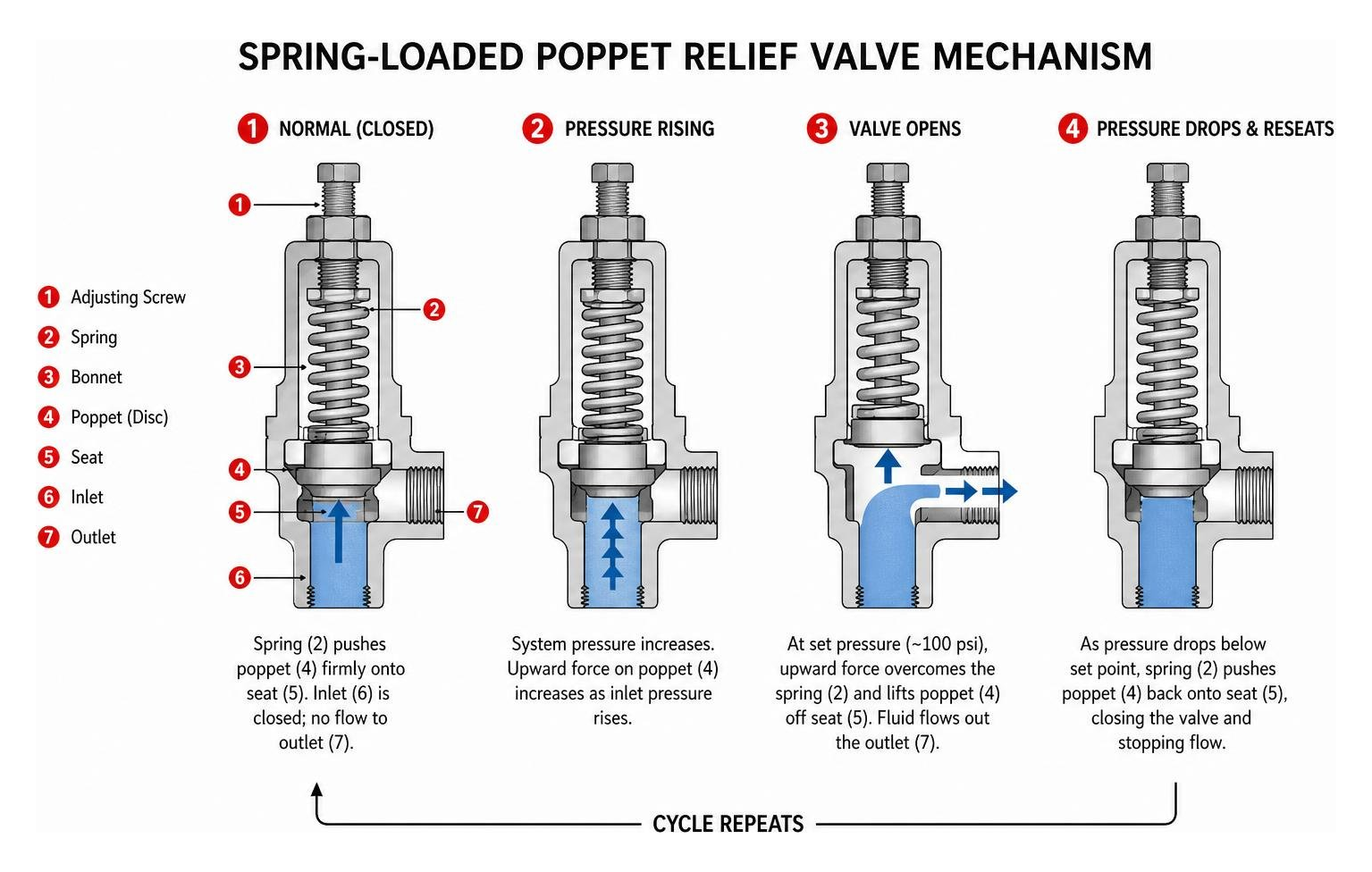
When this opening threshold is reached, the poppet mechanism lifts off its seating surface, opening the discharge port to vent the surplus liquid or gas safely into a drain or atmosphere. As the fluid vents, internal system pressure drops below the set point. The calibrated spring then expands, driving the poppet back onto the seat to automatically reseat the valve and re-establish a leak-tight seal.
Pressure-Only vs. Temperature and Pressure (T&P) Relief Valves
One of the most frequent misapplications we see in the field involves swapping a pressure-only safety valve with a Temperature and Pressure (T&P) relief valve. While both protect pressurized vessels, they serve distinct functions and operate under different mechanisms:
- Pressure-Only Relief Valves: Designed strictly to monitor hydrostatic or pneumatic system pressure. When internal fluid pressure reaches 100 PSI, the mechanical spring compresses to discharge fluid. They do not react to thermal conditions. They are ideal for cold-water well pump tanks, cold distribution lines, and compressed air receiver tanks.
- Temperature and Pressure (T&P) Relief Valves: Designed primarily for hot water supply equipment, storage tanks, and water heaters. In addition to a pressure relief spring set at a threshold like 100 or 150 PSI, a T&P valve incorporates a specialized thermal element (often a 4-inch thermostat probe filled with wax or specialized thermo-bonded element). If the water temperature reaches 210°F (99°C), the thermal element expands to mechanically force the valve open, regardless of whether system pressure has reached 100 PSI. This critical thermal relief function prevents superheated water from flashing into dangerous high-expansion steam inside a closed water heater vessel.
| Feature / Parameter | Pressure-Only Relief Valve | Temperature & Pressure (T&P) Valve |
|---|---|---|
| Primary Trigger | System pressure exceeding set point (e.g., 100 PSI) | High system pressure OR temperature reaching 210°F |
| Internal Components | Calibrated spring, poppet, disc/seat | Calibrated spring, poppet, thermal probe/thermostat |
| Typical Applications | Cold water well tanks, air compressors, pumps | Water heaters, hot water storage tanks, boilers |
| Code Standard | ASME Section VIII, ANSI/NSF 61 | ANSI Z21.22 / CSA 4.4, ASME Section IV |
| Hot Water Protection | Cannot prevent thermal superheating explosions | Provides full thermal expansion & over-temp protection |
Choosing Between Adjustable and Fixed 100 PSI Relief Valve Options
When selecting a 100 psi relief valve, we must also choose between a fixed (non-adjustable) factory setting and an field-adjustable relief range.
- Fixed (Non-Adjustable) Relief Valves: These factory-calibrated valves come pre-set to crack open precisely at 100 PSI. Models like the Boshart RVNB05-100NL 1/2-inch brass valve feature a pre-set accuracy within ±15%, whereas high-precision ASME safety valves like the Control Devices PRV-ST25-0V100 hold a setting accuracy within 3%. Fixed valves are tamper-resistant, making them the preferred choice for residential plumbing codes, well pressure tank setups, and ASME code-stamped vessels where unauthorized field adjustments could compromise safety.
- Adjustable Relief Valves: These models feature an adjustable tension screw, knurled knob, or internal hex key mechanism that allows technicians to tune the cracking pressure within a defined spring calibration window—such as 20 to 100 PSI or 75 to 150 PSI. For instance, specialized 316 stainless steel process valves (like the 1/4" Discover Valve model 102743) are factory-set at 100 PSI but allow field adjustments anywhere between 20 and 100 PSI for system fine-tuning. Adjustable options are widely utilized in pneumatic automation circuits, hydraulic pump bypass loops, and industrial process lines.
Key Applications and System Integration
A 100 psi relief valve acts as an essential safeguard across a broad spectrum of commercial, industrial, and residential systems. Because different fluids exhibit vastly different expansion rates and physical properties, matching the valve to the exact media and application is critical.
Cold Water Well Systems and Storage Tanks
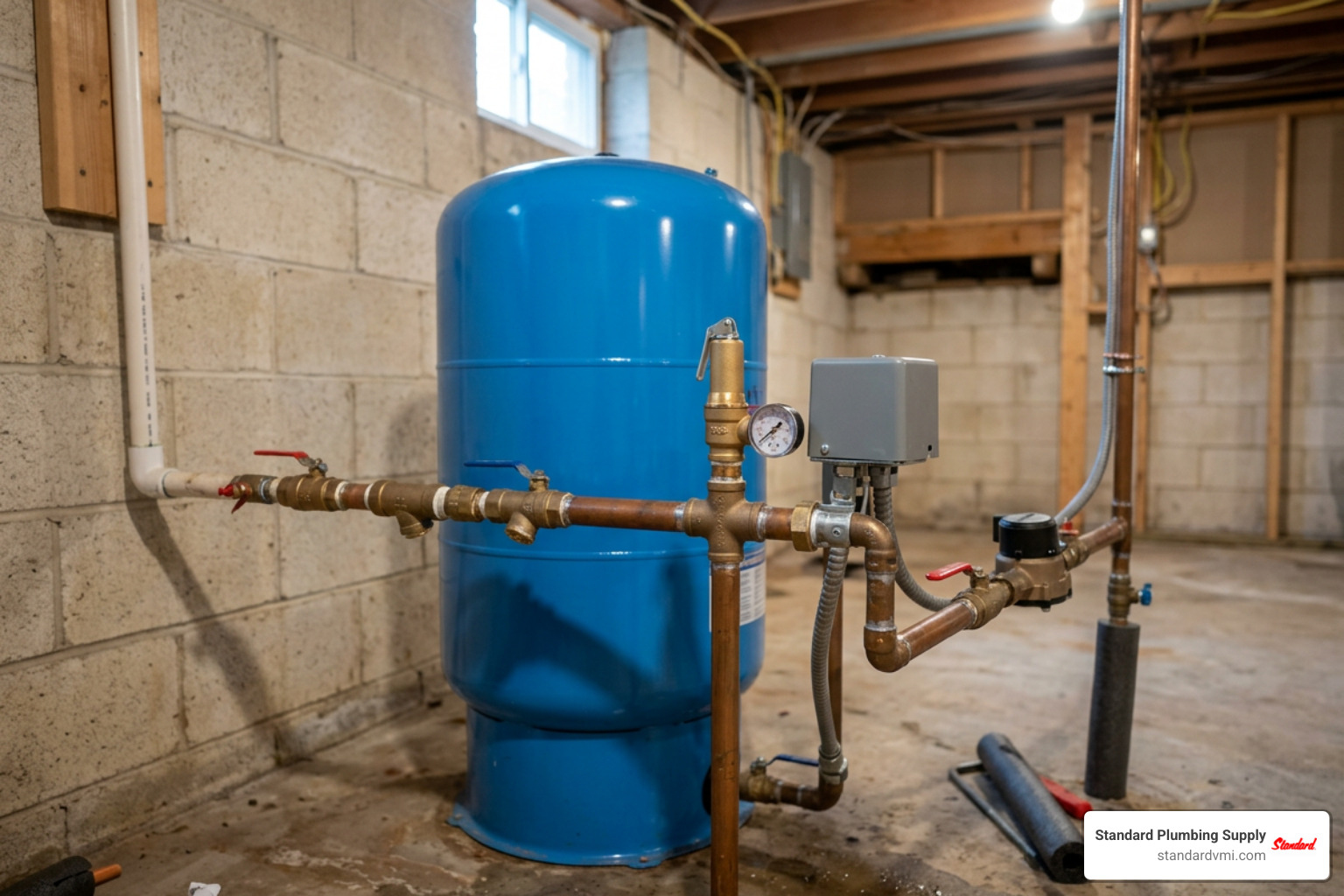
In private well applications, a 100 psi relief valve provides continuous overpressure protection for cold-water distribution piping and hydro-pneumatic well tanks. Standard residential well systems utilize a pressure switch calibrated to cycle the submersible pump on and off at 30/50 PSI or 40/60 PSI.
If contacts on the pressure switch weld together, or if the switch electrical contacts stick shut, the well pump will run continuously. Deep-well submersible pumps can generate hydrostatic pressures exceeding 120 to 150 PSI. Without a reliable safety release valve, this sudden pressure wave can rupture synthetic pressure tank bladders, burst domestic cold-water pipes, or flood homes.
Installing a lead-free brass pressure relief valve—such as the Merrill MFG PRVNL75100 pre-set to 100 PSI—directly onto the well tank tee ensures that any excess pressure above 100 PSI is immediately relieved into a safe floor drain. To explore additional system options for gas and pressure control, check out our insights on different types of gas regulator.
Heating Systems and Air Compressors
In sealed wet heating and hydronic boiler loops, thermal expansion occurs as water heats up. High-capacity sealed pressure relief valves feature high-lift designs to evacuate expanding water efficiently. For instance, the Reliance Valves 100 Series features an outlet connection sized one step larger than the inlet connection (such as a 1/2" FBSP inlet paired with a 3/4" FBSP outlet). This design prevents downstream backpressure buildup and allows high discharge flow rates when pressure surges occur. You can review full design specifications on the official 100 Series High Capacity Sealed PRV | Reliance Valves documentation.
In compressed air networks, pneumatic safety pop-off valves serve a similar purpose. Air compressor tanks undergo intense mechanical stress during repeated pressurization cycles. A 1/4" NPT brass pop-off valve pre-set to 100 PSI (such as the Kundinger RV01 series with a flow capacity of 70.39 Cv at 150 PSI) instantly pops open if the automatic pressure switch fails to cut power to the compressor motor.
Furthermore, installing a 100 PSI relief valve downstream of gas or air pressure regulators acts as a vital safety barrier. If minor seat leakage occurs on a primary pressure regulator, the downstream relief valve vents the small bleed-off air to protect sensitive downstream instruments and air tools from over-pressurization.
Valve Selection: Materials, Connection Types, and Codes
Selecting the right 100 psi relief valve requires evaluating mechanical materials, connection geometry, and code certifications to ensure safety and full building compliance.
Material Performance: Brass, Stainless Steel, and Bronze
The chemical composition of a relief valve determines its corrosion resistance, thermal range, and fluid compatibility:
- Lead-Free Brass: Standard for domestic potable water lines, cold water well systems, and residential heating circuits. Manufacturers utilize hot-pressed lead-free brass alloys meeting NSF/ANSI 61 and NSF 372 standards to ensure drinking water safety.
- 316 Stainless Steel: Preferred for harsh industrial environments, chemical feed lines, high-temperature fluid handling, and offshore process piping. Stainless steel construction provides excellent resistance to aggressive chemicals and organic acids while supporting operating temperatures up to 480°F (250°C) and maximum system working pressure limits up to 750 PSI.
- Bronze: Widely used in marine environments, industrial steam loops, and heavy commercial plumbing lines due to its high resistance to dezincification and salt pitting.
- Seals and Elastomers: Internal soft seats depend on durable polymers. Nitrile/Buna-N offers robust sealing for water and pneumatic air between 32°F and 200°F. Viton (FKM) seals extend thermal performance up to 250°F (121°C) with enhanced chemical resistance, while specialized PTFE/Torlon seats handle extreme process demands.
Connection Sizes, Threads, and ASME/ANSI Certifications
Matching connection sizes and thread standards ensures leak-free installation and unhindered discharge capacity:
- Thread Formats: Standard North American installations utilize National Pipe Taper (NPT) male or female threads, which create a mechanical seal as the tapered threads tighten together. European or international machinery may require British Standard Pipe Parallel (BSPP) connections.
-
Connection Sizing: Common port sizes range from 1/4" NPT (frequently used for air compressor pop-off valves and pneumatic instruments), 1/2" NPT (standard for cold water well installations), up to 3/4" NPT (standard for high-flow water heaters and residential storage tanks).
-
Certifications and Standards:
- ASME UV Mark (Section VIII / Section IV): Verifies that the safety valve's pressure release performance and discharge flow rate (SCFM for air, GPM for liquid) have been independently tested and certified for pressure vessel safety.
- ANSI Z21.22 / CSA 4.4: The mandatory standard governing safety relief valves for hot water supply systems, establishing strict spring life cycles and thermal opening thresholds.
- PED 2014/68/EU (Category IV): Highest European pressure equipment directive compliance level for high-hazard gas and liquid process lines.
Operational Care, Troubleshooting, and Maintenance
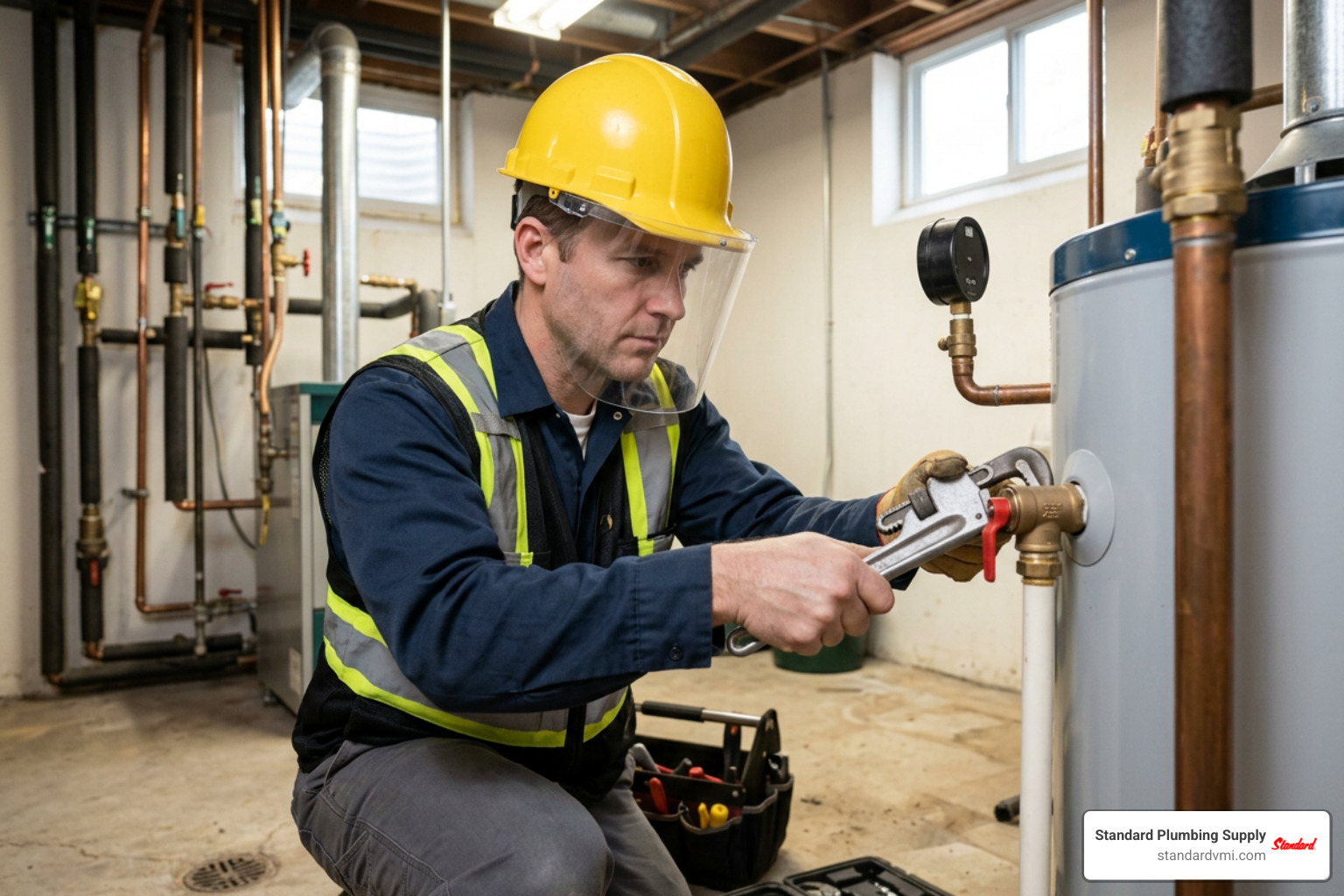
A 100 psi relief valve is an active safety device. Like any mechanical assembly subject to constant spring tension, mineral deposits, and thermal stress, it requires regular inspection and proper installation to guarantee operation when an overpressure emergency occurs.
Proper Installation Steps for Your 100 PSI Relief Valve
- Verify Line Isolation & System Depressurization: Always isolate the water main or air receiver and completely vent trapped pressure before installing or replacing a valve.
- Inspect Thread Compatibility & Sealant: Clean male NPT pipe threads. Apply a UL-listed, lead-free pipe thread sealant tape or paste. Ensure sealant is applied strictly to male threads starting two threads back from the end to avoid getting compound into the internal valve disc or spring seat.
- Avoid Over-Torquing: Thread the valve into the receiving female fitting hand-tight, then tighten 1.5 to 2 additional turns with a smooth-jaw wrench. Over-tightening can distort the valve body, misalign the internal spring, and cause premature seat leaks.
- Orient the Discharge Piping Correctly: Install dedicated, unthreaded discharge piping from the valve outlet pointing down toward an approved floor drain. Never reduce the discharge pipe diameter below the valve's outlet thread size, and never install a shutoff valve in the discharge line! For complete gas vessel safety, review manufacturer recommendations such as the H100 Series External Relief Valves guidelines.
Diagnosing Leaks, Failure Causes, and Maintenance Best Practices
When a 100 psi relief valve continuously drips or discharges unexpectedly, technicians can diagnose the root cause using the following breakdown:
- Debris on Valve Seat: Rust flakes, pipe scale, or mineral grit lodged between the soft seal disc and brass seat preventing complete closure. Fix: Manually lift the test lever for 3 to 5 seconds while under pressure to flush clean fluid through the seat, then snap it shut to clear debris.
- Thermal Expansion Pressure Spikes: In closed domestic cold-water plumbing systems equipped with backflow preventers, heating water expands into a closed volume. This drives static water pressure up past 100 PSI without any valve defect present. Fix: Install a properly pre-charged potable water expansion tank on the cold-water supply line.
- Defective Pressure Switches or Regulators: High main pressure caused by a failed well switch or regulator seat leak forcing the valve to open as intended. Fix: Inspect main system gauges or check pressure balance using a dual gauge regulator to confirm actual operating pressure before replacing the valve.
- Spring Fatigue or Scale Buildup: Over years of service, mineral scale encrusts the internal spring and poppet, or spring fatigue lowers the crack pressure below 100 PSI. Fix: Manufacturer guidelines (such as Emerson Fisher documentation) recommend replacing safety relief valves no longer than 15 years from the date of manufacture—or sooner if subjected to corrosive environments or major discharge events.
Frequently Asked Questions about Pressure Relief Valves
Why is my pressure relief valve leaking water or air?
A relief valve typically leaks for one of three reasons: line pressure has actually exceeded the 100 PSI set point (caused by thermal expansion, pressure switch failure, or regulator seat leak), dirt/mineral debris is trapped under the sealing seat, or the internal spring has fatigued over time. Try flushing the valve using its manual test lever. If it continues dripping under normal pressure, the valve must be replaced.
How often should a pressure relief valve be replaced?
Industry standards and leading manufacturers recommend visually inspecting relief valves every 6 months and operating the manual test lever annually to ensure free movement. Most safety relief valves have a maximum recommended service life of up to 15 years from the date of manufacture. However, if a valve fully "pops" during a major overpressure event or shows external mineral buildup, it should be inspected and replaced immediately.
Can I adjust a pre-set fixed relief valve in the field?
No. Fixed (non-adjustable) relief valves are factory-calibrated under strict lab conditions to satisfy ASME, ANSI, or CSA safety standards. Attempting to bend the spring, alter internal shims, or tighten locknuts on a non-adjustable safety valve voids its safety certifications, breaks building code compliance, and creates a severe risk of vessel explosion. If your system requires a different opening threshold, always replace the valve with a properly rated factory unit.
Conclusion
A 100 psi relief valve is a simple mechanical fitting that carries an immense safety responsibility. Whether you are protecting a private well pressure tank, managing hydronic boiler expansion, or safeguarding a commercial air compressor receiver, choosing the right valve—matching set pressure, material, certification, and flow capacity—is what stands between a safe system and a catastrophic failure.
At Standard Plumbing Supply, we understand that contractors, property directors, and facility managers cannot afford downtime or code delays. With our expansive network of warehouse locations across Utah, Idaho, Wyoming, Oregon, California, Arizona, Nevada, Colorado, and Nebraska, we deliver trusted plumbing, HVAC, and irrigation brands right when you need them.
Beyond quick order fulfillment, our Vendor-Managed Inventory (VMI) solutions help commercial teams keep critical safety valves, gauges, and maintenance fittings fully stocked on site—freeing up your working cash flow while making sure your technicians always have the right part on hand. If you need specialized testing equipment for diagnostic field service, explore our compression gauge schrader valve options to verify line pressures accurately.
Ready to secure your water and mechanical systems with certified overpressure protection? Contact our expert support team at your nearest Standard Plumbing Supply location today, or explore our online catalog for fast nationwide shipping on all your plumbing and safety valve needs!