
Finding the Right Compression Gauge Schrader Valve
Learn how a compression gauge Schrader valve ensures accurate pressure readings in HVAC and plumbing diagnostics, plus replacement tips.

Choose the Right Compression Gauge Schrader Valve
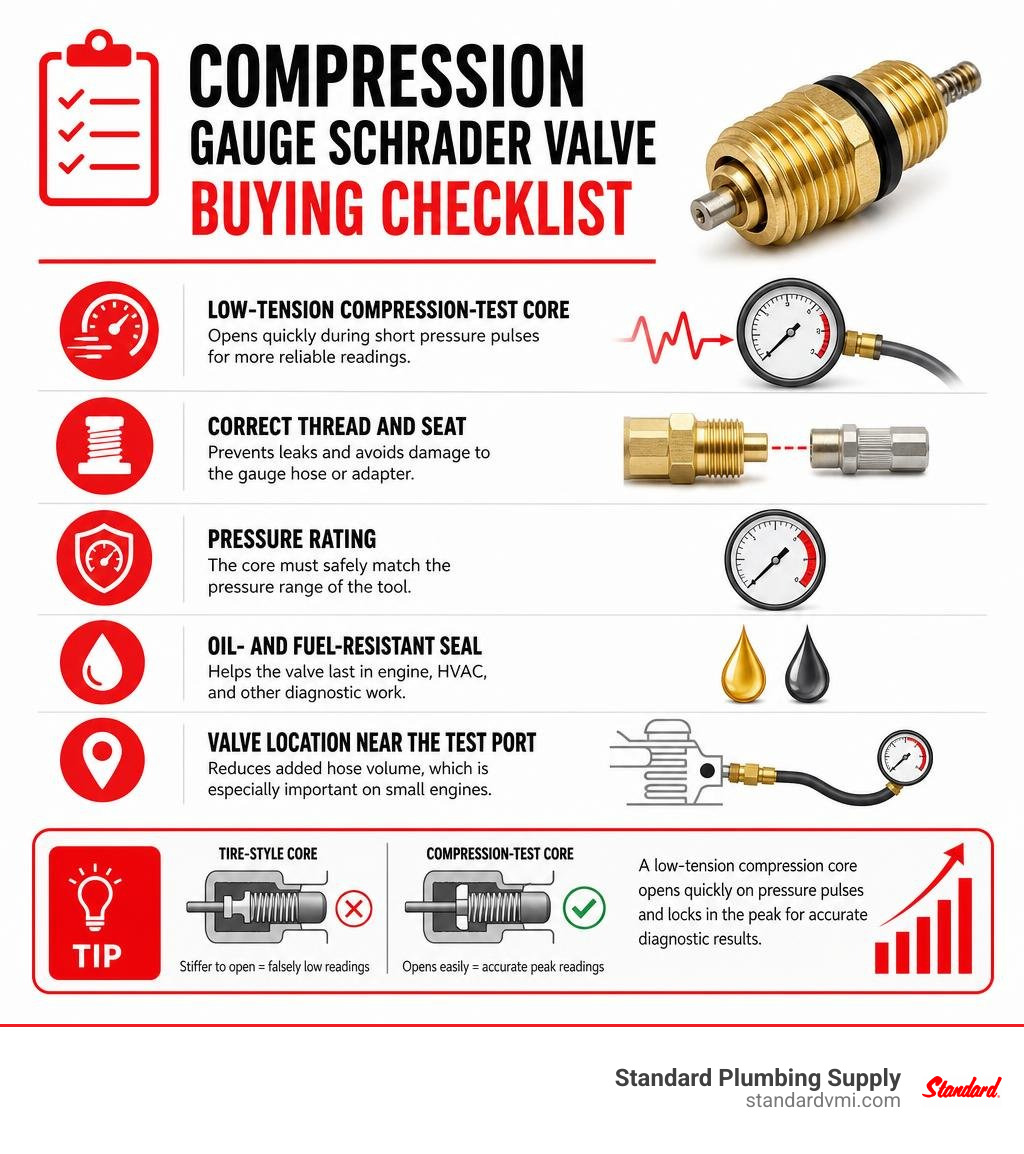
A compression gauge schrader valve is a low-tension check valve core that opens under pressure, lets the gauge capture the peak reading, and then closes to hold that reading in place. For a replacement core, choose one made specifically for compression or diagnostic gauges - not a standard tire valve core - and confirm the thread, pressure rating, seal material, and tool compatibility before ordering.
| What to check | Why it matters |
|---|---|
| Low-tension compression-test core | Opens quickly during short pressure pulses for more reliable readings |
| Correct thread and seat | Prevents leaks and avoids damage to the gauge hose or adapter |
| Pressure rating | The core must safely match the pressure range of the tool |
| Oil- and fuel-resistant seal | Helps the valve last in engine, HVAC, and other diagnostic work |
| Valve location near the test port | Reduces added hose volume, which is especially important on small engines |
A Schrader valve may be tiny, but it has a large effect on diagnostic accuracy. A stiff tire-style core can need far more pressure to open than a dedicated compression core, causing a gauge to show a falsely low result. The right core is also useful wherever crews need dependable pressure retention during equipment service, maintenance checks, or troubleshooting.
For contractors, maintenance teams, and property managers, having the right replacement parts on hand helps prevent a simple gauge leak from delaying a repair. Standard Plumbing Supply supports trade customers with practical product guidance, reliable availability, fast nationwide shipping, and inventory support for the plumbing and HVAC supplies that keep work moving.
I'm Jacob Reese, Vice President at Standard Plumbing Supply. Through my work with contractors, supply operations, and diagnostic-tool needs across the trades, I have seen how selecting the correct compression gauge schrader valve supports accurate testing and reduces avoidable downtime.
How a Compression Gauge Schrader Valve Works in Diagnostic Tools
To understand why a compression gauge schrader valve is critical to accurate diagnostic readings, we must look at how check valve mechanics function inside a pressure test kit. When testing mechanical equipment, small engines, gas lines, or pressurized HVAC loops, pressure moves through the system in short, rapid pulses.
A standard diagnostic pressure gauge relies on a spring-loaded check valve located at the end of the test hose or adapter. When a pressure pulse arrives, air or gas pushes against the internal valve pin. The valve opens momentarily, allowing pressurized fluid into the gauge manifold, and then immediately snaps shut as the pulse ebbs. This mechanism traps peak pressure inside the hose so the needle on your dial gauge stays at the highest reading recorded rather than falling back to zero between cycles.
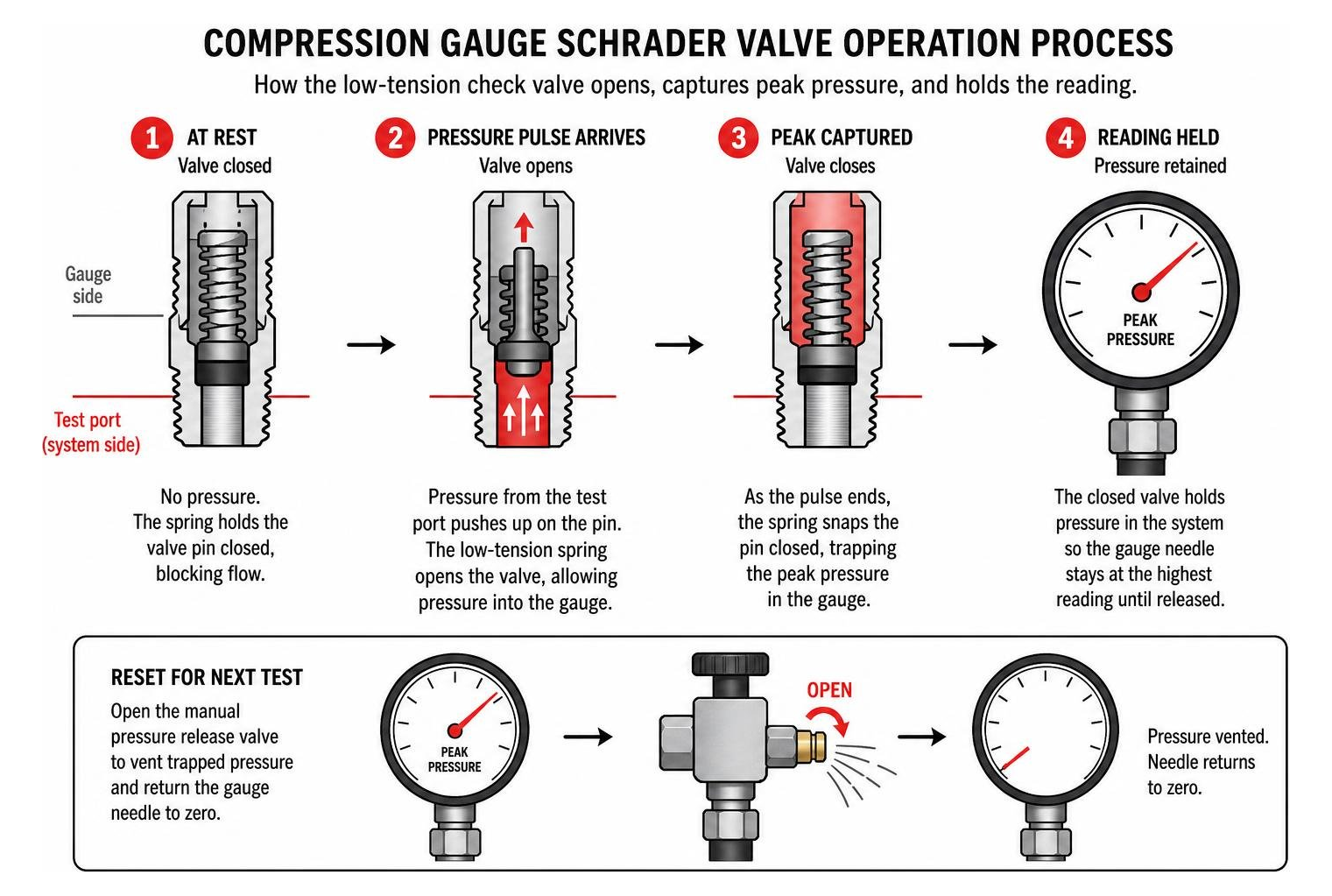
Without a functioning valve core trapping peak pressure, the dial needle would bounce wildly with every stroke or pulse, making precise diagnostic measurements impossible. When you finish taking your reading, a manual pressure release valve located on the gauge manifold opens a bypass channel, venting the trapped air so you can reset the needle to zero for the next test.
When servicing or replacing these components, using specialized parts like Deluxe Compression Tester Replacement Valve Core (Box ... ensures that the core maintains an airtight seal under high pressures without restricting airflow during rapid testing pulses.
Cracking Pressure and Low-Tension Springs
The key mechanical metric defining any compression gauge schrader valve is its cracking pressure—the minimum amount of pressure required to unseat the internal seal against spring tension.
Standard pneumatic valves used in everyday applications rely on heavy internal springs that require upwards of 30 PSI just to start opening. In sharp contrast, a dedicated diagnostic core features an ultra-light, low-tension spring engineered to pop open at a low 2 to 5 PSI threshold (or 5 to 8 PSI on specific specialized test units).
Why is this low pop-off pressure so critical? During a manual pull-start on a small engine or during slow hand-cranking of equipment, initial pressure pulses can be brief and relatively light. If your test hose contains a valve with high cracking pressure, the pulse energy gets wasted just pushing open the stiff spring. Consequently, that spring resistance acts as a threshold that gets subtracted directly from your total pressure reading. A low-tension core opens effortlessly under single-digit PSI, capturing every bit of pressure force and delivering true diagnostic accuracy.
Standard Tire Core vs. Compression Gauge Schrader Valve
It is a common pitfall in field service to assume all Schrader valves are created equal. When a test hose starts leaking, technicians might be tempted to grab a spare valve core from a tire repair kit or shop air compressor line. Doing so almost always ruins test results.
Tire valve cores are designed with heavy spring tension specifically to prevent air from escaping under high static pressure, even when subjected to road vibration and heavy vehicle loads. Installing a tire stem core into a compression testing assembly creates a severe artificial pressure drop. In real-world field tests, swapping a proper low-tension diagnostic valve core for a standard automotive tire core caused test readings on identical equipment to plummet from an actual 130 PSI down to a misleading 60 PSI!
To help identify the right core in your toolbox, manufacturers frequently use color-coded rubber band gaskets. Dedicated diagnostic cores commonly feature white, clear, or light-colored oil-resistant seals, while standard tire cores usually feature red or plain black seals.
| Feature / Property | Standard Tire Valve Core | Compression Gauge Schrader Valve Core |
|---|---|---|
| Spring Tension | High tension (heavy internal spring) | Low tension (ultra-light internal spring) |
| Cracking / Pop-Off Pressure | Exceeds 30 PSI | 2 to 5 PSI (up to 8 PSI on select heavy kits) |
| Primary Design Function | Retain high static pressure without leaking during movement | Traps rapid dynamic pressure pulses instantly |
| Diagnostic Measurement Impact | Causes severe artificial pressure drops (e.g., 130 PSI drops to 60 PSI) | Captures true peak pressure with minimal measurement error |
| Common Seal Identification | Red or black rubber band gasket | White, clear, or specialized fuel/oil resistant gasket |
| Standard Thread Specification | .206-36 thread | .206-36 thread (machined to precision tolerances) |
Essential Features When Buying Replacement Compression Valve Cores
When sourcing replacement parts or outfitting diagnostic kits for plumbing, HVAC, or equipment service, identifying the correct technical specifications ensures your equipment operates without leaks or calibration errors.

Thread Sizes and Pressure Ratings
Most standard pneumatic diagnostic cores share a standard thread size of .206-36. However, diagnostic cores differ significantly in manufacturing tolerances, brass body density, and seal composition.
- Pressure Range Limits: Standard gasoline diagnostic gauges and small engine tools, such as the Digital Compression Test Kit MV5532 | Mityvac | SKF or the TOPTUL Compression Tester Set: Dial Gauge 0-300PSI0-21kgcm² with Adapter Set M14M18universal rubber cone , operate up to 300 PSI (20.7 bar). However, heavy equipment and commercial diesel systems require heavy-duty testing apparatus like a Compression tester kit diesel 19 pieces , which operate at pressures up to 1,000 PSI (70 bar). The valve core must match these pressure dynamics without seal degradation.
- Brass Durability: Precision-machined solid brass core bodies resist thread galling and stripping when inserted into brass adapter tubes or quick-connect fittings.
- Chemical and Seal Resistance: In diagnostic environments, core seals encounter lubricant oil, gasoline, diesel fuels, or refrigerants. High-grade synthetic elastomeric seals maintain their shape and elasticity without swelling or dissolving over extended service exposure.
- Adapter Compatibility: Professional multi-use kits utilize inter-changeable brass adapters to connect to different port sizes. Common diagnostic adapter thread sizes include 10 mm, 12 mm, 14 mm, 18 mm, and specialized fittings like 5/16 NPT. Kits such as the Compression Tester with 10 mm, 12 mm and 14 mm adapters - Motion Pro or the 9007A Compression Test Adapter Tool W/ Schrader Valve Alt rely on precisely positioned internal cores to yield accurate results across varying port diameters.
Adapter Location and Hose Displacement Impact
Where the compression gauge schrader valve is physically located within your testing setup plays a massive role in diagnostic accuracy—especially on small displacement equipment or small volume test piping.
If the check valve core is placed high up near the gauge dial at the end of a 15-inch or 25-inch rubber hose, the entire volume inside the flexible test hose gets added directly to the chamber volume of the equipment being tested. On a small 30cc or 50cc cylinder engine, expanding the combustion chamber volume by adding the interior space of a long diagnostic hose dilutes the effective compression ratio. This results in dramatically lower pressure readings on your dial.
For instance, technicians testing small engines have noted that placing the valve core up near the gauge produced a reading of just 90 PSI, whereas moving a low-tension valve core down to the threaded adapter tip—directly at the spark plug or service port—instantly revealed the true pressure of 130 PSI!
Placing the check valve right at the tip of the service port isolates the gauge hose expansion volume behind the valve, ensuring that only true system pressure enters the testing circuit.
How to Test, Maintain, and Replace a Compression Valve Core
Regular inspection and simple maintenance steps keep diagnostic gauges working accurately year after year.
Replacing a Faulty Compression Gauge Schrader Valve
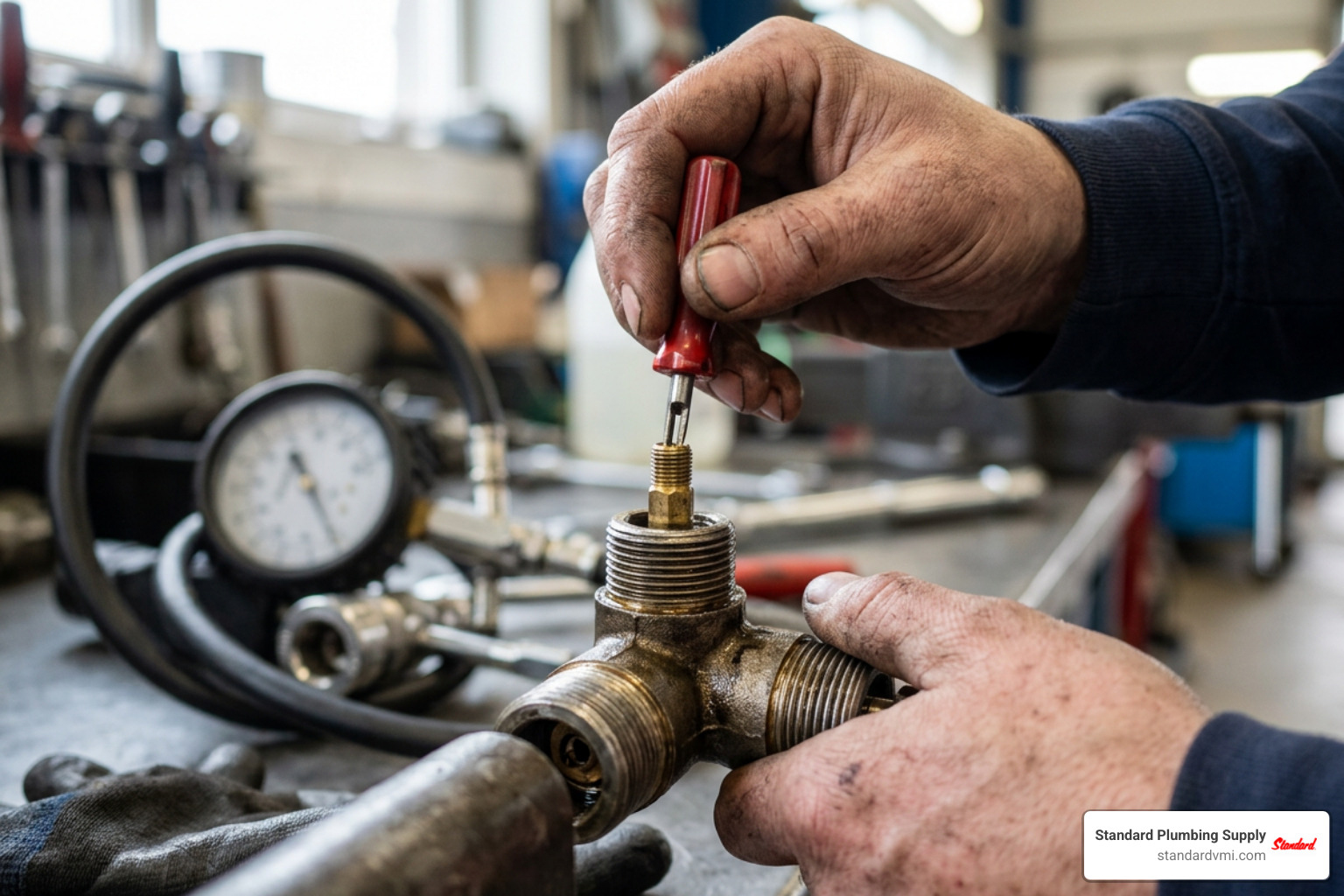
If your pressure gauge fails to hold steady needle pressure during a test, or if pressure drops slowly immediately after cranking stops, you likely have a leaking valve core or fitting seal. Here is how to diagnose and replace a faulty core step-by-step:
- Perform a Soapy Water Bubble Test: Connect your diagnostic hose to a pressurized air source or charge it with air, then submerge the tip or spray soapy water over the adapter end and hose crimps. Bubbles forming around the central stem indicate a leaking valve core seal, while bubbles around outer threads point to fitting ring leaks.
- Remove the Old Core: Insert a standard 4-way valve core tool or 1/4-inch core screwdriver into the adapter tip. Engage the two flats on the core stem, turn counterclockwise, and back the old valve core completely out of the internal threads.
- Inspect and Clean Internal Threads: Use compressed air or a lint-free shop towel to remove dirt, metal bits, or old rubber residue from inside the adapter seating threads.
- Install the New Low-Tension Core: Thread a fresh low-tension compression gauge schrader valve core into the adapter stem by hand. Turn clockwise with your core tool until snug. Caution: Do not overtighten, as excessive torque can crush the tiny rubber sealing ring and ruin its low-cracking-pressure characteristics.
- Zero and Sanity-Check the Gauge: Depress the manual release button to ensure smooth stem travel, apply shop air to confirm instant seal lockup, and verify that the needle returns smoothly to absolute zero.
Converting Diagnostic Hoses for Leak-Down Pressure Testing
While standard compression testing measures peak dynamic pressure generated by mechanical movement, differential cylinder or system leak-down testing requires continuous air input to locate hidden leaks.
Because a compression check valve acts as a one-way gate preventing air from flowing into the cylinder or line, you must remove the compression gauge schrader valve core entirely when converting a standard compression hose for continuous leak-down testing. Removing the valve core allows pressurized shop air to flow down through the hose and into the engine or pipe loop.
When conducting fuel line pressure checks or gas equipment maintenance alongside continuous air leak tests, technicians frequently rely on specialized pressure regulation devices. You can read more about regulating gas pressures safely in our guide on different types of lpg regulators.
Frequently Asked Questions About Compression Gauge Schrader Valves
Can I replace a compression tester valve with a standard tire valve core?
No, you should never substitute a standard tire valve core into a diagnostic compression tester. Standard tire valve cores utilize stiff internal springs requiring over 30 PSI to open, whereas dedicated compression gauge cores feature soft, low-tension springs designed to pop open at 2 to 5 PSI. Installing a tire core will restrict initial pulse airflow, resulting in severely inaccurate, low compression readings (often showing 50 to 70 PSI below actual system pressure).
Why does my compression gauge read artificially low on piping systems?
An artificially low pressure reading usually stems from two primary causes: using a high-tension tire valve core instead of a low-tension diagnostic core, or placing the check valve too far away from the testing port. If your valve core is located at the top of a long test hose rather than at the adapter tip, the air volume inside the hose expands the total system volume being tested, diluting peak pressure readings.
How do I release pressure after taking a system pressure reading?
Quality compression testing sets feature a built-in pressure release valve (or bleeder valve button) located on the gauge manifold stem below the dial face. Depressing this manual push-button bypasses the internal check valve, releasing trapped air to atmosphere and dropping the gauge needle back to zero for subsequent testing.
Conclusion
A high-performing compression gauge schrader valve is a small component that plays a critical role in diagnostic accuracy. Using the right low-tension valve core positioned directly at the test port ensures that your diagnostic tools capture true peak pressures without artificial pressure drops or hose expansion errors.
Whether you are performing routine maintenance on commercial mechanical equipment, testing small engines, or checking pressurized gas and fluid lines across facility installations, having reliable testing tools protects your operational uptime.
At Standard Plumbing Supply, we support commercial contractors, municipal service teams, and property managers with the highest quality plumbing, HVAC, and irrigation products. Beyond offering trusted national brands and expert technical guidance, we provide fast nationwide shipping and tailored Vendor-Managed Inventory (VMI) solutions that optimize stock levels, prevent jobsite delays, and free up valuable cash flow.
For setups requiring precise dual-stage pressure monitoring during fluid or gas servicing, explore our companion resource on dual gauge regulator systems to keep your equipment operating safely and efficiently.